


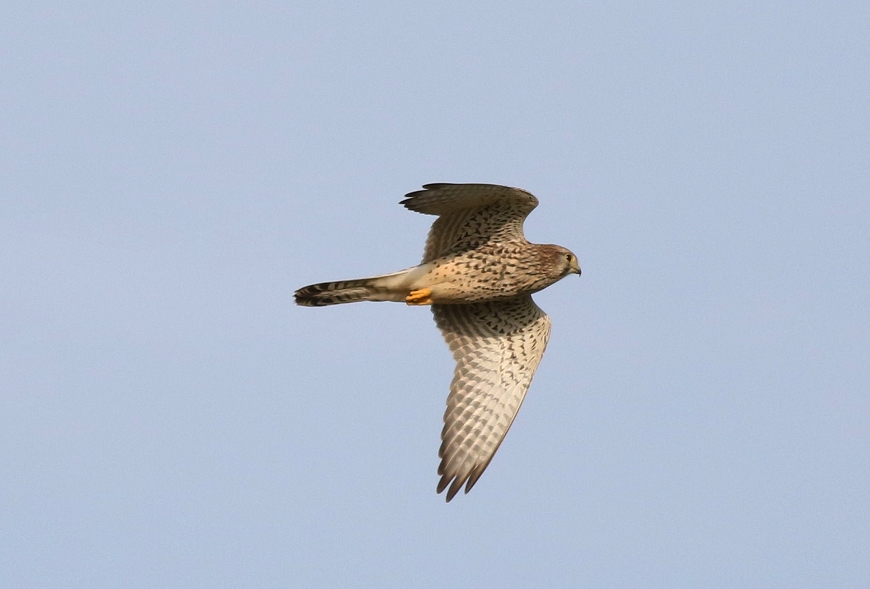
Falco tinnunculus · sokol myšiar · Common Kestrel
Alternative and historical names
Slovak names
- sokol myšiar (pustovka) (Kovalik 2010)
- pustovka obyčajná (Kovalik 2010)
- sokol myšiar (Kovalik 2010)
- sokol myšiar (Matoušek 1990)
- sokol myšiar (Ferianc 1987)
English names
- Common Kestrel (IOC 2.5 2010)
- Kestrel (BOU 1923)
Scientific names
- Falco tinnunculus (AviList 2026)
- Falco tinnunculus (IOC 15.2 2026)
- Falco tinnunculus (IOC 2.5 2010)
- Falco tinnunculus (BOU 1923)
Taxonomic synonyms
- Cerchneis tinnunculus (Linnaeus, 1758)
- Falco tinnunculus Linnaeus, 1758
Birding Slovakia database
This species through our community’s eyes
Species characteristics in Slovakia
- General occurrence
- some are resident, some are migratory / R+M
- Breeding
- common nidificant / Nc
- Migration
- common transmigrant / Tc
- Wintering
- common wintering / Wc
- Rarities committee:
- Does not require any reporting or registration by Raritties commitee
Observation map

Detailed species observation statistics

Source: the Birding.sk database. Counts reflect observer contributions, not population size.
About this species
Distribution
Kestrel is widespread in Europe, Asia and Africa. In Slovakia it is among the commonest breeding raptors, from lowlands to mountains and towns. Some remain year-round, others move seasonally and young disperse. Winter occurrence also depends on weather and voles; the same site need not hold the same individual continuously.
Habitat
It needs open low-growing hunting ground and a suitable nest support. Fields, meadows, pastures, roadsides and urban lawns are used. Buildings and boxes permit nesting where cliffs and others' old nests are absent.
Breeding
It builds no twig nest, using cavities, ledges, boxes or old nests. The female incubates usually four to six eggs while the male provisions her; both later supply food.
Food
Small mammals predominate, with large insects, lizards and birds also taken. Prey is watched while hovering or from elevated perches.
Interesting fact
Hovering birds hold the head remarkably steady despite working wings. Adult males have grey heads and tails, contrasting with browner barred females and young.
Sources: Slovak Wikipedia · English Wikipedia · Raptor Protection of Slovakia: winter census 2026
Sign in to send private feedback on the text to our editors.
Explore further
Overview and identification
Descriptions, identification and names.
- Slovak Wikipedia ↗
Taxon account in Slovak: distribution, biology and references for further reading.
https://sk.wikipedia.org/wiki/Sokol_my%C5%A1iar - English Wikipedia ↗
Taxon account in English: distribution, biology and taxonomic context.
https://en.wikipedia.org/wiki/Common_kestrel - Raptor Protection of Slovakia: winter census 2026 ↗
Results of the 2026 winter raptor census in the Pannonian region.
https://www.dravce.sk/web/index.php/sk/aktuality-2026/1852-vysledky-zimneho-scitania-dravych-vtakov-v-panonskom-regione-2026 - BTO: Identifying Hobby and Kestrel ↗
English identification video comparing this taxon with similar species and explaining distinguishing features.
https://www.bto.org/learn/skills/bird-identification/videos/hobby-kestrel - BTO: Identifying Kestrel and Merlin ↗
English identification video comparing this taxon with similar species and explaining distinguishing features.
https://www.bto.org/learn/skills/bird-identification/videos/kestrel-and-merlin


