


Fulica atra · lyska čierna · Eurasian Coot
Alternative and historical names
Slovak names
- lyska čierna (Kovalik 2010)
- lyska čierna (Matoušek 1990)
English names
- Eurasian Coot (IOC 2.5 2010)
- Coot (BOU 1923)
Scientific names
- Fulica atra (AviList 2026)
- Fulica atra (IOC 15.2 2026)
- Fulica atra (IOC 2.5 2010)
- Fulica atra (BOU 1923)
Taxonomic synonyms
- Fulica prior (De Vis, 1888)
- Fulicula atra (Linnaeus, 1758)
- Fulica atra Linnaeus, 1758
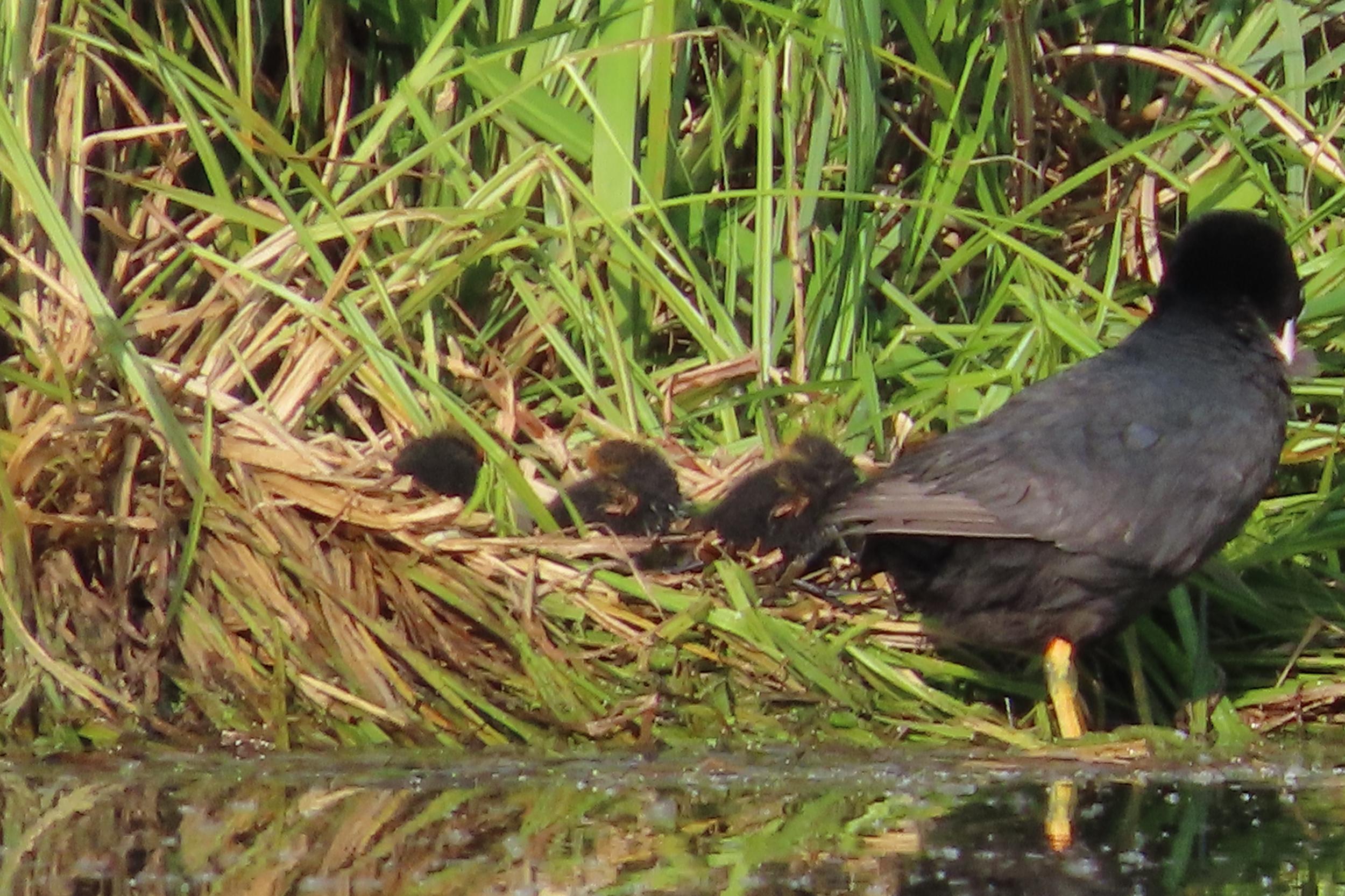
Birding Slovakia database
This species through our community’s eyes
Species characteristics in Slovakia
- General occurrence
- some are resident, some are migratory / R+M
- Breeding
- common nidificant / Nc
- Migration
- common transmigrant / Tc
- Wintering
- common wintering / Wc
- Rarities committee:
- Does not require any reporting or registration by Raritties commitee
Observation map
Detailed species observation statistics

Source: the Birding.sk database. Counts reflect observer contributions, not population size.
About this species
Distribution
Eurasian Coot has a broad range in Europe, Asia, parts of Africa and Australia. It is a common waterbird in Slovakia, breeding regularly mainly at lower elevations. Partially migratory, it moves as waters freeze and is joined by passage birds. Suitable unfrozen waters can hold substantial winter flocks.
Habitat
It occupies ponds, lakes, reservoirs and quiet river sections offering vegetation as well as open water. Breeding birds need cover near the water’s edge, whereas at other times they are easily seen far from shore. Winter concentrations form where food remains accessible.
Breeding
The bulky plant nest is anchored in waterside vegetation or rests on a firm support in shallow water. Both parents incubate and feed the chicks, defending their nesting territory against other waterbirds.
Food
Aquatic plants and algae are important, supplemented by seeds and small animals. Food is collected from the surface, grazed on shore or obtained by diving.
Interesting fact
Its toes have separate fleshy lobes rather than a continuous duck-like web. These enlarge the pushing surface in water while still allowing the bird to move over shorelines and vegetation.
Sources: Slovak Wikipedia · English Wikipedia
Sign in to send private feedback on the text to our editors.
Explore further
Overview and identification
Descriptions, identification and names.
- Slovak Wikipedia ↗
Taxon account in Slovak: distribution, biology and references for further reading.
https://sk.wikipedia.org/wiki/Lyska_%C4%8Dierna - English Wikipedia ↗
Taxon account in English: distribution, biology and taxonomic context.
https://en.wikipedia.org/wiki/Eurasian_coot - BTO: Identifying Coot and Moorhen ↗
English identification video comparing this taxon with similar species and explaining distinguishing features.
https://www.bto.org/learn/skills/bird-identification/videos/coot-and-moorhen
























