


Pluvialis apricaria · kulík zlatý · European Golden Plover
Alternative and historical names
Slovak names
- kulík zlatý (Kovalik 2010)
- kulík zlatý (Matoušek 1990)
English names
- European Golden Plover (IOC 2.5 2010)
- Golden Plover (BOU 1923)
Scientific names
- Pluvialis apricaria (AviList 2026)
- Pluvialis apricaria (IOC 15.2 2026)
- Pluvialis apricaria (IOC 2.5 2010)
- Pluvialis apricarius (BOU 1923)
Taxonomic synonyms
- Charadrius altifrons (Brehm, 1831)
- Pluvialis apricaria altifrons (C.L.Brehm, 1831)
- Charadrius apricarius (Linnaeus, 1758)
- Pluvialis apricaria (Linnaeus, 1758)
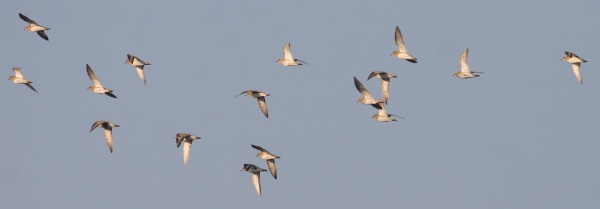
Birding Slovakia database
This species through our community’s eyes
Photographs by category
Species characteristics in Slovakia
- Migration
- uncommon transmigrant / Tu
- Wintering
- rare wintering / Wr
- Rarities committee:
- Does not require any reporting or registration by Raritties commitee
Observation map

Detailed species observation statistics

Source: the Birding.sk database. Counts reflect observer contributions, not population size.
About this species
Distribution
European Golden Plover breeds in northern Europe and northwestern Asia in tundra and open uplands. It winters farther south in Europe and around the Mediterranean. It regularly passes through Slovakia in spring and autumn, often with lapwings. It is not a regular breeder here, and winter observations depend on weather.
Habitat
Its breeding habitat has low tundra or upland vegetation. In Slovakia, look mainly on short grassland, pastures, winter crops and freshly cultivated fields. Unlike many sandpipers, it need not remain immediately beside open water.
Breeding
The nest is a discreet lined scrape in low northern vegetation. Both parents incubate usually four eggs. Mobile chicks collect their own food and are brooded by adults in cold weather.
Food
It picks insects, larvae, earthworms and other invertebrates from grass or bare ground. Small flying insects matter for chicks on breeding grounds, with availability influenced by weather.
Interesting fact
Golden spotting on the back is more than decoration: it provides effective camouflage in mottled low vegetation. A flock conspicuous in flight can become surprisingly difficult to find after landing in a field.
Sources: Slovak Wikipedia · English Wikipedia
Sign in to send private feedback on the text to our editors.
Explore further
Overview and identification
Descriptions, identification and names.
- Slovak Wikipedia ↗
Taxon account in Slovak: distribution, biology and references for further reading.
https://sk.wikipedia.org/wiki/Kul%C3%ADk_zlat%C3%BD - English Wikipedia ↗
Taxon account in English: distribution, biology and taxonomic context.
https://en.wikipedia.org/wiki/European_golden_plover - BTO: Identifying Grey Plover and Golden Plover ↗
English identification video comparing this taxon with similar species and explaining distinguishing features.
https://www.bto.org/learn/skills/bird-identification/videos/golden-grey-plovers


