


Tringa erythropus · kalužiak tmavý · Spotted Redshank
Alternative and historical names
Slovak names
- kalužiak tmavý (Kovalik 2010)
- kalužiak tmavý (Matoušek 1990)
English names
- Spotted Redshank (IOC 2.5 2010)
- Spotted Redshank (BOU 1923)
Scientific names
- Tringa erythropus (AviList 2026)
- Tringa erythropus (IOC 15.2 2026)
- Tringa erythropus (IOC 2.5 2010)
- Tringa erythropus (BOU 1923)
Taxonomic synonyms
- Erythroscelus erythropus (Pallas, 1764)
- Scolopax erythropus (Pallas, 1764)
- Tringa erythropus (Pallas, 1764)
- Scolopax fusca (Linnæus, 1758)
Birding Slovakia database
This species through our community’s eyes
Photographs by category
Species characteristics in Slovakia
- Migration
- uncommon transmigrant / Tu
- Rarities committee:
- Does not require any reporting or registration by Raritties commitee
Observation map

Detailed species observation statistics

Source: the Birding.sk database. Counts reflect observer contributions, not population size.
About this species
Distribution
It breeds in northern Europe and Asia where taiga meets tundra and winters from western and southern Europe to Africa and tropical Asia. It does not breed in Slovakia, passing mainly in April and May and returning from summer into October. Numbers and stopover duration depend on suitable shallows.
Habitat
Northern breeding sites are open wetlands near the forest belt. In Slovakia, search shallow fishponds, reservoirs, flooded meadows and muddy bays. It often enters deeper water than small sandpipers and can also swim.
Breeding
It nests on the ground outside Slovakia. Usually four eggs are laid in an inconspicuous scrape among vegetation. Chicks move around soon after hatching and collect their own food.
Food
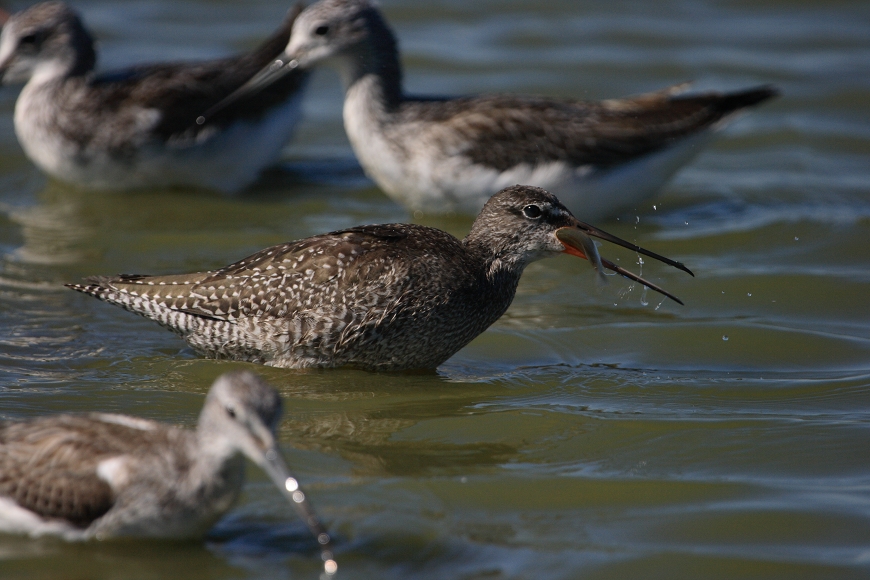
It catches small invertebrates in water and soft sediment. Its long bill probes the shallows, and feeding birds often move more briskly than neighbouring stationary waders.
Interesting fact
Plumage changes dramatically: a breeding adult can be almost black with white spots, whereas winter birds are pale grey. A dark body therefore cannot be expected at every encounter.
Sources: Slovak Wikipedia · English Wikipedia
Sign in to send private feedback on the text to our editors.
Explore further
Overview and identification
Descriptions, identification and names.
- Slovak Wikipedia ↗
Taxon account in Slovak: distribution, biology and references for further reading.
https://sk.wikipedia.org/wiki/Kalu%C5%BEiak_tmav%C3%BD - English Wikipedia ↗
Taxon account in English: distribution, biology and taxonomic context.
https://en.wikipedia.org/wiki/Spotted_redshank - BTO: Identifying common shanks ↗
English identification video comparing this taxon with similar species and explaining distinguishing features.
https://www.bto.org/learn/skills/bird-identification/videos/common-shanks


