


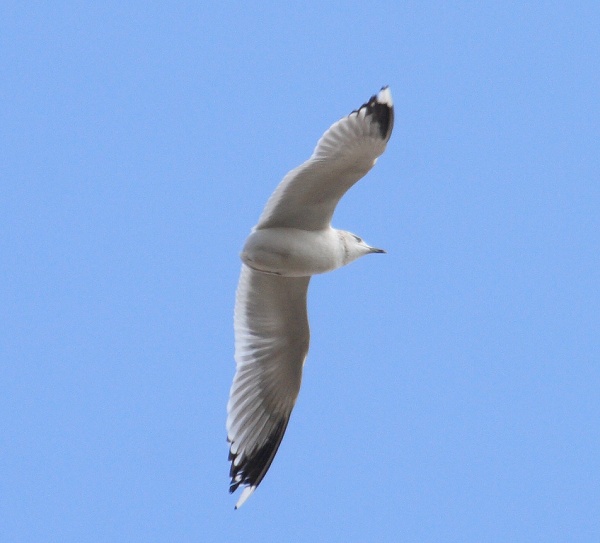
Larus canus · čajka sivá · Common Gull
Alternative and historical names
Slovak names
- čajka sivá (Kovalik 2010)
- čajka sivá (Matoušek 1990)
English names
- Mew Gull (IOC 2.5 2010)
- Common Gull (BOU 1923)
Scientific names
- Larus canus (AviList 2026)
- Larus canus (IOC 15.2 2026)
- Larus canus (IOC 2.5 2010)
- Larus canus (BOU 1923)
Taxonomic synonyms
- Larus heinei (Homeyer, 1853)
- Larus canus Linnaeus, 1758
Birding Slovakia database
This species through our community’s eyes
Photographs by category
Species characteristics in Slovakia
- General occurrence
- migrant / M
- Breeding
- rare nidificant / Nr
- Migration
- common transmigrant / Tc
- Wintering
- common wintering / Wc
- Rarities committee:
- Does not require any reporting or registration by Raritties commitee
Conservation — Red Lists
- Slovakia 2023breeding population
- Breeding population Period: 2013–2023 Source: Demko M. a kol. 2025: Červený zoznam vtákov Slovenska: aktualizácia 2013 – 2023. Tichodroma 37: 107–117. Online 18. 1. 2026. DOI: 10.31577/tichodroma.2025.37.18. Výsledky, s. 112, výslovne menovaný druh Druh uvedený v texte medzi 19 druhmi NA.
Observation map

Detailed species observation statistics

Source: the Birding.sk database. Counts reflect observer contributions, not population size.
About this species
Distribution
Common Gull breeds in cooler Eurasia, from northwestern Europe to eastern Asia. Some populations move farther south for winter. In Slovakia it is best known outside the breeding season as a regular passage and wintering bird. Breeding is rare and local, so a large winter flock does not represent the size of the domestic breeding population.
Habitat
In winter it uses unfrozen rivers, reservoirs, fields and grassland, roosting on water with other gulls. Breeding sites include islands and watersides; artificial substrates are also used within its wider range.
Breeding
The nest consists of plant material on a substrate near water. Both partners incubate the usually three eggs and feed the chicks. Although chicks soon move around the nest, they remain dependent on their parents for food.
Food
It is omnivorous, collecting earthworms, insects and scraps and catching small aquatic prey. Birds often follow cultivation that exposes invertebrates.
Interesting fact
Adults have a finer bill and smaller head than the large gulls. Leg and bill colour changes seasonally, so structure and wingtip pattern also help identification.
Sources: Slovak Wikipedia · English Wikipedia
Sign in to send private feedback on the text to our editors.
Explore further
Overview and identification
Descriptions, identification and names.
- Slovak Wikipedia ↗
Taxon account in Slovak: distribution, biology and references for further reading.
https://sk.wikipedia.org/wiki/%C4%8Cajka_siv%C3%A1 - English Wikipedia ↗
Taxon account in English: distribution, biology and taxonomic context.
https://en.wikipedia.org/wiki/Common_gull - BTO: Identifying Common and Herring Gull ↗
English identification video comparing this taxon with similar species and explaining distinguishing features.
https://www.bto.org/learn/skills/bird-identification/videos/common-herring-gull


