


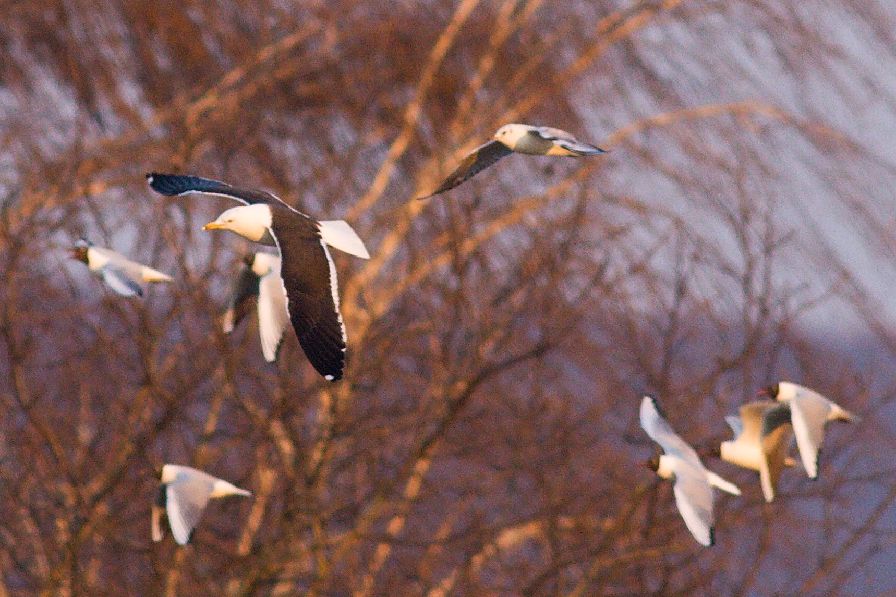
Larus fuscus · čajka tmavá · Lesser Black-backed Gull
Alternative and historical names
Slovak names
- čajka tmavá (Kovalik 2010)
- čajka tmavá (Matoušek 1990)
English names
- Lesser Black-backed Gull (IOC 2.5 2010)
- Lesser Black-backed Gull (BOU 1923)
Scientific names
- Larus fuscus (AviList 2026)
- Larus fuscus (IOC 15.2 2026)
- Larus fuscus (IOC 2.5 2010)
- Larus fuscus (BOU 1923)
Taxonomic synonyms
- Larus fuscus Linnaeus, 1758
Birding Slovakia database
This species through our community’s eyes
Photographs by category
Species characteristics in Slovakia
- Migration
- uncommon transmigrant / Tu
- Wintering
- uncommon wintering / Wu
- Rarities committee:
- Sigthings of this specie are registered by Raritties commitee
Observation map

Detailed species observation statistics

Source: the Birding.sk database. Counts reflect observer contributions, not population size.
About this species
Distribution
The Lesser Black-backed Gull (Larus fuscus) breeds in western and northern Europe and parts of northern and central Asia. Depending on the subspecies, wintering areas extend from western and southern Europe through Africa to southern Asia. In Slovakia it occurs mainly on passage, with smaller numbers in winter, and does not breed regularly. This card covers the whole species, so records cannot automatically be assigned to the nominate subspecies fuscus.
Habitat
In Slovakia it uses reservoirs, rivers and open feeding areas, often joining mixed gull flocks. Breeding habitats include coasts, islands and inland lakes; some populations also nest in towns. Wintering birds use both seashores and inland waters.
Breeding
It breeds mainly in colonies. The plant-built nest may be on the ground, a rock ledge or a roof. Both parents incubate the usually three eggs and subsequently feed the chicks. This breeding account concerns its range outside Slovakia.
Food
It catches fish, insects and other small animals, also taking carrion and scraps. Feeding methods adapt to available habitats along migration routes.
Interesting fact
A very dark back alone does not establish subspecies. Age, primary moult and often a ring of known origin matter; some birds can safely be identified only as Lesser Black-backed Gull.
Sources: Slovak Wikipedia · English Wikipedia · OSPAR: Lesser Black-backed Gull · Gull Research: Baltic Lesser Black-backed Gull
Sign in to send private feedback on the text to our editors.
Explore further
Overview and identification
Descriptions, identification and names.
- Slovak Wikipedia ↗
Taxon account in Slovak: distribution, biology and references for further reading.
https://sk.wikipedia.org/wiki/%C4%8Cajka_tmav%C3%A1 - English Wikipedia ↗
Taxon account in English: distribution, biology and taxonomic context.
https://en.wikipedia.org/wiki/Lesser_black-backed_gull - OSPAR: Lesser Black-backed Gull ↗
Scientific assessment and conservation context for the taxon in the north-east Atlantic.
https://oap.ospar.org/en/versions/1735-en-1-0-1-lesser-black-backed-gull/ - Gull Research: Baltic Lesser Black-backed Gull ↗
Detailed photographic material on the nominate subspecies and age-related plumages.
https://gull-research.org/2cyfuscus/ - eBird – taxon map: Larus fuscus fuscus ↗
Observation map for the specific taxon Larus fuscus fuscus; subspecies, form or group according to eBird taxonomy.
https://ebird.org/map/lbbgul1 - BTO: Identifying adult black-backed gulls ↗
English identification video comparing this taxon with similar species and explaining distinguishing features.
https://www.bto.org/learn/skills/bird-identification/videos/adult-black-backed-gulls


