


Aegolius funereus · pôtik kapcavý · Boreal Owl
Alternative and historical names
Slovak names
- pôtik kapcavý (Kovalik 2010)
- kuvik kapcavý (Kovalik 2010)
- kuvik kapcový (Kovalik 2010)
- kuvik Tengmalmov (Kovalik 2010)
- pôtik kapcavý (kapčiar) (Kovalik 2010)
- kuvik kapcavý (Matoušek 1990)
English names
- Boreal Owl (IOC 2.5 2010)
- Tengmalm’s Owl (BOU 1923)
Scientific names
- Aegolius funereus (AviList 2026)
- Aegolius funereus (IOC 15.2 2026)
- Aegolius funereus (IOC 2.5 2010)
- AegolCryptoglaux funereus (BOU 1923)
Taxonomic synonyms
- Strix funerea (Linnaeus, 1758)
- Aegolius funereus (Linnaeus, 1758)
Birding Slovakia database
This species through our community’s eyes
Species characteristics in Slovakia
- General occurrence
- resident / R
- Breeding
- uncommon nidificant / Nu
- Wintering
- uncommon wintering / Wu
- Rarities committee:
- Does not require any reporting or registration by Raritties commitee
Observation map

Detailed species observation statistics

Source: the Birding.sk database. Counts reflect observer contributions, not population size.
About this species
Distribution
Boreal Owl inhabits boreal forests of Eurasia and North America and isolated mountain forests farther south. In Slovakia it is resident, mainly in mountain regions. Adult males may use the same territory long-term, while females and young move according to food. It is not a regular long-distance migrant, but residence does not mean the population is motionless.
Habitat
It favours older coniferous and mixed forests with cavities and varied structure, needing dense branches for sheltered resting sites. Black Woodpecker holes and retained old trees can determine nesting opportunities.
Breeding
It uses tree cavities and nest boxes. The female incubates usually three to seven eggs and broods young during their first weeks. The male brings most food, with success depending on small-mammal abundance.
Food
Mostly nocturnal, it hunts from elevated perches. Voles, mice and other small mammals dominate, supplemented by birds and occasional other prey.
Interesting fact
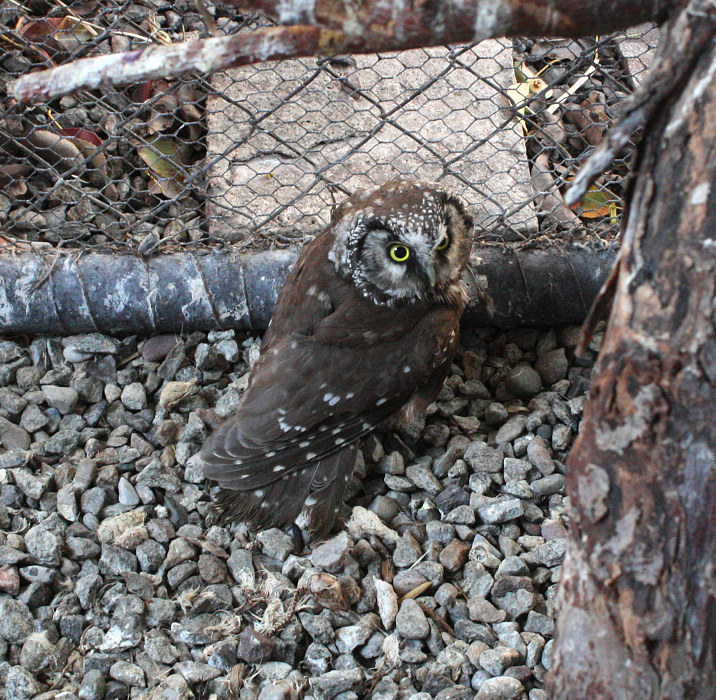
A pale facial disc with a dark border and yellow eyes gives the head a distinctive appearance. The spring song is a rapid series of regular notes, sometimes continuing from one place for a long time.
Sources: Slovak Wikipedia · English Wikipedia
Sign in to send private feedback on the text to our editors.
Explore further
Overview and identification
Descriptions, identification and names.
- Slovak Wikipedia ↗
Taxon account in Slovak: distribution, biology and references for further reading.
https://sk.wikipedia.org/wiki/P%C3%B4tik_kapcav%C3%BD - English Wikipedia ↗
Taxon account in English: distribution, biology and taxonomic context.
https://en.wikipedia.org/wiki/Boreal_owl


