


Alcedo atthis · rybárik riečny · Common Kingfisher
Alternative and historical names
Slovak names
- rybárik riečny (Kovalik 2010)
- rybárik obyčajný (zelený) (Kovalik 2010)
- rybárik obyčajný (Kovalik 2010)
- rybárik riečny (Matoušek 1990)
English names
- Common Kingfisher (IOC 2.5 2010)
- Kingfisher (BOU 1923)
Scientific names
- Alcedo atthis (AviList 2026)
- Alcedo atthis (IOC 15.2 2026)
- Alcedo atthis (IOC 2.5 2010)
- Alcedo atthis (BOU 1923)
Taxonomic synonyms
- Alcedo atthis corsicana (Laubmann, 1920)
- Gracula spec (Linnaeus, 1758)
- Gracula atthis (Linnaeus, 1758)
- Alcedo atthis (Linnaeus, 1758)
Birding Slovakia database
This species through our community’s eyes
Species characteristics in Slovakia
- General occurrence
- some are resident, some are migratory / R+M
- Breeding
- common nidificant / Nc
- Migration
- common transmigrant / Tc
- Wintering
- common wintering / Wc
- Rarities committee:
- Does not require any reporting or registration by Raritties commitee
Observation map

Detailed species observation statistics

Source: the Birding.sk database. Counts reflect observer contributions, not population size.
About this species
Distribution
The Common Kingfisher occurs in Europe, North Africa and much of Asia. In Slovakia it breeds regularly beside suitable waters, particularly at low and middle elevations. It is scattered and locally common along favourable stretches, but is not present on every river. It occurs throughout the year; in winter it moves to unfrozen waters, and severe winters can greatly reduce its numbers.
Habitat
It seeks streams, rivers, side channels and still waters holding small fish. Branches or other perches above the water are useful, as are steep earth or sandy banks for nesting. Its presence is most often revealed by a sharp whistle and a low, direct flight over the water.
Breeding
Both partners excavate a tunnel in a bank, ending in a nesting chamber. The female usually lays five to seven white eggs. Both parents share the care of the brood, and under favourable conditions a pair can nest repeatedly in one season.
Food
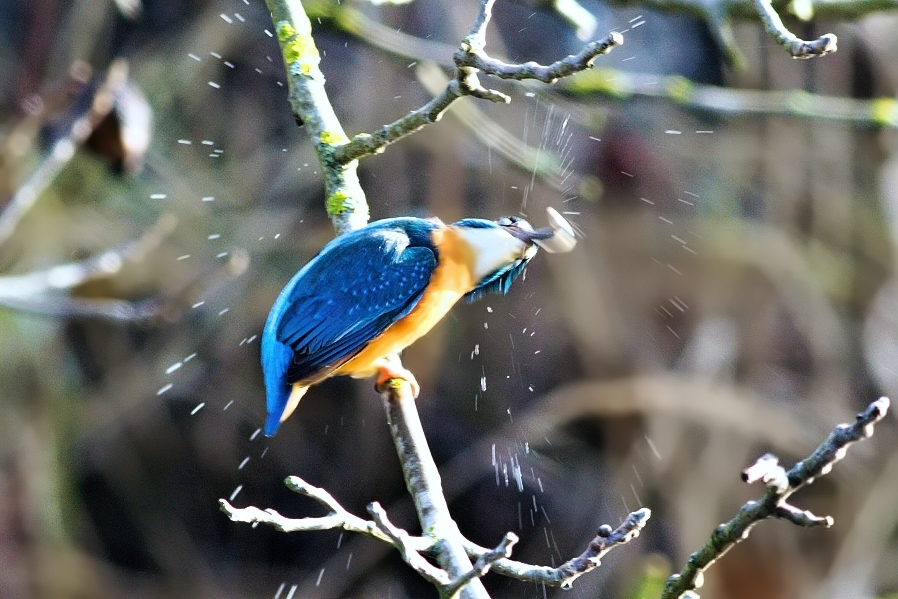
It mainly catches small fish, with aquatic invertebrates forming a smaller part of its diet. It watches the water from a perch and plunges below the surface after prey. It often handles the catch by striking it against a branch.
Interesting fact
It generally swallows a fish head first. This simple manoeuvre aligns the fins and scales with the direction of swallowing. Watching carefully from a distance, you may see the kingfisher turn its catch in its bill before eating it.
Sources: Slovak Wikipedia · BTO BirdFacts · English Wikipedia
Sign in to send private feedback on the text to our editors.
Explore further
Overview and identification
Descriptions, identification and names.
- Slovak Wikipedia ↗
Taxon account in Slovak: distribution, biology and references for further reading.
https://sk.wikipedia.org/wiki/Ryb%C3%A1rik_rie%C4%8Dny - BTO BirdFacts ↗
Biology and identification in English; population figures and trends refer to Britain.
https://www.bto.org/learn/about-birds/birdfacts/kingfisher - English Wikipedia ↗
Taxon account in English: distribution, biology and taxonomic context.
https://en.wikipedia.org/wiki/Common_kingfisher


