


Anthus cervinus · ľabtuška červenohrdlá · Red-throated Pipit
Alternative and historical names
Slovak names
- ľabtuška červenohrdlá (Kovalik 2010)
- ľaptuška červenokrká (Kovalik 2010)
- ľabtuška červenohrdlá (Matoušek 1990)
English names
- Red-throated Pipit (IOC 2.5 2010)
- Red-throated Pipit (BOU 1923)
Scientific names
- Anthus cervinus (AviList 2026)
- Anthus cervinus (IOC 15.2 2026)
- Anthus cervinus (IOC 2.5 2010)
- Anthus cervinus (BOU 1923)
Taxonomic synonyms
- Anthus cervinus rufogularis (C.L.Brehm, 1824)
- Anthus rufogularis (Brehm, 1824)
- Anthus cervinus cervinus (Pallas, 1811)
- Motacilla cervina (Pallas, 1811)
- Anthus cervinus (Pallas, 1811)
Birding Slovakia database
This species through our community’s eyes
Species characteristics in Slovakia
- Migration
- uncommon transmigrant / Tu
- Rarities committee:
- Does not require any reporting or registration by Raritties commitee
Observation map

Detailed species observation statistics

Source: the Birding.sk database. Counts reflect observer contributions, not population size.
About this species
Distribution
It breeds in far northern Eurasia and reaches Alaska, wintering chiefly in Africa and southern Asia. Slovakia lies along migration routes rather than within its breeding range. It is an uncommon spring and autumn migrant, locally regular at suitable stopovers. It neither breeds nor normally winters here.
Habitat
Northern breeding habitats include open tundra and wet grassy areas. In Slovakia, search wet meadows, flooded fields, muddy water margins and sparsely vegetated temporary pools. Wetlands provide a more useful search focus than dry farmland.
Breeding
Within the tundra range the nest is hidden beside a grass tussock or on a wetland hummock, using dry grasses and sedges with a fine lining. The usual 4–6 eggs are incubated by the female; Slovak records concern migration away from breeding grounds.
Food
It collects insects and other small invertebrates on the ground and in low vegetation. Passage birds inspect damp vegetation margins and exposed mud. Seeds are taken occasionally, but most food consists of small animal prey.
Interesting fact
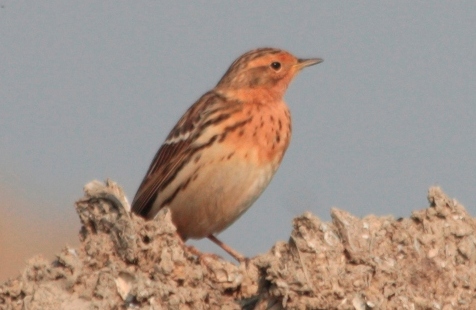
The reddish-brown throat is most conspicuous in spring plumage. Young autumn birds may lack it entirely, so the species’ name is not a year-round identification guide; body pattern and voice remain important.
Sources: Slovak Wikipedia · English Wikipedia
Sign in to send private feedback on the text to our editors.
Explore further
Overview and identification
Descriptions, identification and names.
- Slovak Wikipedia ↗
Taxon account in Slovak: distribution, biology and references for further reading.
https://sk.wikipedia.org/wiki/%C4%BDabtu%C5%A1ka_%C4%8Dervenohrdl%C3%A1 - English Wikipedia ↗
Taxon account in English: distribution, biology and taxonomic context.
https://en.wikipedia.org/wiki/Red-throated_pipit


