


Luscinia luscinia · slávik veľký · Thrush Nightingale
Alternative and historical names
Slovak names
- slávik veľký (Kovalik 2010)
- slávik tmavý (Kovalik 2010)
- slávik tmavý (Matoušek 1990)
English names
- Thrush Nightingale (IOC 2.5 2010)
- Thrush-Nightingale or Sposser (BOU 1923)
Scientific names
- Luscinia luscinia (AviList 2026)
- Luscinia luscinia (IOC 15.2 2026)
- Luscinia luscinia (IOC 2.5 2010)
- Luscinia luscinia (BOU 1923)
Taxonomic synonyms
- Erithacus luscinia (Linnaeus, 1758)
- Motacilla luscinia (Linnaeus, 1758)
- Luscinia luscinia (Linnaeus, 1758)
Birding Slovakia database
This species through our community’s eyes
Photographs by category
Species characteristics in Slovakia
- General occurrence
- migrant / M
- Breeding
- uncommon nidificant / Nu
- Migration
- uncommon transmigrant / Tu
- Rarities committee:
- Does not require any reporting or registration by Raritties commitee
Conservation — Red Lists
- Slovakia 2023breeding population
- Breeding population Period: 2013–2023 Source: Demko M. a kol. 2025: Červený zoznam vtákov Slovenska: aktualizácia 2013 – 2023. Tichodroma 37: 107–117. Online 18. 1. 2026. DOI: 10.31577/tichodroma.2025.37.18. Príloha 1, s. 117, riadok 74, stĺpec 6 Criteria: C1
- Europe 2021
- Population scope unspecified Source: BirdLife International 2021: European Red List of Birds. Publications Office of the European Union, Luxembourg. Reported in: Demko M. a kol. 2025: Červený zoznam vtákov Slovenska: aktualizácia 2013 – 2023. Tichodroma 37: 107–117. Online 18. 1. 2026. DOI: 10.31577/tichodroma.2025.37.18. Príloha 1, s. 117, riadok 74, stĺpec 4
- World 2025
- Species Source: BirdLife International 2025: Species factsheets. Citované v Demko a kol. 2025, prístup 16. 4. 2025. Reported in: Demko M. a kol. 2025: Červený zoznam vtákov Slovenska: aktualizácia 2013 – 2023. Tichodroma 37: 107–117. Online 18. 1. 2026. DOI: 10.31577/tichodroma.2025.37.18. Príloha 1, s. 117, riadok 74, stĺpec 3
Previous assessments
- Slovakia 2013
- Breeding population Period: 2002–2012 Source: Demko M., Krištín A. & Pačenovský S. 2014: Červený zoznam vtákov Slovenska. SOS/BirdLife Slovensko, Bratislava. Zdroj stĺpca SK 2013 podľa poznámky 5 prílohy Demko a kol. 2025. Reported in: Demko M. a kol. 2025: Červený zoznam vtákov Slovenska: aktualizácia 2013 – 2023. Tichodroma 37: 107–117. Online 18. 1. 2026. DOI: 10.31577/tichodroma.2025.37.18. Príloha 1, s. 117, riadok 74, stĺpec 5 Category downgraded by 1 level due to surrounding populations.
Observation map
Detailed species observation statistics

Source: the Birding.sk database. Counts reflect observer contributions, not population size.
About this species
Distribution
Its breeding range lies chiefly in northeastern Europe and western Asia, and it winters in Africa. In Slovakia it is much less widespread than the Common Nightingale, with regular breeding centred on the eastern lowlands. It is a summer visitor and migrant. Song reveals it in spring and summer; it does not normally remain here in winter.
Habitat
It favours damp deciduous and floodplain woodland with dense undergrowth, riverside scrub and nettle beds. It often stays close to the ground under cover. Listening from the vegetation edge is more effective than trying to enter its dense hiding places.
Breeding
The plant-material nest is hidden near the ground in dense floodplain woodland vegetation or waterside thickets. A typical clutch contains 4–5 eggs. Parents bring invertebrates, and dense undergrowth also shelters young after they leave the nest.
Food
It gathers insects, spiders, larvae and other invertebrates from the ground and leaf litter. Berries supplement the diet in late summer and autumn before migration.
Interesting fact
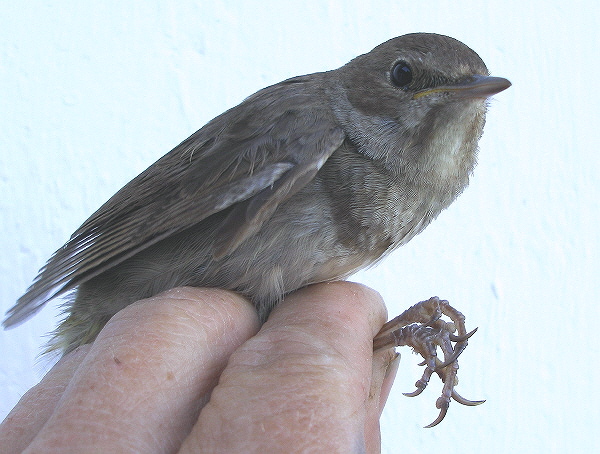
It is often easier to distinguish from the similar Common Nightingale by voice than by appearance. Its strong rhythmic phrases lack the relative’s characteristic long, swelling whistles; plain brown plumage is a less reliable guide.
Sources: Slovak Wikipedia · English Wikipedia
Sign in to send private feedback on the text to our editors.
Explore further
Overview and identification
Descriptions, identification and names.
- Slovak Wikipedia ↗
Taxon account in Slovak: distribution, biology and references for further reading.
https://sk.wikipedia.org/wiki/Sl%C3%A1vik_ve%C4%BEk%C3%BD - English Wikipedia ↗
Taxon account in English: distribution, biology and taxonomic context.
https://en.wikipedia.org/wiki/Thrush_nightingale
Data and research
Occurrences, distribution and research.
- Slovak Red List: Thrush Nightingale ↗
Species entry in Appendix1,p.59 (2023 assessment).
https://www.tichodroma.sk/pdfs/37/Tichodroma_37_18_Demko.pdf#page=11
























