


Saxicola rubicola · pŕhľaviar čiernohlavý · European Stonechat
Alternative and historical names
Slovak names
- pŕhľaviar bielokrký (Kovalik 2010)
- pŕhľaviar černohlavý (Kovalik 2010)
- pŕhľaviar čiernohlavý (Matoušek 1990)
English names
- European Stonechat (IOC 2.5 2010)
- Stonechat (BOU 1923)
Scientific names
- Saxicola rubicola (AviList 2026)
- Saxicola rubicola (IOC 15.2 2026)
- Saxicola rubicola (IOC 2.5 2010)
- Saxicola torquatus (BOU 1923)
Taxonomic synonyms
- Motacilla rubicola (Linnaeus, 1766)
- Saxicola torquata rubicola (Linnaeus, 1766)
- Saxicola torquatus rubicola (Linnaeus, 1766)
- Saxicola rubicola (Linnaeus, 1766)
Birding Slovakia database
This species through our community’s eyes
Species characteristics in Slovakia
- General occurrence
- migrant / M
- Breeding
- common nidificant / Nc
- Migration
- common transmigrant / Tc
- Wintering
- rare wintering / Wr
- Rarities committee:
- Does not require any reporting or registration by Raritties commitee
Observation map
Detailed species observation statistics

Source: the Birding.sk database. Counts reflect observer contributions, not population size.
About this species
Distribution
It occurs in Europe, northwestern Africa and adjacent western Asia. In Slovakia it breeds regularly in open country, chiefly lowlands and hills. Birds appear early in spring and most leave in autumn. Some European populations are resident, but only small numbers winter in Slovakia, where winter encounters remain unusual.
Habitat
Search dry grassland with scattered bushes, field margins, embankments, pastures and neglected ground. It needs both low vegetation for hunting and denser cover for shelter. Males often watch their territory from a bush top or fence.
Breeding
The nest is on the ground, well concealed in grass or at the base of a shrub. The female usually lays 5–6 eggs and incubates alone. Both parents feed the young; the long season allows two and sometimes further broods.
Food
Its food consists mainly of insects, spiders and other small invertebrates. It watches from a low perch before dropping onto prey on the ground or in vegetation.
Interesting fact
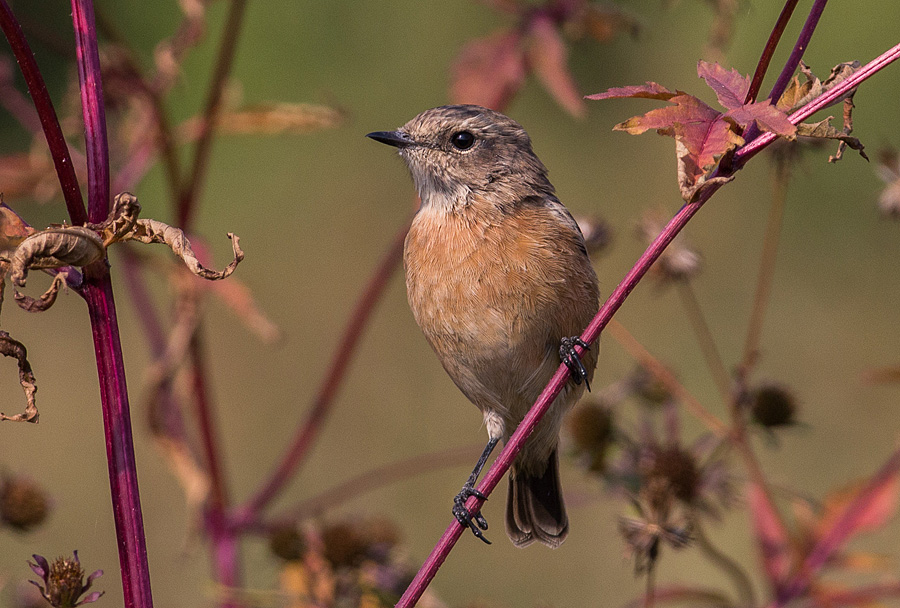
Its contact call resembles two stones being tapped together, giving the stonechat its English name. The adult male's black head is conspicuous, but females are browner and identification also requires attention to wing and neck patterns.
Sources: Slovak Wikipedia · English Wikipedia · BTO BirdFacts
Sign in to send private feedback on the text to our editors.
Explore further
Overview and identification
Descriptions, identification and names.
- Slovak Wikipedia ↗
Taxon account in Slovak: distribution, biology and references for further reading.
https://sk.wikipedia.org/wiki/P%C5%95h%C4%BEaviar_%C4%8Diernohlav%C3%BD - English Wikipedia ↗
Taxon account in English: distribution, biology and taxonomic context.
https://en.wikipedia.org/wiki/European_stonechat - BTO BirdFacts ↗
Biology and identification in English; population figures and trends refer to Britain.
https://www.bto.org/learn/about-birds/birdfacts/stonechat
Sounds, photographs and video
Recordings and visual comparisons.
- BTO: identifying Whinchat, Stonechat and Wheatear ↗
English comparative identification video covering appearance and vocalisations.
https://www.bto.org/learn/skills/bird-identification/videos/chats


