


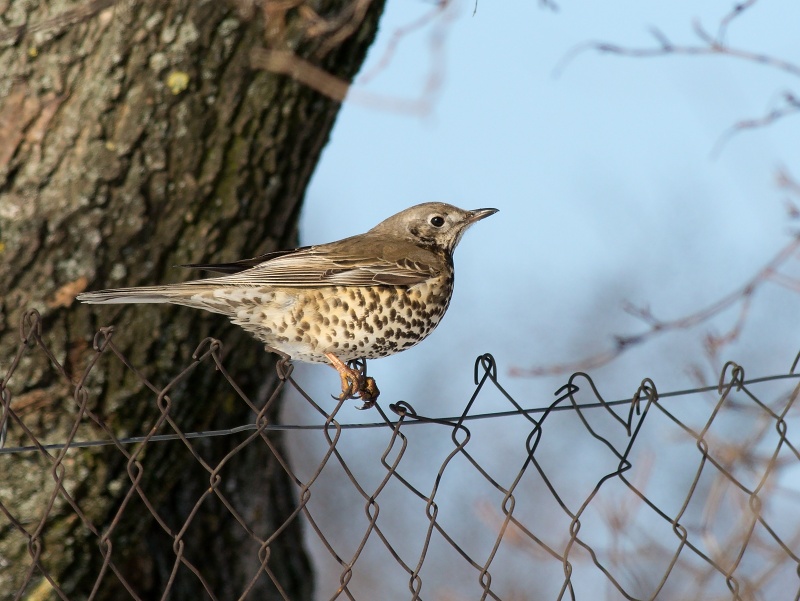
Turdus viscivorus · drozd trskota · Mistle Thrush
Alternative and historical names
Slovak names
- drozd trskota (Kovalik 2010)
- drozd trskotavý (trskota) (Kovalik 2010)
- drozd trskotavý (Kovalik 2010)
- trskota obyčajná (Kovalik 2010)
- drozd trskotavý (Matoušek 1990)
English names
- Mistle Thrush (IOC 2.5 2010)
- Mistle-Thrush (BOU 1923)
Scientific names
- Turdus viscivorus (AviList 2026)
- Turdus viscivorus (IOC 15.2 2026)
- Turdus viscivorus (IOC 2.5 2010)
- Turdus viscivorus (BOU 1923)
Taxonomic synonyms
- Turdus viscivorus reiseri (Schiebel, 1911)
- Turdus viscivorus Linnaeus, 1758
Birding Slovakia database
This species through our community’s eyes
Species characteristics in Slovakia
- General occurrence
- migrant / M
- Breeding
- common nidificant / Nc
- Migration
- common transmigrant / Tc
- Wintering
- uncommon wintering / Wu
- Rarities committee:
- Does not require any reporting or registration by Raritties commitee
Observation map

Detailed species observation statistics

Source: the Birding.sk database. Counts reflect observer contributions, not population size.
About this species
Distribution
It occurs in Europe, northern Africa and temperate Asia. In Slovakia it breeds regularly, especially in wooded regions and hills, and some birds remain through winter. Northern and eastern populations move south. Winter encounters consequently reflect both local movements and migration, including birds descending from mountain areas.
Habitat
It favours open woodland, forest margins, large parks and trees beside meadows or pastures. Feeding often takes place on open ground. In winter it may repeatedly visit a particular fruit-bearing or mistletoe-covered tree and remain nearby.
Breeding
The large, mud-lined cup nest is placed in a branch fork or against a trunk. A typical clutch contains 3–5 eggs. The female does most incubation and both parents feed the young, usually raising two broods.
Food
It takes earthworms, insects and other invertebrates, alongside berries and fruit. Mistletoe, rowan and other woody plants become especially important when animal food is less accessible.
Interesting fact
An individual or pair may defend a fruiting tree against other birds as a winter food reserve. By eating mistletoe it also helps distribute seeds to other branches where the plant can germinate.
Sources: Slovak Wikipedia · English Wikipedia · BTO BirdFacts
Sign in to send private feedback on the text to our editors.
Explore further
Overview and identification
Descriptions, identification and names.
- Slovak Wikipedia ↗
Taxon account in Slovak: distribution, biology and references for further reading.
https://sk.wikipedia.org/wiki/Drozd_trskota - English Wikipedia ↗
Taxon account in English: distribution, biology and taxonomic context.
https://en.wikipedia.org/wiki/Mistle_thrush - BTO BirdFacts ↗
Biology and identification in English; population figures and trends refer to Britain.
https://www.bto.org/learn/about-birds/birdfacts/mistle-thrush
Sounds, photographs and video
Recordings and visual comparisons.
- BTO: identifying Redwing and Fieldfare ↗
English comparative identification video covering appearance and vocalisations.
https://www.bto.org/learn/skills/bird-identification/videos/redwing-and-fieldfare - BTO: identifying Song Thrush and Mistle Thrush ↗
English comparative identification video covering appearance and vocalisations.
https://www.bto.org/learn/skills/bird-identification/videos/thrushes-song-and-mistle


