


Locustella luscinioides · svrčiak slávikovitý · Savi's Warbler
Alternative and historical names
Slovak names
- svrčiak slávikovitý (Kovalik 2010)
- trsteniarik slávikovitý (Kovalik 2010)
- svrčiak slávikovitý (Matoušek 1990)
English names
- Savi's Warbler (IOC 2.5 2010)
- Savi’s Warbler (BOU 1923)
Scientific names
- Locustella luscinioides (AviList 2026)
- Locustella luscinioides (IOC 15.2 2026)
- Locustella luscinioides (IOC 2.5 2010)
- Locustella luscinioides (BOU 1923)
Taxonomic synonyms
- Sylvia luscinioides (Savi, 1824)
- Locustella luscinioides (Savi, 1824)
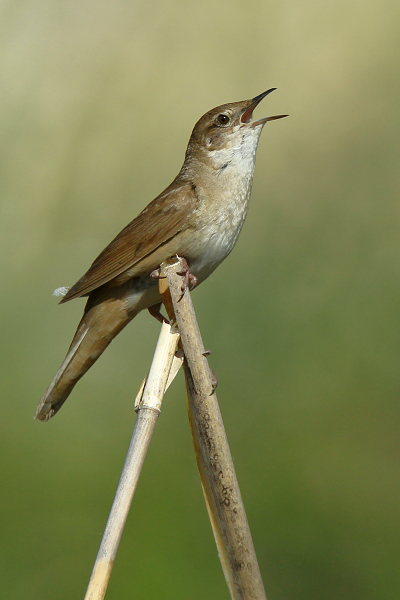
Birding Slovakia database
This species through our community’s eyes
Species characteristics in Slovakia
- General occurrence
- migrant / M
- Breeding
- common nidificant / Nc
- Migration
- common transmigrant / Tc
- Rarities committee:
- Does not require any reporting or registration by Raritties commitee
Observation map

Detailed species observation statistics

Source: the Birding.sk database. Counts reflect observer contributions, not population size.
About this species
Distribution
It breeds in Europe and western to central Asia and winters chiefly in Africa. In Slovakia it regularly nests in suitable lowland wetlands, closely following extensive stands of aquatic vegetation. It arrives in spring and departs from late summer; routine wintering does not occur. Singing males usually provide the first evidence of presence.
Habitat
Search reedbeds and cattail stands with old broken stems and dense lower growth. This tangle provides both routes through the vegetation and shelter. Birds often sing from higher stems but vanish deeper into cover when disturbed.
Breeding
The nest is concealed low in vegetation on a platform of old plants. A typical clutch contains 4–5 eggs, incubated by the female. She also supplies the first chick feeding; the well-covered structure shelters the young in the lower wetland tangle.
Food
It eats insects, their immature stages and spiders, collecting them from wetland plants and the lower tangle often invisible from the bank.
Interesting fact
The low, continuous reel can sound like an insect hidden in the reeds. Its pulses are less separate than a River Warbler's, and the bird generally has a plainer breast without clear streaking.
Sources: Slovak Wikipedia · English Wikipedia · BTO BirdFacts
Sign in to send private feedback on the text to our editors.
Explore further
Overview and identification
Descriptions, identification and names.
- Slovak Wikipedia ↗
Taxon account in Slovak: distribution, biology and references for further reading.
https://sk.wikipedia.org/wiki/Svr%C4%8Diak_sl%C3%A1vikovit%C3%BD - English Wikipedia ↗
Taxon account in English: distribution, biology and taxonomic context.
https://en.wikipedia.org/wiki/Savi%27s_warbler - BTO BirdFacts ↗
Biology and identification in English; population figures and trends refer to Britain.
https://www.bto.org/learn/about-birds/birdfacts/savis-warbler


