Acrocephalus melanopogon · trsteniarik tamariškový · Moustached Warbler
Alternative and historical names
Slovak names
- trsteniarik tamariškový (Kovalik 2010)
- šašinárik tenkozobý (Kovalik 2010)
- šašiniarik tenkozobý (Kovalik 2010)
- trsteniarik tamariškový (Matoušek 1990)
- šašiniarik tenkozobý (Ferianc 1958)
English names
- Moustached Warbler (IOC 2.5 2010)
Scientific names
- Acrocephalus melanopogon (AviList 2026)
- Acrocephalus melanopogon (IOC 15.2 2026)
- Acrocephalus melanopogon (IOC 2.5 2010)
Taxonomic synonyms
- Lusciniola melanopogon (Temminck, 1823)
- Sylvia melanopogon (Temminck, 1823)
- Acrocephalus melanopogon (Temminck, 1823)
Birding Slovakia database
This species through our community’s eyes
Photographs by category
Species characteristics in Slovakia
- General occurrence
- migrant / M
- Breeding
- rare nidificant / Nr
- Rarities committee:
- Sigthings of this specie are registered by Raritties commitee
Conservation — Red Lists
- Slovakia 2023breeding population
- Breeding population Period: 2013–2023 Source: Demko M. a kol. 2025: Červený zoznam vtákov Slovenska: aktualizácia 2013 – 2023. Tichodroma 37: 107–117. Online 18. 1. 2026. DOI: 10.31577/tichodroma.2025.37.18. Príloha 1, s. 117, riadok 81, stĺpec 6 Criteria: D Category downgraded by 1 level due to surrounding populations.
- Europe 2021
- Population scope unspecified Source: BirdLife International 2021: European Red List of Birds. Publications Office of the European Union, Luxembourg. Reported in: Demko M. a kol. 2025: Červený zoznam vtákov Slovenska: aktualizácia 2013 – 2023. Tichodroma 37: 107–117. Online 18. 1. 2026. DOI: 10.31577/tichodroma.2025.37.18. Príloha 1, s. 117, riadok 81, stĺpec 4
- World 2025
- Species Source: BirdLife International 2025: Species factsheets. Citované v Demko a kol. 2025, prístup 16. 4. 2025. Reported in: Demko M. a kol. 2025: Červený zoznam vtákov Slovenska: aktualizácia 2013 – 2023. Tichodroma 37: 107–117. Online 18. 1. 2026. DOI: 10.31577/tichodroma.2025.37.18. Príloha 1, s. 117, riadok 81, stĺpec 3
Previous assessments
- Slovakia 2013
- Breeding population Period: 2002–2012 Source: Demko M., Krištín A. & Pačenovský S. 2014: Červený zoznam vtákov Slovenska. SOS/BirdLife Slovensko, Bratislava. Zdroj stĺpca SK 2013 podľa poznámky 5 prílohy Demko a kol. 2025. Reported in: Demko M. a kol. 2025: Červený zoznam vtákov Slovenska: aktualizácia 2013 – 2023. Tichodroma 37: 107–117. Online 18. 1. 2026. DOI: 10.31577/tichodroma.2025.37.18. Príloha 1, s. 117, riadok 81, stĺpec 5 Category downgraded by 1 level due to surrounding populations.
Observation map

Detailed species observation statistics

Source: the Birding.sk database. Counts reflect observer contributions, not population size.
About this species
Distribution
It breeds in southern Europe, northwestern Africa and southern temperate Asia. Some populations are resident; others move towards the Mediterranean or southern Asia. In Slovakia it is a very rare, local breeder near the northern part of its European distribution. Presence in one wetland does not imply continuous occurrence throughout southern Slovakia, and regular wintering is not established.
Habitat
It favours dense wetland vegetation, especially cattails, sedges and reeds beside open water. Complex lower growth provides feeding places and concealment. Patient listening from the bank is preferable to entering breeding vegetation.
Breeding
The female builds a deep cup attached among plants above water. A typical clutch contains 3–6 eggs; both parents incubate and feed the young. Two broods may be raised within the main range.
Food
Small insects and other invertebrates are collected in dense vegetation as birds move close to the water and between stems.
Interesting fact
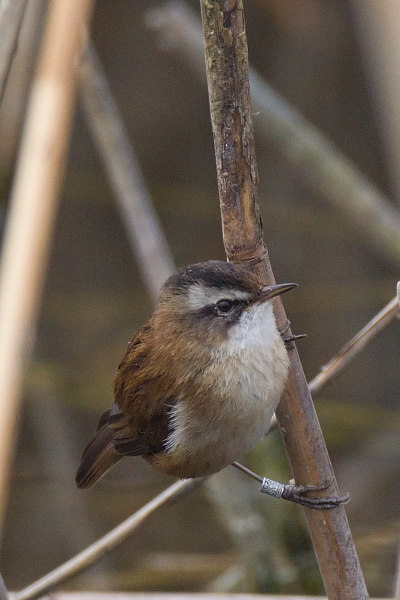
A strong white eyebrow contrasts with the dark crown and cheek. The song can include soft repeated whistles reminiscent of a nightingale; the Slovak name does not imply dependence exclusively on tamarisks.
Sources: Slovak Wikipedia · English Wikipedia
Sign in to send private feedback on the text to our editors.
Explore further
Overview and identification
Descriptions, identification and names.
- Slovak Wikipedia ↗
Taxon account in Slovak: distribution, biology and references for further reading.
https://sk.wikipedia.org/wiki/Trsteniarik_tamari%C5%A1kov%C3%BD - English Wikipedia ↗
Taxon account in English: distribution, biology and taxonomic context.
https://en.wikipedia.org/wiki/Moustached_warbler
Data and research
Occurrences, distribution and research.
- Slovak Red List: Moustached Warbler ↗
Species entry in Appendix1,p.59 (2023 assessment).
https://www.tichodroma.sk/pdfs/37/Tichodroma_37_18_Demko.pdf#page=11 - ŠOP SR: Moustached Warbler – morphology and ecology ↗
Slovak state nature-conservation atlas with species morphology and ecology.
https://www.biomonitoring.sk/Registration/AtlasAnimal/Detail/48559