


Acrocephalus schoenobaenus · trsteniarik malý · Sedge Warbler
Alternative and historical names
Slovak names
- trsteniarik malý (Kovalik 2010)
- trsteniarik menší (Kovalik 2010)
- trsteniarik pásikavý (Kovalik 2010)
- trsteniarik pásikový (Kovalik 2010)
- trsteniarik pásikový (Matoušek 1990)
English names
- Sedge Warbler (IOC 2.5 2010)
- Sedge-Warbler (BOU 1923)
Scientific names
- Acrocephalus schoenobaenus (AviList 2026)
- Acrocephalus schoenobaenus (IOC 15.2 2026)
- Acrocephalus schoenobaenus (IOC 2.5 2010)
- Acrocephalus schoenobaenus (BOU 1923)
Taxonomic synonyms
- Motacilla schoenobaenus (Linnaeus, 1758)
- Acrocephalus schoenobaenus (Linnaeus, 1758)
Birding Slovakia database
This species through our community’s eyes
Species characteristics in Slovakia
- General occurrence
- migrant / M
- Breeding
- common nidificant / Nc
- Migration
- common transmigrant / Tc
- Rarities committee:
- Does not require any reporting or registration by Raritties commitee
Observation map

Detailed species observation statistics

Source: the Birding.sk database. Counts reflect observer contributions, not population size.
About this species
Distribution
It breeds in Europe and western to central Asia and winters south of the Sahara. In Slovakia it is both a regular wetland breeder and a passage migrant occurring away from local breeding sites. Birds arrive in spring and leave from late summer into autumn. Regular wintering does not occur, and stopover numbers can change quickly.
Habitat
It favours sedges, reeds mixed with herbs, waterside thickets and overgrown damp ditches, rather than exclusively pure reeds above deep water. Early-season males sing from stem tips or make song flights above vegetation.
Breeding
The female builds a nest low among dense plants, often near the ground. A clutch typically contains about five eggs. She incubates and both parents feed the chicks, which remain dependent for a time after leaving the nest.
Food
It hunts insects and other small invertebrates on leaves and stems, occasionally in flight. Before migration it can exploit aphid-rich sites intensively to build fat reserves.
Interesting fact
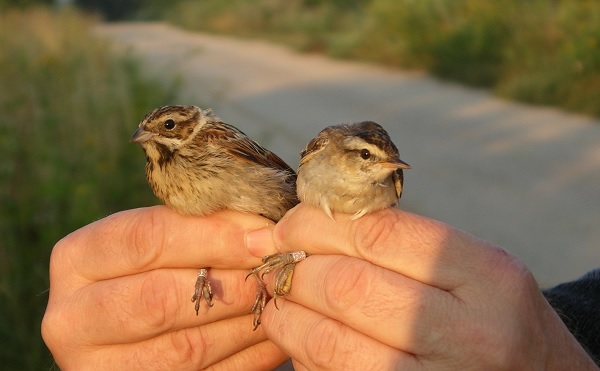
Its variable song mixes harsh and musical passages with imitations of other species. Juveniles require care in identification: a suggestion of a pale central crown stripe can make them resemble the rarer Aquatic Warbler.
Sources: Slovak Wikipedia · English Wikipedia · BTO BirdFacts
Sign in to send private feedback on the text to our editors.
Explore further
Overview and identification
Descriptions, identification and names.
- Slovak Wikipedia ↗
Taxon account in Slovak: distribution, biology and references for further reading.
https://sk.wikipedia.org/wiki/Trsteniarik_mal%C3%BD - English Wikipedia ↗
Taxon account in English: distribution, biology and taxonomic context.
https://en.wikipedia.org/wiki/Sedge_warbler - BTO BirdFacts ↗
Biology and identification in English; population figures and trends refer to Britain.
https://www.bto.org/learn/about-birds/birdfacts/sedge-warbler
Sounds, photographs and video
Recordings and visual comparisons.
- BTO: identifying Sedge Warbler and Reed Warbler ↗
English comparative identification video covering appearance and vocalisations.
https://www.bto.org/learn/skills/bird-identification/videos/reed-warbler-sedge-warbler


