Acrocephalus arundinaceus · trsteniarik veľký · Great Reed Warbler
Alternative and historical names
Slovak names
- trsteniarik veľký (Kovalik 2010)
- trsteniarik škriekavý (Kovalik 2010)
- trsteniarik škriekavý (Matoušek 1990)
English names
- Great Reed Warbler (IOC 2.5 2010)
- Great Reed-Warbler (BOU 1923)
Scientific names
- Acrocephalus arundinaceus (AviList 2026)
- Acrocephalus arundinaceus (IOC 15.2 2026)
- Acrocephalus arundinaceus (IOC 2.5 2010)
- Acrocephalus arundinaceus (BOU 1923)
Taxonomic synonyms
- Acrocephalus turdoides (Meyer, 1815)
- Sylvia turdoides (Meyer, 1815)
- Turdus arundinaceus (Linnaeus, 1758)
- Acrocephalus arundinaceus (Linnaeus, 1758)
Birding Slovakia database
This species through our community’s eyes
Species characteristics in Slovakia
- General occurrence
- migrant / M
- Breeding
- common nidificant / Nc
- Migration
- common transmigrant / Tc
- Rarities committee:
- Does not require any reporting or registration by Raritties commitee
Observation map

Detailed species observation statistics

Source: the Birding.sk database. Counts reflect observer contributions, not population size.
About this species
Distribution
It breeds in mainland Europe and western to central Asia and winters in sub-Saharan Africa. In Slovakia it regularly nests in wetlands, chiefly lowlands and warmer basins. Birds arrive in spring and leave in late summer and autumn. It can be conspicuous at a suitable fishpond but is not widespread away from reedbeds.
Habitat
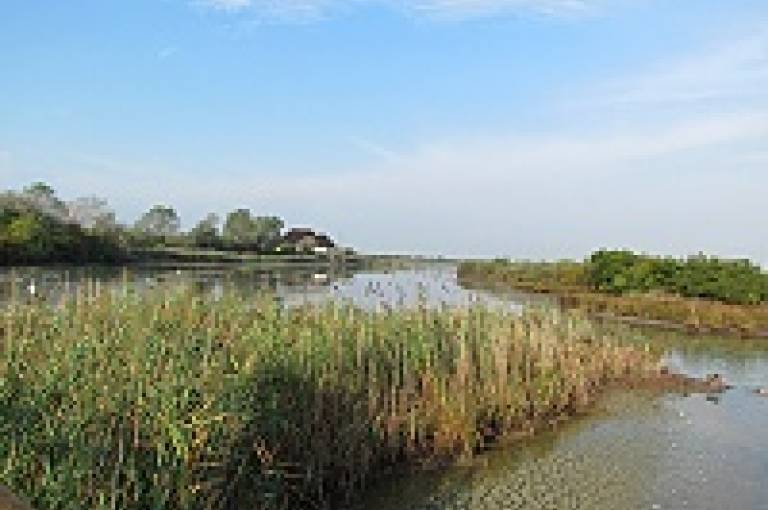
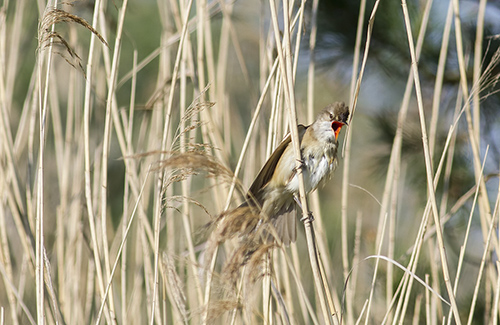
It favours tall, sturdy reeds beside water, often along an open-water edge. Cattails and neighbouring trees are also used, but wetlands remain the main breeding habitat. Singing males often cling high on stems and are easier to see than smaller reed warblers.
Breeding
The female builds a nest between strong stems above water and lays several spotted eggs. Parents bring insects to the young. Chicks may scramble into surrounding reeds before they can fly well, so these young birds should not be assumed abandoned.
Food
It feeds chiefly on insects and larvae collected from aquatic plants, shrubs and trees near the wetland. Its large bill allows it to handle relatively large prey.
Interesting fact
Loud, harsh phrases with repeated syllables are characteristic sounds of spring reedbeds. It resembles an enlarged Common Reed Warbler but looks more robust and has a substantially stronger bill.
Sources: Slovak Wikipedia · English Wikipedia · BTO BirdFacts
Sign in to send private feedback on the text to our editors.
Explore further
Overview and identification
Descriptions, identification and names.
- Slovak Wikipedia ↗
Taxon account in Slovak: distribution, biology and references for further reading.
https://sk.wikipedia.org/wiki/Trsteniarik_ve%C4%BEk%C3%BD - English Wikipedia ↗
Taxon account in English: distribution, biology and taxonomic context.
https://en.wikipedia.org/wiki/Great_reed_warbler - BTO BirdFacts ↗
Biology and identification in English; population figures and trends refer to Britain.
https://www.bto.org/learn/about-birds/birdfacts/great-reed-warbler