


Curruca communis · penica obyčajná · Common Whitethroat
Alternative and historical names
Slovak names
- penica obyčajná (Kovalik 2010)
- penica hnedokrídla (Kovalik 2010)
- penica hnedokrídla (Matoušek 1990)
English names
- Common Whitethroat (IOC 2.5 2010)
- Whitethroat (BOU 1923)
Scientific names
- Curruca communis (AviList 2026)
- Curruca communis (IOC 15.2 2026)
- Sylvia communis (IOC 2.5 2010)
- Sylvia communis (BOU 1923)
Taxonomic synonyms
- Curruca communis icterops (Ménétriés, 1832)
- Sylvia communis (Latham, 1787)
- Curruca communis (Latham, 1787)
Birding Slovakia database
This species through our community’s eyes
Photographs by category
Species characteristics in Slovakia
- General occurrence
- migrant / M
- Breeding
- common nidificant / Nc
- Migration
- common transmigrant / Tc
- Rarities committee:
- Does not require any reporting or registration by Raritties commitee
Observation map

Detailed species observation statistics

Source: the Birding.sk database. Counts reflect observer contributions, not population size.
About this species
Distribution
It occurs in Europe and temperate western Asia and winters mainly in tropical Africa. In Slovakia it regularly breeds in open scrubby country from lowlands to foothills. Birds arrive in spring and depart from late summer, without regular wintering. Varied farmland with unmanaged margins is more suitable than continuous forest.
Habitat
It favours field margins, pastures, young scrub, neglected gardens and ditches with dense herbs and scattered bushes. Both low cover and more open patches matter. Males often sing from bush tops and during brief flights over their territory.
Breeding
The cup nest of grass and stems is hidden low in scrub or dense herbs. A typical clutch contains 4–5 eggs. Both parents incubate and feed the young, and a second clutch may follow in a favourable season.
Food
Insects, larvae and other invertebrates dominate during nesting. Berries and small fruits increase in late summer and help prepare birds for long migration.
Interesting fact
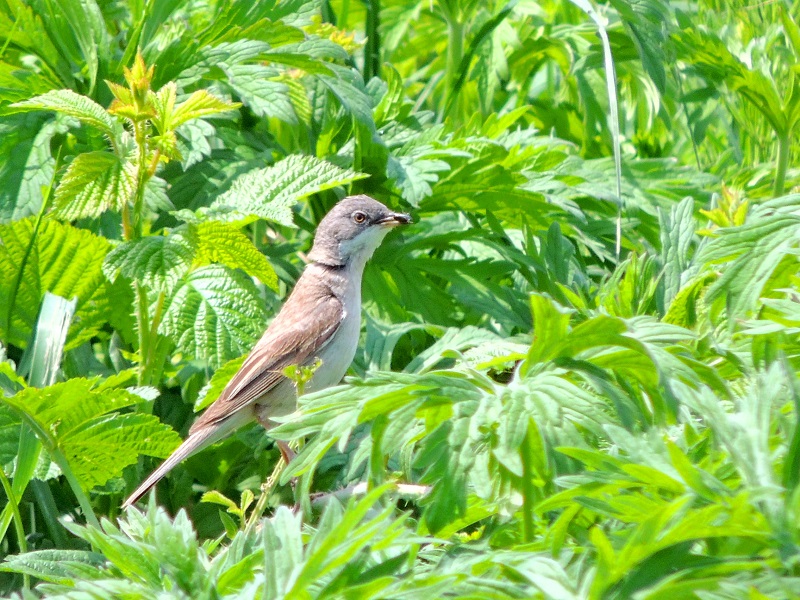
Rusty feather fringes on the wing and a strong white throat distinguish adults from Lesser Whitethroats. A singing male may fluff its throat feathers, making the white patch momentarily more prominent.
Sources: Slovak Wikipedia · English Wikipedia · BTO BirdFacts
Sign in to send private feedback on the text to our editors.
Explore further
Overview and identification
Descriptions, identification and names.
- Slovak Wikipedia ↗
Taxon account in Slovak: distribution, biology and references for further reading.
https://sk.wikipedia.org/wiki/Penica_oby%C4%8Dajn%C3%A1 - English Wikipedia ↗
Taxon account in English: distribution, biology and taxonomic context.
https://en.wikipedia.org/wiki/Common_whitethroat - BTO BirdFacts ↗
Biology and identification in English; population figures and trends refer to Britain.
https://www.bto.org/learn/about-birds/birdfacts/whitethroat - Bird.watching: Common Whitethroat – identification and voice ↗
Slovak species lesson with identification features and an example vocalisation.
https://bird.watching.sk/sk/penica-obycajna-sylvia-communis/
Sounds, photographs and video
Recordings and visual comparisons.
- BTO: identifying Whitethroat and Lesser Whitethroat ↗
English comparative identification video covering appearance and vocalisations.
https://www.bto.org/learn/skills/bird-identification/videos/whitethroat-lesser-whitethroat


