


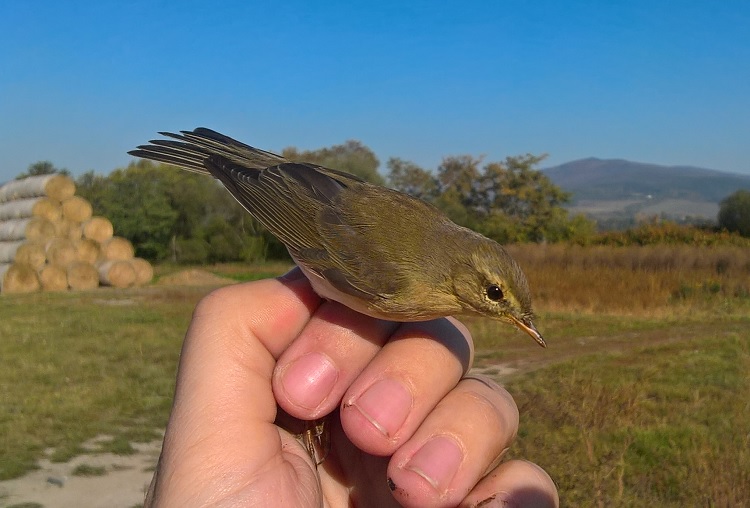
Phylloscopus trochilus · kolibiarik spevavý · Willow Warbler
Alternative and historical names
Slovak names
- kolibiarik spevavý (Kovalik 2010)
- kolibiarik väčší (Kovalik 2010)
- kolibkárik spevavý (Kovalik 2010)
- kolibkárik spevavý (Matoušek 1990)
English names
- Willow Warbler (IOC 2.5 2010)
- Willow-Warbler (BOU 1923)
Scientific names
- Phylloscopus trochilus (AviList 2026)
- Phylloscopus trochilus (IOC 15.2 2026)
- Phylloscopus trochilus (IOC 2.5 2010)
- Phylloscopus trochilus (BOU 1923)
Taxonomic synonyms
- Motacilla fitis (Bechstein, 1793)
- Phylloscopus trochilus fitis (Bechstein, 1793)
- Motacilla trochilus (Linnaeus, 1758)
- Phylloscopus trochilus (Linnaeus, 1758)
Birding Slovakia database
This species through our community’s eyes
Species characteristics in Slovakia
- General occurrence
- migrant / M
- Breeding
- common nidificant / Nc
- Migration
- common transmigrant / Tc
- Rarities committee:
- Does not require any reporting or registration by Raritties commitee
Observation map

Detailed species observation statistics

Source: the Birding.sk database. Counts reflect observer contributions, not population size.
About this species
Distribution
It breeds in northern and temperate Europe and across Asia to eastern Siberia, wintering in sub-Saharan Africa. In Slovakia it is both a regular breeder from lowlands to mountains and a common migrant. It arrives in spring, usually later than Common Chiffchaff, and leaves in late summer and autumn. Regular Slovak wintering is not expected.
Habitat
It prefers young open woods, birch stands, willows, scrub and edges with dense ground cover, using dwarf pine in mountains. Suitability changes as woodland develops: young scrub with undergrowth offers different conditions from later closed mature forest.
Breeding
The female builds a domed nest with a side entrance on the ground beneath grass, beside a stump or in low cover. A typical clutch contains 5–7 eggs. She incubates, parents feed the chicks and usually raise one brood.
Food
Insects, larvae and other small invertebrates are gleaned from leaves and fine branches, often from leaf undersides and sometimes while briefly hovering.
Interesting fact
Its soft descending song differs markedly from the Chiffchaff's regular alternating notes. Silent birds are very similar, requiring several features to be assessed together rather than relying entirely on leg colour.
Sources: Slovak Wikipedia · English Wikipedia · BTO BirdFacts
Sign in to send private feedback on the text to our editors.
Explore further
Overview and identification
Descriptions, identification and names.
- Slovak Wikipedia ↗
Taxon account in Slovak: distribution, biology and references for further reading.
https://sk.wikipedia.org/wiki/Kolibiarik_spevav%C3%BD - English Wikipedia ↗
Taxon account in English: distribution, biology and taxonomic context.
https://en.wikipedia.org/wiki/Willow_warbler - BTO BirdFacts ↗
Biology and identification in English; population figures and trends refer to Britain.
https://www.bto.org/learn/about-birds/birdfacts/willow-warbler - Bird.watching: Willow Warbler – identification and voice ↗
Slovak species lesson with identification features and an example vocalisation.
https://bird.watching.sk/sk/kolibkarik-spevavy-phylloscopus-trochilus/
Sounds, photographs and video
Recordings and visual comparisons.
- BTO: identifying Chiffchaff and Willow Warbler ↗
English comparative identification video covering appearance and vocalisations.
https://www.bto.org/learn/skills/bird-identification/videos/willow-warbler-chiffchaff
























