


Ficedula albicollis · muchárik bielokrký · Collared Flycatcher
Alternative and historical names
Slovak names
- muchárik bielokrký (Kovalik 2010)
- muchárik belokrký (Kovalik 2010)
- muchárik bielokrký (Matoušek 1990)
English names
- Collared Flycatcher (IOC 2.5 2010)
- White-collared Flycatcher (BOU 1923)
Scientific names
- Ficedula albicollis (AviList 2026)
- Ficedula albicollis (IOC 15.2 2026)
- Ficedula albicollis (IOC 2.5 2010)
- Ficedula albicollis (BOU 1923)
Taxonomic synonyms
- Ficedula albicollis (Temminck, 1815)
- Muscicapa albicollis (Temminck, 1795)
Birding Slovakia database
This species through our community’s eyes
Species characteristics in Slovakia
- General occurrence
- migrant / M
- Breeding
- common nidificant / Nc
- Migration
- common transmigrant / Tc
- Rarities committee:
- Does not require any reporting or registration by Raritties commitee
Observation map

Detailed species observation statistics

Source: the Birding.sk database. Counts reflect observer contributions, not population size.
About this species
Distribution
It breeds chiefly in central and southeastern Europe, with isolated populations farther north, and winters in sub-Saharan Africa. In Slovakia it regularly and locally commonly nests in suitable deciduous woods. It arrives in April and May and leaves in late summer and autumn. Passage birds also appear in parks and gardens away from breeding territories.
Habitat
It favours mature oak, beech and floodplain forests with abundant cavities, also some orchards and large parks. Trees must supply both nest sites and food. Short sallies from branches into gaps between crowns help reveal birds.
Breeding
It uses natural and woodpecker-excavated holes and accepts suitable nest boxes. The female builds the nest and usually lays 4–7 bluish eggs. She incubates and both parents feed the young. Cavity shortage can limit occupation of otherwise suitable forest.
Food
It catches flying insects and gleans invertebrates from leaves and branches. Soft larvae and caterpillars in the canopy are important when feeding chicks.
Interesting fact
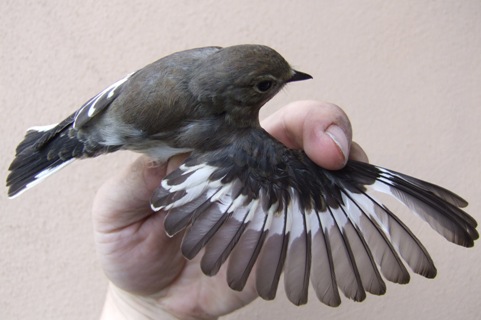
Adult males show a complete white collar and large white wing patches. Females and juveniles are harder to separate from European Pied Flycatchers, requiring a combination of plumage pattern, proportions and voice.
Sources: Slovak Wikipedia · English Wikipedia · BTO BirdFacts
Sign in to send private feedback on the text to our editors.
Explore further
Overview and identification
Descriptions, identification and names.
- Slovak Wikipedia ↗
Taxon account in Slovak: distribution, biology and references for further reading.
https://sk.wikipedia.org/wiki/Much%C3%A1rik_bielokrk%C3%BD - English Wikipedia ↗
Taxon account in English: distribution, biology and taxonomic context.
https://en.wikipedia.org/wiki/Collared_flycatcher - BTO BirdFacts ↗
Biology and identification in English; population figures and trends refer to Britain.
https://www.bto.org/learn/about-birds/birdfacts/collared-flycatcher
Data and research
Occurrences, distribution and research.
- Tichodroma: Collared Flycatcher laying dates ↗
Slovak study of species breeding phenology during 2001–2020.
https://www.tichodroma.sk/pdfs/34/Tichodroma_34_4_balaz.pdf - ŠOP SR: Collared Flycatcher – morphology and ecology ↗
Slovak state nature-conservation atlas with species morphology and ecology.
https://www.biomonitoring.sk/Registration/AtlasAnimal/Detail/48714


