Ficedula hypoleuca · muchárik čiernohlavý · European Pied Flycatcher
Alternative and historical names
Slovak names
- muchárik čiernohlavý (Kovalik 2010)
- muchárik černohlavý (Kovalik 2010)
- muchárik čiernohlavý (Matoušek 1990)
English names
- European Pied Flycatcher (IOC 2.5 2010)
- Pied Flycatcher (BOU 1923)
Scientific names
- Ficedula hypoleuca (AviList 2026)
- Ficedula hypoleuca (IOC 15.2 2026)
- Ficedula hypoleuca (IOC 2.5 2010)
- Ficedula hypoleuca (BOU 1923)
Taxonomic synonyms
- Motacilla hypoleuca (Pallas, 1764)
- Muscicapa hypoleuca (Pallas, 1764)
- Ficedula hypoleuca (Pallas, 1764)
Birding Slovakia database
This species through our community’s eyes
Species characteristics in Slovakia
- General occurrence
- migrant / M
- Breeding
- rare nidificant / Nr
- Migration
- common transmigrant / Tc
- Rarities committee:
- Does not require any reporting or registration by Raritties commitee
Conservation — Red Lists
- Slovakia 2023breeding population
- Breeding population Period: 2013–2023 Source: Demko M. a kol. 2025: Červený zoznam vtákov Slovenska: aktualizácia 2013 – 2023. Tichodroma 37: 107–117. Online 18. 1. 2026. DOI: 10.31577/tichodroma.2025.37.18. Výsledky, s. 112, výslovne menovaný druh Druh uvedený v texte ako jediný DD.
Observation map

Detailed species observation statistics

Source: the Birding.sk database. Counts reflect observer contributions, not population size.
About this species
Distribution
It breeds in Europe, northwestern Africa and western Asia and winters chiefly in tropical Africa. In Slovakia it is much more frequent on spring and autumn passage than as a breeder. Nesting is rare and local, especially in suitable mountain and foothill forests. It arrives in spring and leaves in late summer and autumn, without regular wintering.
Habitat
Breeding requires woodland with cavities, including Slovak mixed mountain forests. Migrants use gardens, parks and many small woods. Space between branches for hunting is important; a still bird often reveals itself only by a short feeding flight.
Breeding
It nests in natural or woodpecker holes and also uses boxes. The female usually lays 5–7 bluish eggs and incubates alone. Both parents bring food, though male assistance can be affected by pairing with another female.
Food
It catches insects in flight and gleans them from vegetation, also taking other small arthropods. Migrants may repeatedly use the same canopy hunting perches.
Interesting fact
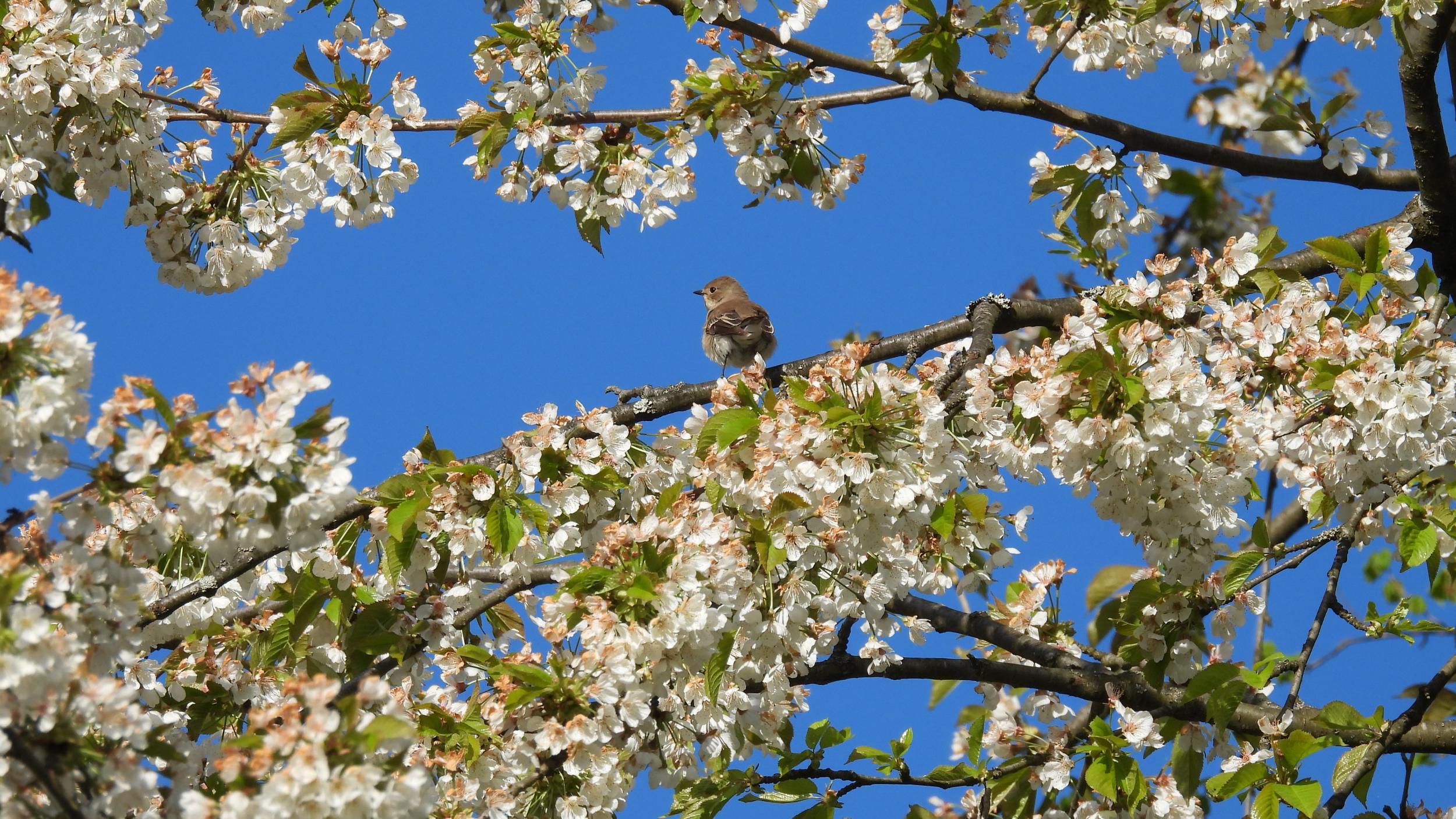
Males are not uniformly black: some have grey-brown backs. Absence of a complete white collar and details of the wing pattern are therefore more useful than simply expecting a black-and-white bird, especially outside spring.
Sources: Slovak Wikipedia · English Wikipedia · BTO BirdFacts
Sign in to send private feedback on the text to our editors.
Explore further
Overview and identification
Descriptions, identification and names.
- Slovak Wikipedia ↗
Taxon account in Slovak: distribution, biology and references for further reading.
https://sk.wikipedia.org/wiki/Much%C3%A1rik_%C4%8Diernohlav%C3%BD - English Wikipedia ↗
Taxon account in English: distribution, biology and taxonomic context.
https://en.wikipedia.org/wiki/European_pied_flycatcher - BTO BirdFacts ↗
Biology and identification in English; population figures and trends refer to Britain.
https://www.bto.org/learn/about-birds/birdfacts/pied-flycatcher