


Panurus biarmicus · fúzatka trstinová · Bearded Reedling
Alternative and historical names
Slovak names
- fúzatka trstinová (Kovalik 2010)
- fúzatka trsťová (Kovalik 2010)
- sýkorka fúzatá (Kovalik 2010)
- fúzatka trsťová (Matoušek 1990)
- fúzatka trstinová (Ferianc 1958)
English names
- Bearded Reedling (IOC 2.5 2010)
- Bearded Titmouse (BOU 1923)
Scientific names
- Panurus biarmicus (AviList 2026)
- Panurus biarmicus (IOC 15.2 2026)
- Panurus biarmicus (IOC 2.5 2010)
- Panurus biarmicus (BOU 1923)
Taxonomic synonyms
- Parus biarmicus (Linnaeus, 1758)
- Panurus biarmicus (Linnaeus, 1758)
Birding Slovakia database
This species through our community’s eyes
Species characteristics in Slovakia
- General occurrence
- some are resident, some are migratory / R+M
- Breeding
- uncommon nidificant / Nu
- Migration
- uncommon transmigrant / Tu
- Wintering
- uncommon wintering / Wu
- Rarities committee:
- Does not require any reporting or registration by Raritties commitee
Conservation — Red Lists
- Slovakia 2023breeding population
- Breeding population Period: 2013–2023 Source: Demko M. a kol. 2025: Červený zoznam vtákov Slovenska: aktualizácia 2013 – 2023. Tichodroma 37: 107–117. Online 18. 1. 2026. DOI: 10.31577/tichodroma.2025.37.18. Príloha 1, s. 117, riadok 66, stĺpec 6 Criteria: C1, D1 Category downgraded by 1 level due to surrounding populations.
- Europe 2021
- Population scope unspecified Source: BirdLife International 2021: European Red List of Birds. Publications Office of the European Union, Luxembourg. Reported in: Demko M. a kol. 2025: Červený zoznam vtákov Slovenska: aktualizácia 2013 – 2023. Tichodroma 37: 107–117. Online 18. 1. 2026. DOI: 10.31577/tichodroma.2025.37.18. Príloha 1, s. 117, riadok 66, stĺpec 4
- World 2025
- Species Source: BirdLife International 2025: Species factsheets. Citované v Demko a kol. 2025, prístup 16. 4. 2025. Reported in: Demko M. a kol. 2025: Červený zoznam vtákov Slovenska: aktualizácia 2013 – 2023. Tichodroma 37: 107–117. Online 18. 1. 2026. DOI: 10.31577/tichodroma.2025.37.18. Príloha 1, s. 117, riadok 66, stĺpec 3
Previous assessments
- Slovakia 2013
- Breeding population Period: 2002–2012 Source: Demko M., Krištín A. & Pačenovský S. 2014: Červený zoznam vtákov Slovenska. SOS/BirdLife Slovensko, Bratislava. Zdroj stĺpca SK 2013 podľa poznámky 5 prílohy Demko a kol. 2025. Reported in: Demko M. a kol. 2025: Červený zoznam vtákov Slovenska: aktualizácia 2013 – 2023. Tichodroma 37: 107–117. Online 18. 1. 2026. DOI: 10.31577/tichodroma.2025.37.18. Príloha 1, s. 117, riadok 66, stĺpec 5 Category downgraded by 1 level due to surrounding populations.
Observation map

Detailed species observation statistics

Source: the Birding.sk database. Counts reflect observer contributions, not population size.
About this species
Distribution
It occupies temperate Eurasian reed wetlands from Europe to eastern Asia. In Slovakia it is a local breeder in larger lowland wetlands and winters at suitable sites. Numbers can fluctuate markedly: some birds remain while others disperse beyond their natal reedbeds. One winter flock does not establish year-round occupation by the same group.
Habitat
It favours extensive reeds with dense lower cover and old stems, often beside open water. Small vocal flocks may appear on stem tops in autumn and winter. In windy conditions they hide deep in the vegetation and become harder to detect.
Breeding
The cup nest is attached low among wetland plants. A typical clutch contains 4–8 eggs; both parents incubate and feed the young. Several broods may be raised in a favourable year, though not every attempt succeeds.
Food
Summer food is chiefly insects and other invertebrates. In winter it switches mainly to seeds of reeds and other wetland plants, taken from seedheads and the ground.
Interesting fact
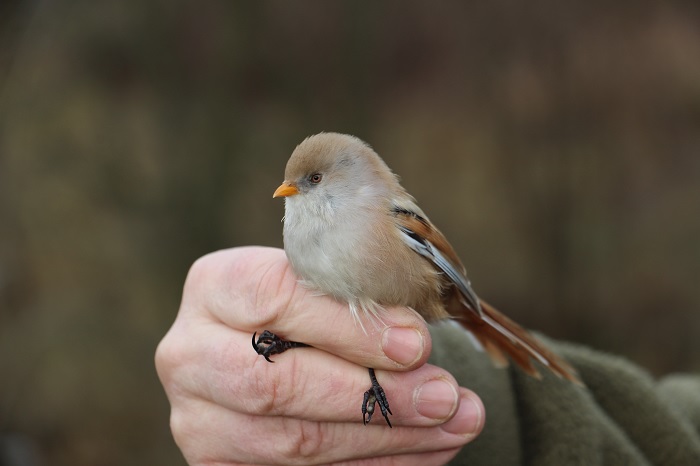
The digestive system adjusts to this seasonal change. Small swallowed stones help grind hard seeds; the black moustaches on a grey head belong only to males.
Sources: Slovak Wikipedia · English Wikipedia · BTO BirdFacts
Sign in to send private feedback on the text to our editors.
Explore further
Overview and identification
Descriptions, identification and names.
- Slovak Wikipedia ↗
Taxon account in Slovak: distribution, biology and references for further reading.
https://sk.wikipedia.org/wiki/F%C3%BAzatka_trstinov%C3%A1 - English Wikipedia ↗
Taxon account in English: distribution, biology and taxonomic context.
https://en.wikipedia.org/wiki/Bearded_reedling - BTO BirdFacts ↗
Biology and identification in English; population figures and trends refer to Britain.
https://www.bto.org/learn/about-birds/birdfacts/bearded-tit - Bird.watching: Bearded Reedling – identification and voice ↗
Slovak species lesson with identification features and an example vocalisation.
https://bird.watching.sk/sk/fuzatka-trstinova-panurus-biarmicus/
Data and research
Occurrences, distribution and research.
- Slovak Red List: Bearded Reedling ↗
Species entry in Appendix1,p.59 (2023 assessment).
https://www.tichodroma.sk/pdfs/37/Tichodroma_37_18_Demko.pdf#page=11


