


Coloeus monedula · kavka tmavá · Western Jackdaw
Alternative and historical names
Slovak names
- kavka tmavá (Kovalik 2010)
- kavka obyčajná (Kovalik 2010)
- kavka tmavá (Matoušek 1990)
English names
- Western Jackdaw (IOC 2.5 2010)
- Jackdaw (BOU 1923)
Scientific names
- Coloeus monedula (AviList 2026)
- Coloeus monedula (IOC 15.2 2026)
- Coloeus monedula (IOC 2.5 2010)
- Corvus monedula (BOU 1923)
Taxonomic synonyms
- Coelus monedula (Linnaeus, 1758)
- Corvus monedula (Linnaeus, 1758)
- Coloeus monedula (Linnaeus, 1758)
Birding Slovakia database
This species through our community’s eyes
Species characteristics in Slovakia
- General occurrence
- mainly resident, minority is migratory / R(M)
- Breeding
- common nidificant / Nc
- Migration
- common transmigrant / Tc
- Wintering
- common wintering / Wc
- Rarities committee:
- Does not require any reporting or registration by Raritties commitee
Observation map

Detailed species observation statistics

Source: the Birding.sk database. Counts reflect observer contributions, not population size.
About this species
Distribution
The Jackdaw occurs across Europe, north-western Africa and parts of western Asia. Slovakia lies within its European range. It breeds regularly, especially in lowlands and basins, although its distribution depends on suitable cavities. It is present throughout the year; in autumn and winter, local birds mix with visitors from farther north.
Habitat
Look around old buildings, churches, ruins, cliffs and hollow trees. Jackdaws forage on lawns, pastures and fields. Outside the breeding season they often associate with Rooks and gather in large communal roosts.
Breeding
It nests in tree cavities, rock crevices, chimneys and holes in buildings, often in small colonies. The nest is lined with soft material. Usually 4–5 eggs are laid, and both parents feed the young.
Food
An omnivore, it takes insects and other invertebrates, seeds, grain and accessible food scraps. Animal food is important when raising chicks.
Interesting fact
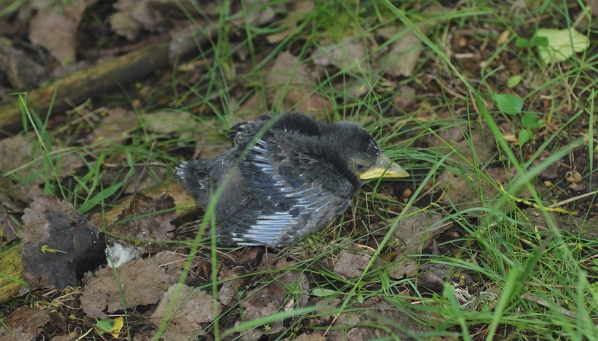
The Jackdaw’s pale eye becomes striking at close range. Adults have a silvery iris, while young birds have bluish eyes: the apparently plain black bird carries a useful clue to its age.
Sources: Slovak Wikipedia · English Wikipedia · BTO BirdFacts
Sign in to send private feedback on the text to our editors.
Explore further
Overview and identification
Descriptions, identification and names.
- Slovak Wikipedia ↗
Taxon account in Slovak: distribution, biology and references for further reading.
https://sk.wikipedia.org/wiki/Kavka_tmav%C3%A1 - English Wikipedia ↗
Taxon account in English: distribution, biology and taxonomic context.
https://en.wikipedia.org/wiki/Western_jackdaw - BTO BirdFacts ↗
Biology and identification in English; population figures and trends refer to Britain.
https://www.bto.org/learn/about-birds/birdfacts/jackdaw
Sounds, photographs and video
Recordings and visual comparisons.
- BTO: identifying dark corvids ↗
English comparative identification video covering appearance and vocalisations.
https://www.bto.org/learn/skills/bird-identification/videos/corvids
























