


Linaria cannabina · stehlík konôpka · Common Linnet
Alternative and historical names
Slovak names
- stehlík konôpka (Kovalik 2010)
- konôpka obyčajná (Kovalik 2010)
- stehlík konopiar (konôpka) (Kovalik 2010)
- stehlík konopiar (Kovalik 2010)
- stehlík konôpkár (konôpka) (Kovalik 2010)
- stehlík konôpkár (Kovalik 2010)
- stehlík konopiar (Matoušek 1990)
English names
- Common Linnet (IOC 2.5 2010)
- Linnet (BOU 1923)
Scientific names
- Linaria cannabina (AviList 2026)
- Linaria cannabina (IOC 15.2 2026)
- Carduelis cannabina (IOC 2.5 2010)
- Acanthis cannabina (BOU 1923)
Taxonomic synonyms
- Acanthis cannabina (Linnaeus, 1758)
- Carduelis cannabina (Linnaeus, 1758)
- Fringilla cannabina (Linnaeus, 1758)
- Linaria cannabina (Linnaeus, 1758)
Birding Slovakia database
This species through our community’s eyes
Species characteristics in Slovakia
- General occurrence
- some are resident, some are migratory / R+M
- Breeding
- common nidificant / Nc
- Migration
- common transmigrant / Tc
- Wintering
- common wintering / Wc
- Rarities committee:
- Does not require any reporting or registration by Raritties commitee
Observation map
Detailed species observation statistics

Source: the Birding.sk database. Counts reflect observer contributions, not population size.
About this species
Distribution
The Linnet occurs in Europe, northern Africa and western parts of Asia. In Slovakia it is a widespread open-country breeder, from lowlands to mountain basins. Some birds migrate for winter, while others remain or wander in search of food. Winter flocks can be locally numerous rather than evenly distributed across the landscape.
Habitat
It favours pastures, fallow land, vineyards, field margins and garden edges with dense shrubs. Nest cover must be combined with low seed-bearing vegetation. Outside breeding, inspect stubbles and uncultivated strips along fields.
Breeding
The nest of fine grass and roots is placed low in a dense shrub or young conifer. Usually 4–6 eggs are laid. Both parents care for the young, and pairs may breed repeatedly during the season.
Food
It is strongly seed-eating, taking seeds of herbs and grasses, often from the ground. Seeds also form a substantial part of the food brought to chicks.
Interesting fact
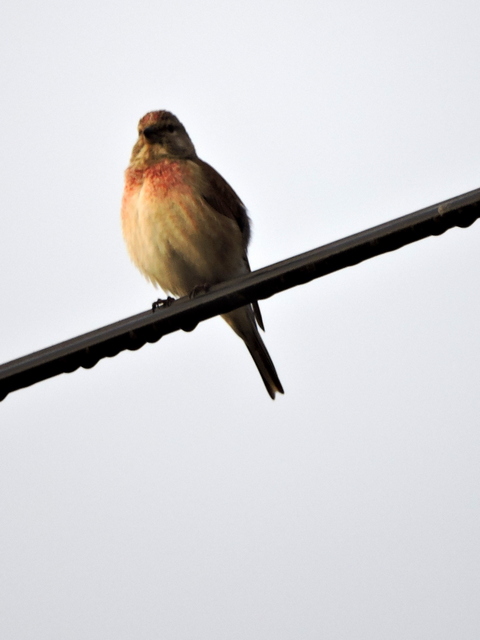
A male’s red forehead and breast become especially conspicuous in spring as pale feather fringes wear away. Its brighter breeding appearance therefore need not result from replacing all its plumage just before nesting.
Sources: Slovak Wikipedia · English Wikipedia · BTO BirdFacts
Sign in to send private feedback on the text to our editors.
Explore further
Overview and identification
Descriptions, identification and names.
- Slovak Wikipedia ↗
Taxon account in Slovak: distribution, biology and references for further reading.
https://sk.wikipedia.org/wiki/Stehl%C3%ADk_kon%C3%B4pka - English Wikipedia ↗
Taxon account in English: distribution, biology and taxonomic context.
https://en.wikipedia.org/wiki/Common_linnet - BTO BirdFacts ↗
Biology and identification in English; population figures and trends refer to Britain.
https://www.bto.org/learn/about-birds/birdfacts/linnet
Sounds, photographs and video
Recordings and visual comparisons.
- BTO: identifying Linnet and Twite ↗
English comparative identification video covering appearance and vocalisations.
https://www.bto.org/learn/skills/bird-identification/videos/linnet-and-twite


