


Larus michahellis · čajka žltonohá · Yellow-legged Gull
Alternative and historical names
Slovak names
- čajka žltonohá (Kovalik 2010)
English names
- Yellow-legged Gull (IOC 2.5 2010)
- Yellow-legged Herring-Gull (BOU 1923)
Scientific names
- Larus michahellis (AviList 2026)
- Larus michahellis (IOC 15.2 2026)
- Larus michahellis (IOC 2.5 2010)
- Larus michahellis (BOU 1923)
Taxonomic synonyms
- Larus argentatus michaellis (J.F.Naumann, 1840)
- Larus cachinnans michahellis (Naumann, 1840)
- Larus michaellis (Naumann, 1840)
- Larus michahelles (Naumann, 1840)
- Larus michahellis Naumann, JF, 1840
Birding Slovakia database
This species through our community’s eyes
Photographs by category
Species characteristics in Slovakia
- Breeding
- common nidificant / Nc
- Migration
- common transmigrant / Tc
- Wintering
- common wintering / Wc
- Rarities committee:
- Does not require any reporting or registration by Raritties commitee
Observation map
Detailed species observation statistics

Source: the Birding.sk database. Counts reflect observer contributions, not population size.
About this species
Distribution
The Yellow-legged Gull breeds mainly around the Mediterranean, the Atlantic and parts of central Europe. In Slovakia it occurs during dispersal, passage and winter and breeds locally. Its share of large-gull flocks varies with site and season. Older uses of “Caspian Gull” or the broader herring-gull complex therefore cannot be transferred uncritically to present species identification.
Habitat
It uses large waters, rivers, islands and surrounding fields, often in modified landscapes. In Slovakia it can be sought on reservoirs, ponds and river roosts alongside Caspian Gulls. Good light and views both standing and in flight are particularly helpful.
Breeding
The nest is placed on the ground, a rocky ledge or a roof, often in a colony. Usually three eggs are laid. Both parents incubate, defend the nesting area and feed the young until they gradually become independent.
Food
It catches fish and invertebrates and uses carrion, refuse and varied opportunistic food, obtained on water and land.
Interesting fact
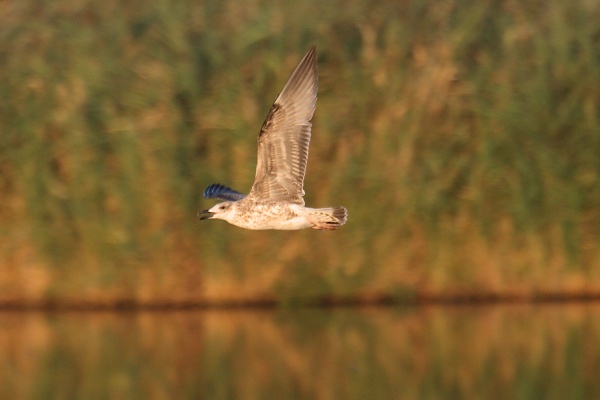
An adult’s yellow legs are useful but not sufficient for identification. Young birds lack strongly yellow legs, while some similar species can also have yellowish legs.
Sources: Slovak Wikipedia · English Wikipedia · BTO BirdFacts
Sign in to send private feedback on the text to our editors.
Explore further
Overview and identification
Descriptions, identification and names.
- Slovak Wikipedia ↗
Taxon account in Slovak: distribution, biology and references for further reading.
https://sk.wikipedia.org/wiki/%C4%8Cajka_%C5%BEltonoh%C3%A1 - English Wikipedia ↗
Taxon account in English: distribution, biology and taxonomic context.
https://en.wikipedia.org/wiki/Yellow-legged_gull - BTO BirdFacts ↗
Biology and identification in English; population figures and trends refer to Britain.
https://www.bto.org/learn/about-birds/birdfacts/yellow-legged-gull
Data and research
Occurrences, distribution and research.
- Gibbins et al.: Identification of Caspian Gull – Part 1 ↗
English identification paper (2010) comparing Caspian Gull with Herring and Yellow-legged Gulls across age classes.
https://gull-research.org/papers/papers5/Caspian-Gulls-part-1.pdf


