Phylloscopus collybita abietinus · kolibiarik škandinávsky · Common Chiffchaff ssp. abietinus
Alternative and historical names
Slovak names
- kolibiarik malý (Kovalik 2010)
- kolibkárik čipčavý (Kovalik 2010)
English names
No records yet.
Scientific names
- Phylloscopus collybita abietinus (AviList 2026)
- Phylloscopus collybita abietinus (IOC 15.2 2026)
Taxonomic synonyms
- Sylvia abietina (Nilsson, 1919)
- Phylloscopus collybita abietinus (Nilsson, 1819)
Birding Slovakia database
This species through our community’s eyes
Photographs by category
Species characteristics in Slovakia
- Migration
- rare transmigrant / Tr
- Rarities committee:
- Sighting of this specie should be reporter to Raritties Commitee
Observation map

Detailed species observation statistics

Source: the Birding.sk database. Counts reflect observer contributions, not population size.
About this species
Distribution
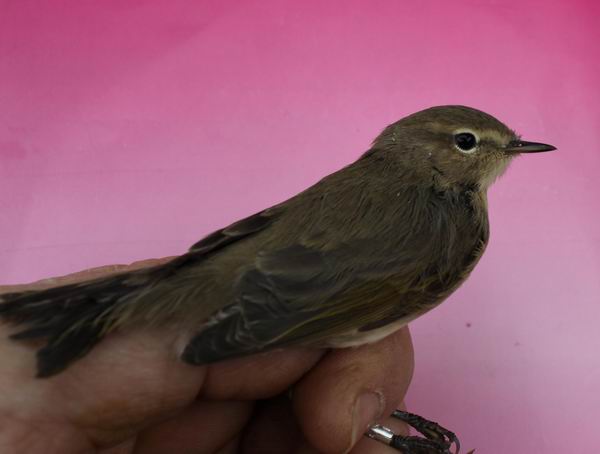
This card represents the Common Chiffchaff subspecies Phylloscopus collybita abietinus. It breeds mainly in Scandinavia and northern European Russia and winters from south-eastern Europe and north-eastern Africa to south-western Asia. It migrates through central Europe, but not every Slovak bird can be safely separated from the nominate subspecies. Identification difficulty therefore affects the frequency of assigned records.
Habitat
It inhabits woodland with undergrowth and forest edges. Migrants can use parks, floodplain woods, gardens and wetland scrub alongside other leaf warblers. Rather than seeking a particular shade of green, observe the bird for longer, record its voice and obtain several photographs.
Breeding
Nesting follows the basic biology of the species. An enclosed side-entrance nest is placed low in dense vegetation, usually holding 5–6 eggs. Breeding information from the northern range cannot be applied to a Slovak observation of an unidentified form.
Food
It takes small invertebrates from leaves and twigs, often hopping actively and occasionally making short aerial sallies.
Interesting fact
It tends to look greyer and less yellow than the nominate subspecies, but variation is substantial. Its voice resembles nominate birds, so a call alone usually does not establish subspecies identity.
Sources: BTO BirdFacts · English Wikipedia
Sign in to send private feedback on the text to our editors.
Explore further
Overview and identification
Descriptions, identification and names.
- BTO BirdFacts ↗
Biology and identification in English; population figures and trends refer to Britain.
https://www.bto.org/learn/about-birds/birdfacts/chiffchaff - English Wikipedia ↗
Taxon account in English: distribution, biology and taxonomic context.
https://en.wikipedia.org/wiki/Common_chiffchaff
Sounds, photographs and video
Recordings and visual comparisons.
- BTO: identifying Chiffchaff and Willow Warbler ↗
English comparative identification video covering appearance and vocalisations. Parent-species comparison; does not independently diagnose this subspecies.
https://www.bto.org/learn/skills/bird-identification/videos/willow-warbler-chiffchaff
Data and research
Occurrences, distribution and research.
- British Birds: identifying Siberian Chiffchaff ↗
English specialist identification paper on the Common Chiffchaff complex (2005).
https://britishbirds.co.uk/sites/default/files/pdf-store/V98_N08_P396_410_A001.pdf - Tichodroma: rare warbler records in Slovakia ↗
Slovak rarities report with specific taxon records from 2009.
https://www.tichodroma.sk/pdfs/Tichodroma_22.split/Tichodroma_22.131-134.pdf