


Branta ruficollis · bernikla červenokrká · Red-breasted Goose
Alternative and historical names
Slovak names
- červenokrčka pestrá (Kovalik 2010)
- hus červenokrká (Kovalik 2010)
- bernikla červenokrká (Kovalik 2010)
- bernikla červenokrká (Matoušek 1990)
- bernikla červenokrká (Ferianc 1986)
English names
- Red-breasted Goose (IOC 2.5 2010)
- Red-breasted Goose (BOU 1923)
Scientific names
- Branta ruficollis (AviList 2026)
- Branta ruficollis (IOC 15.2 2026)
- Branta ruficollis (IOC 2.5 2010)
- Branta ruficollis (BOU 1923)
Taxonomic synonyms
- Anas ruficollis (Pallas, 1769)
- Anser ruficollis (Pallas, 1769)
- Rufibrenta ruficollis (Pallas, 1769)
- Branta ruficollis (Pallas, 1769)
Birding Slovakia database
This species through our community’s eyes
Photographs by category
Species characteristics in Slovakia
- Migration
- rare transmigrant / Tr
- Wintering
- rare wintering / Wr
- Rarities committee:
- Sigthings of this specie are registered by Raritties commitee
Observation map

Detailed species observation statistics

Source: the Birding.sk database. Counts reflect observer contributions, not population size.
About this species
Distribution
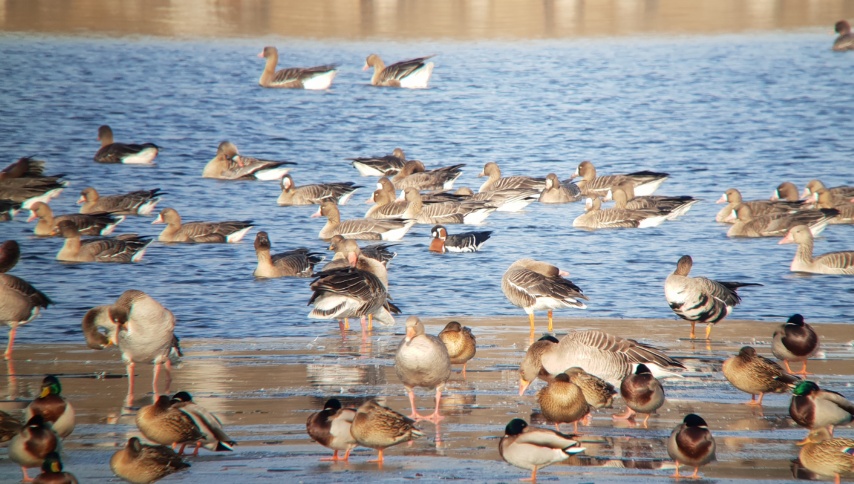
It breeds in Siberian tundra and winters mainly around the Black Sea. In Slovakia it is a rare but repeatedly recorded passage and winter visitor, especially among Greater White-fronted Geese. Breeding is not known here, and the summer presence of an individual also requires consideration of possible captive origin.
Habitat
On the breeding grounds it uses open tundra, slopes and small islands near water. Wintering birds graze steppe grassland and fields. In Slovakia, check lowland feeding areas of large goose flocks and their water roosts; patiently scanning the flock is more useful than looking for an isolated colourful bird.
Breeding
It nests on the ground, often in small colonies. The female incubates and both parents accompany the young. Nests may lie close to breeding raptors, which drive off terrestrial predators.
Food
Grasses, herbs, leaves and seeds dominate the diet. In winter it often uses winter cereals and other crops.
Interesting fact
Nesting beside a Peregrine Falcon may sound risky, but it can protect the geese from foxes. This is not a risk-free partnership: the benefit arises chiefly because the falcon defends the surroundings of its own nest.
Sources: Slovak Wikipedia · English Wikipedia · BTO BirdFacts
Sign in to send private feedback on the text to our editors.
Explore further
Overview and identification
Descriptions, identification and names.
- Slovak Wikipedia ↗
Taxon account in Slovak: distribution, biology and references for further reading.
https://sk.wikipedia.org/wiki/Bernikla_%C4%8Dervenokrk%C3%A1 - English Wikipedia ↗
Taxon account in English: distribution, biology and taxonomic context.
https://en.wikipedia.org/wiki/Red-breasted_goose - BTO BirdFacts ↗
Biology and identification in English; population figures and trends refer to Britain.
https://www.bto.org/learn/about-birds/birdfacts/red-breasted-goose
Data and research
Occurrences, distribution and research.
- AEWA: Red-breasted Goose conservation action plan ↗
English AEWA conservation action plan for Red-breasted Goose, Technical Series 46, published in 2012.
https://www.unep-aewa.org/publication/international-single-species-action-plan-conservation-red-breasted-goose-ts-no-46
























