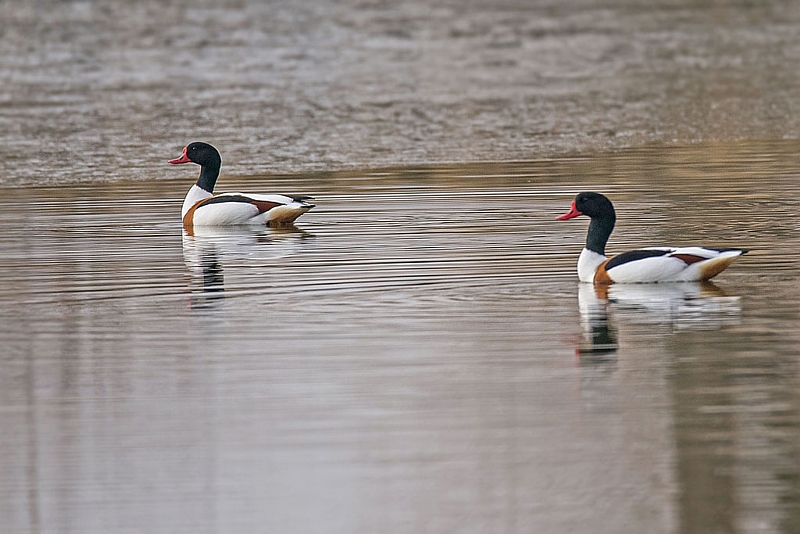
Tadorna tadorna · kazarka pestrá · Common Shelduck
Alternative and historical names
Slovak names
- kazarka pestrá (Kovalik 2010)
- hus morská (Kovalik 2010)
- húska pestrá (Kovalik 2010)
- kazarka pestrá (Matoušek 1990)
- húska pestrá (Ferianc 1986)
English names
- Common Shelduck (IOC 2.5 2010)
- Common Sheld-Duck (BOU 1923)
Scientific names
- Tadorna tadorna (AviList 2026)
- Tadorna tadorna (IOC 15.2 2026)
- Tadorna tadorna (IOC 2.5 2010)
- Tadorna tadorna (BOU 1923)
Taxonomic synonyms
- Anas tadorna (Linnaeus, 1758)
- Tadorna tadorna (Linnaeus, 1758)
Birding Slovakia database
This species through our community’s eyes
Photographs by category
Species characteristics in Slovakia
- General occurrence
- mainly resident, minority is migratory / R(M)
- Breeding
- rare nidificant / Nr
- Migration
- uncommon transmigrant / Tu
- Wintering
- uncommon wintering / Wu
- Rarities committee:
- Does not require any reporting or registration by Raritties commitee
Conservation — Red Lists
- Slovakia 2023breeding population
- Breeding population Period: 2013–2023 Source: Demko M. a kol. 2025: Červený zoznam vtákov Slovenska: aktualizácia 2013 – 2023. Tichodroma 37: 107–117. Online 18. 1. 2026. DOI: 10.31577/tichodroma.2025.37.18. Výsledky, s. 112, výslovne menovaný druh Druh uvedený v texte medzi 19 druhmi NA.
Observation map

Detailed species observation statistics

Source: the Birding.sk database. Counts reflect observer contributions, not population size.
About this species
Distribution
It ranges from European and North African coasts to inland parts of Asia. In Europe it also occupies freshwater wetlands far from the sea. In Slovakia it is a scarce passage visitor, locally present in winter, and a rare breeder. The first breeding was documented in 2006, and its occurrence remains strongly local.
Habitat
It favours shallow water with muddy or sandy bottoms, exposed shores and open wetlands. In Slovakia, look on fishponds, gravel pits, reservoirs and flooded areas. Deep water without accessible shallows mainly offers a resting place rather than its principal feeding habitat.
Breeding
It hides its nest in a burrow, cavity or other sheltered space, sometimes away from water. The female incubates, while both parents lead and protect the ducklings. The young gather their own food soon after hatching.
Food
It takes small aquatic invertebrates, especially molluscs, crustaceans and insect larvae, as well as some plant material, sifting soft substrate for food.
Interesting fact
Ducklings from several pairs may join a communal group watched over by a few adults. Such a 'crèche' can look like an impossibly large family, although the young belong to several sets of parents.
Sources: Slovak Wikipedia · English Wikipedia · BTO BirdFacts
Sign in to send private feedback on the text to our editors.
Explore further
Overview and identification
Descriptions, identification and names.
- Slovak Wikipedia ↗
Taxon account in Slovak: distribution, biology and references for further reading.
https://sk.wikipedia.org/wiki/Kazarka_pestr%C3%A1 - English Wikipedia ↗
Taxon account in English: distribution, biology and taxonomic context.
https://en.wikipedia.org/wiki/Common_shelduck - BTO BirdFacts ↗
Biology and identification in English; population figures and trends refer to Britain.
https://www.bto.org/learn/about-birds/birdfacts/shelduck