


Mergellus albellus · potápač malý · Smew
Alternative and historical names
Slovak names
- potápač malý (Kovalik 2010)
- potápač biely (Kovalik 2010)
- potápač biely (Matoušek 1990)
- potápač malý (Ferianc 1986)
- potápač malý (Ferianc 1958)
English names
- Smew (IOC 2.5 2010)
- Smew (BOU 1923)
Scientific names
- Mergellus albellus (AviList 2026)
- Mergellus albellus (IOC 15.2 2026)
- Mergellus albellus (IOC 2.5 2010)
- Mergellus albellus (BOU 1923)
Taxonomic synonyms
- Mergus albellus (Aerc Tac, 2003)
- Mergus albellus albellus (Cramp & Simmons, 1977-1994)
- Mergullus albellus (Linnaeus, 1758)
- Mergus albellus (Linnaeus, 1758)
- Mergellus albellus (Linnaeus, 1758)
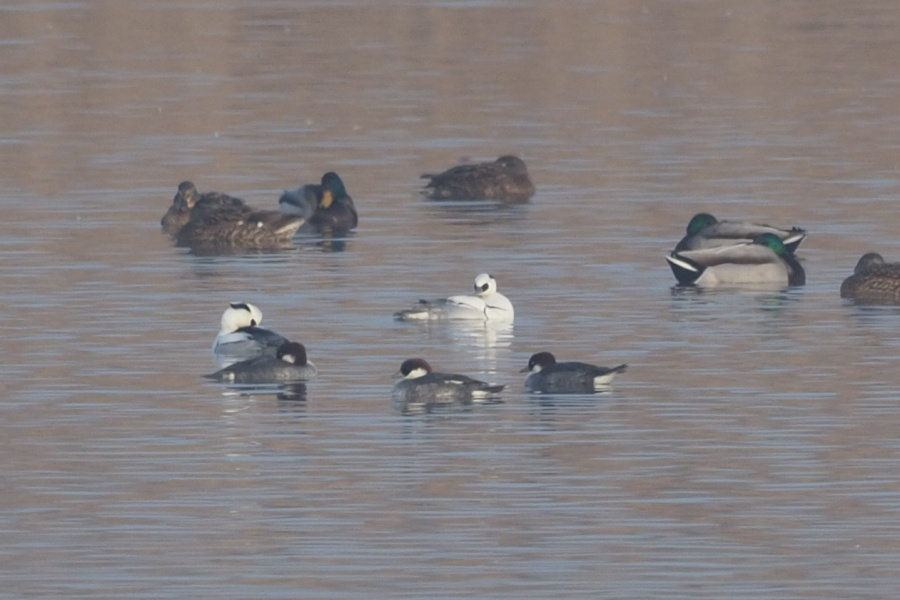
Birding Slovakia database
This species through our community’s eyes
Photographs by category
Species characteristics in Slovakia
- Migration
- uncommon transmigrant / Tu
- Wintering
- uncommon wintering / Wu
- Rarities committee:
- Does not require any reporting or registration by Raritties commitee
Observation map
Detailed species observation statistics

Source: the Birding.sk database. Counts reflect observer contributions, not population size.
About this species
Distribution
It breeds in boreal forests of northern Europe and Asia and winters farther south in Europe and eastern Asia. In Slovakia it is a regular but scarce winter visitor and passage migrant, occurring mainly from autumn to spring. It is not a Slovak breeder. Numbers are also influenced by freezing conditions farther north.
Habitat
Its breeding habitats include forest lakes and quieter rivers with cavity-bearing trees. In Slovakia, look on large rivers, reservoirs and sheltered bays. It often stays in small groups, and inconspicuous females and young birds can easily be overlooked.
Breeding
It nests in tree cavities, often old woodpecker holes. The female incubates and accompanies the young, which leave the cavity soon after hatching. Suitable holes near water are therefore part of its breeding requirements, although Slovak observers mainly know it from open water.
Food
It catches small fish and aquatic invertebrates by diving. The balance of prey changes with season and habitat.
Interesting fact
The black-and-white male is conspicuous, but a rusty-headed bird is not necessarily a female. Young males wear a similar plumage, so winter counts should not automatically classify every 'redhead' as female.
Sources: Slovak Wikipedia · English Wikipedia · BTO BirdFacts
Sign in to send private feedback on the text to our editors.
Explore further
Overview and identification
Descriptions, identification and names.
- Slovak Wikipedia ↗
Taxon account in Slovak: distribution, biology and references for further reading.
https://sk.wikipedia.org/wiki/Pot%C3%A1pa%C4%8D_mal%C3%BD - English Wikipedia ↗
Taxon account in English: distribution, biology and taxonomic context.
https://en.wikipedia.org/wiki/Smew - BTO BirdFacts ↗
Biology and identification in English; population figures and trends refer to Britain.
https://www.bto.org/learn/about-birds/birdfacts/smew - BTO: Identifying Goosanders, Red-breasted Mergansers and Smew ↗
English identification video comparing this taxon with similar species and explaining distinguishing features.
https://www.bto.org/learn/skills/bird-identification/videos/goosander-and-red-breasted-merganser


