


Podiceps auritus · potápka ušatá · Horned Grebe
Alternative and historical names
Slovak names
- potápka ušatá (Kovalik 2010)
- potápka ušatá (Matoušek 1990)
English names
- Horned Grebe (IOC 2.5 2010)
- Slavonian or Eared Grebe (BOU 1923)
Scientific names
- Podiceps auritus (AviList 2026)
- Podiceps auritus (IOC 15.2 2026)
- Podiceps auritus (IOC 2.5 2010)
- Podiceps auritus (BOU 1923)
Taxonomic synonyms
- Podicipes auritus (Linnaeus, 1758)
- Colymbus auritus (Linnaeus, 1758)
- Podiceps auritus (Linnaeus, 1758)
Birding Slovakia database
This species through our community’s eyes
Photographs by category
Species characteristics in Slovakia
- Migration
- rare transmigrant / Tr
- Wintering
- rare wintering / Wr
- Rarities committee:
- Sigthings of this specie are registered by Raritties commitee
Observation map

Detailed species observation statistics

Source: the Birding.sk database. Counts reflect observer contributions, not population size.
About this species
Distribution
It breeds in northern Eurasia and North America. It does not breed in Slovakia, but small numbers occur on passage and it is a rare winter visitor. It is worth looking for during autumn and winter checks of large water bodies, although regular sightings at any particular site cannot be expected.
Habitat
Its breeding habitats include smaller lakes and vegetated wetlands, while wintering birds mainly use coastal waters. In Slovakia it rests and feeds on reservoirs, gravel pits and larger rivers. On open water it can be inconspicuous and easily overlooked among other grebes.
Breeding
The nest of aquatic plants is attached to vegetation in shallow water. Partners perform elaborate shared displays before breeding, and both care for the brood. Chicks leave the nest soon after hatching.
Food
In summer it catches many aquatic insects and other invertebrates. Fish and crustaceans taken by diving become more important in winter.
Interesting fact
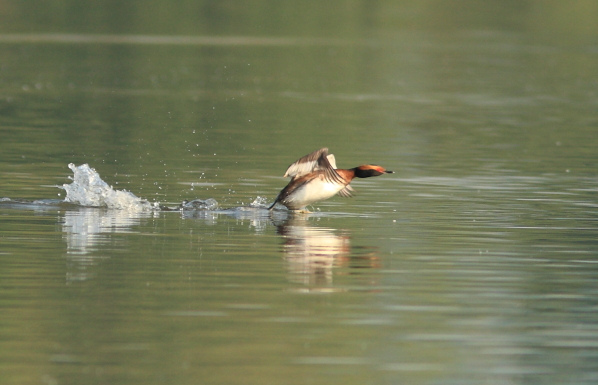
The golden feather ornaments beside the head resemble ears or horns, explaining its various common names. They disappear in winter plumage, when the bird shows a sharp contrast between its dark crown and white cheeks.
Sources: Slovak Wikipedia · English Wikipedia · BTO BirdFacts
Sign in to send private feedback on the text to our editors.
Explore further
Overview and identification
Descriptions, identification and names.
- Slovak Wikipedia ↗
Taxon account in Slovak: distribution, biology and references for further reading.
https://sk.wikipedia.org/wiki/Pot%C3%A1pka_u%C5%A1at%C3%A1 - English Wikipedia ↗
Taxon account in English: distribution, biology and taxonomic context.
https://en.wikipedia.org/wiki/Horned_grebe - BTO BirdFacts ↗
Biology and identification in English; population figures and trends refer to Britain.
https://www.bto.org/learn/about-birds/birdfacts/slavonian-grebe - BTO: Identifying small breeding grebes ↗
English identification video comparing this taxon with similar species and explaining distinguishing features.
https://www.bto.org/learn/skills/bird-identification/videos/small-breeding-grebes - BTO: Identifying winter grebes: Great Crested, Slavonian and Black-necked ↗
English identification video comparing this taxon with similar species and explaining distinguishing features.
https://www.bto.org/learn/skills/bird-identification/videos/winter-grebes


