


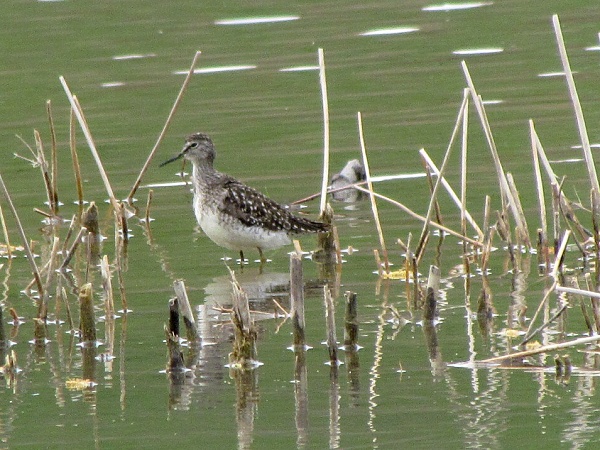
Tringa glareola · kalužiak močiarny · Wood Sandpiper
Alternative and historical names
Slovak names
- kalužiak močiarny (Kovalik 2010)
- kalužiak močiarny (Matoušek 1990)
English names
- Wood Sandpiper (IOC 2.5 2010)
- Wood-Sandpiper (BOU 1923)
Scientific names
- Tringa glareola (AviList 2026)
- Tringa glareola (IOC 15.2 2026)
- Tringa glareola (IOC 2.5 2010)
- Tringa glareola (BOU 1923)
Taxonomic synonyms
- Rhyacophilus glareola (Linnaeus, 1758)
- Totanus glareolus (Linnaeus, 1758)
- Tringa glareola Linnaeus, 1758
Birding Slovakia database
This species through our community’s eyes
Photographs by category
Species characteristics in Slovakia
- Migration
- common transmigrant / Tc
- Rarities committee:
- Does not require any reporting or registration by Raritties commitee
Observation map

Detailed species observation statistics

Source: the Birding.sk database. Counts reflect observer contributions, not population size.
About this species
Distribution
The Wood Sandpiper breeds in northern Europe and across a broad belt of northern Asia. Its wintering areas lie mainly in Africa and southern Asia, extending as far as Australia. Slovakia is a stopover on its migration route, rather than a regular breeding area. It is among our more common passage waders: spring birds occur from late March to May, with return passage mainly from July into autumn. Wintering is exceptional.
Habitat
Its breeding habitats include northern wetlands, peatlands and waterlogged wooded landscapes; in winter it uses shallow waters. In Slovakia, look on flooded meadows, shallow pond margins, exposed mud and temporary pools in fields. It tolerates more low vegetation than several smaller sandpipers.
Breeding
It does not breed regularly in Slovakia. In its northern range, the nest is usually on the ground among vegetation and normally contains four eggs. The chicks leave the nest after hatching and find their own food under parental supervision.
Food
It takes insects and their larvae, small molluscs and other invertebrates from shallow water and mud, moving briskly among sparse plants as it feeds.
Interesting fact
Even a small temporary pool in a field can be a useful refuelling stop for this long-distance migrant. A place that will dry out within a few weeks may briefly host a surprisingly varied gathering of waders during migration.
Sources: Slovak Wikipedia · BTO BirdFacts · English Wikipedia
Sign in to send private feedback on the text to our editors.
Explore further
Overview and identification
Descriptions, identification and names.
- Slovak Wikipedia ↗
Taxon account in Slovak: distribution, biology and references for further reading.
https://sk.wikipedia.org/wiki/Kalu%C5%BEiak_mo%C4%8Diarny - BTO BirdFacts ↗
Biology and identification in English; population figures and trends refer to Britain.
https://www.bto.org/learn/about-birds/birdfacts/wood-sandpiper - English Wikipedia ↗
Taxon account in English: distribution, biology and taxonomic context.
https://en.wikipedia.org/wiki/Wood_sandpiper - BTO: Identifying Wood Sandpipers and Green Sandpipers ↗
English identification video comparing this taxon with similar species and explaining distinguishing features.
https://www.bto.org/learn/skills/bird-identification/videos/wood-and-green-sandpiper
Data and research
Occurrences, distribution and research.
- State Nature Conservancy: identification, ecology and conservation – Tringa glareola ↗
Slovak expert profile with morphology, ecology and species conservation information.
https://www.biomonitoring.sk/Registration/AtlasAnimal/Detail/48920


