


Mergus merganser · potápač veľký · Common Merganser
Alternative and historical names
Slovak names
- potápač veľký (Kovalik 2010)
- potápač husovitý (Kovalik 2010)
- potápač veľký (Matoušek 1990)
- potápač veľký (Ferianc 1986)
English names
- Common Merganser (IOC 2.5 2010)
- Goosander (BOU 1923)
Scientific names
- Mergus merganser (AviList 2026)
- Mergus merganser (IOC 15.2 2026)
- Mergus merganser (IOC 2.5 2010)
- Mergus merganser (BOU 1923)
Taxonomic synonyms
- Mergus merganser Linnaeus, 1758
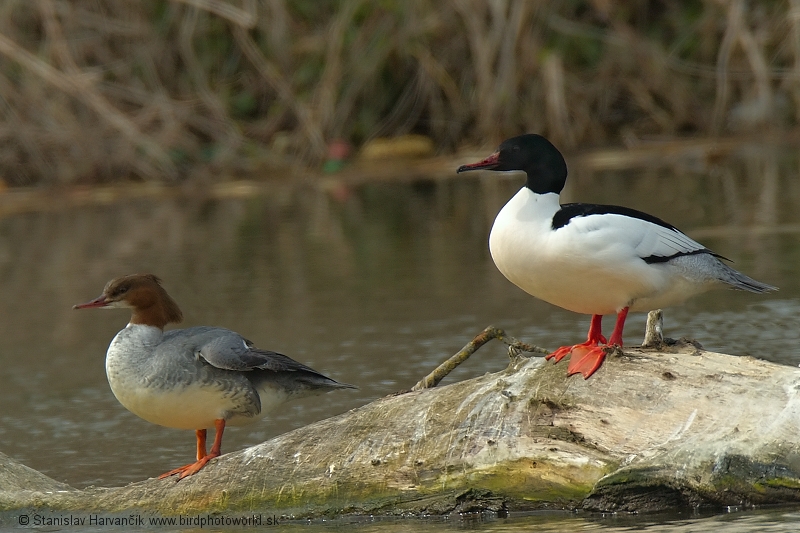
Birding Slovakia database
This species through our community’s eyes
Species characteristics in Slovakia
- General occurrence
- migrant / M
- Breeding
- rare nidificant / Nr
- Migration
- common transmigrant / Tc
- Wintering
- common wintering / Wc
- Rarities committee:
- Does not require any reporting or registration by Raritties commitee
Observation map
Detailed species observation statistics

Source: the Birding.sk database. Counts reflect observer contributions, not population size.
About this species
Distribution
It occupies much of northern Eurasia and North America, with breeding populations also in some more southerly mountain regions. In Slovakia it is a regular passage and winter visitor as well as a local breeder. The first confirmed successful breeding dates from 2007. Winter flocks nevertheless continue to include birds from other areas.
Habitat
It favours rivers, lakes and reservoirs with fish and water clear enough for hunting. In Slovakia it can be seen on larger rivers and reservoirs. Breeding requires suitable cavities or other shelters near water, including in human-modified landscapes.
Breeding
It nests mainly in tree cavities but also uses other covered spaces and suitable nest boxes. The female incubates and accompanies the young. After leaving the nest, the family moves along the water, where the ducklings progressively obtain food for themselves.
Food
It mainly pursues fish underwater. The long narrow bill, with fine serrations, helps retain slippery prey; other aquatic animals form a smaller part of the diet.
Interesting fact
Young hatched in a cavity high in a tree must leave before they can fly. Responding to the female's calls, they jump out and follow her to water — their first journey may therefore begin with a leap into space.
Sources: Slovak Wikipedia · English Wikipedia · BTO BirdFacts · First confirmed Goosander breeding in Slovakia
Sign in to send private feedback on the text to our editors.
Explore further
Overview and identification
Descriptions, identification and names.
- Slovak Wikipedia ↗
Taxon account in Slovak: distribution, biology and references for further reading.
https://sk.wikipedia.org/wiki/Pot%C3%A1pa%C4%8D_ve%C4%BEk%C3%BD - English Wikipedia ↗
Taxon account in English: distribution, biology and taxonomic context.
https://en.wikipedia.org/wiki/Common_merganser - BTO BirdFacts ↗
Biology and identification in English; population figures and trends refer to Britain.
https://www.bto.org/learn/about-birds/birdfacts/goosander - First confirmed Goosander breeding in Slovakia ↗
Author-uploaded copy of the original scientific report of breeding in 2007.
https://www.researchgate.net/publication/272496879_Prve_potvrdene_vyhniezdenie_potapaca_velkeho_Mergus_merganser_na_Slovensku - BTO: Identifying Goosanders, Red-breasted Mergansers and Smew ↗
English identification video comparing this taxon with similar species and explaining distinguishing features.
https://www.bto.org/learn/skills/bird-identification/videos/goosander-and-red-breasted-merganser
























