Circus macrourus · kaňa stepná · Pallid Harrier
Alternative and historical names
Slovak names
- kaňa stepná (Kovalik 2010)
- kaňa východná (Kovalik 2010)
- kaňa stepná (Matoušek 1990)
- kaňa stepná (Ferianc 1987)
English names
- Pallid Harrier (IOC 2.5 2010)
Scientific names
- Circus macrourus (AviList 2026)
- Circus macrourus (IOC 15.2 2026)
- Circus macrourus (IOC 2.5 2010)
Taxonomic synonyms
- Accipiter macrourus (S.G.Gmelin, 1771)
- Circus macrourus (Gmelin, SG, 1770)
Birding Slovakia database
This species through our community’s eyes
Photographs by category
Species characteristics in Slovakia
- Migration
- rare transmigrant / Tr
- Wintering
- rare wintering / Wr
- Rarities committee:
- Sighting of this specie should be reporter to Raritties Commitee
Observation map

Detailed species observation statistics

Source: the Birding.sk database. Counts reflect observer contributions, not population size.
About this species
Distribution
Pallid Harrier breeds mainly in eastern Europe and central Asia, with recent nesting farther west, and winters in tropical Africa and southern Asia. In Slovakia it is scarce but now regularly recorded on spring and autumn passage. It is not a regular domestic breeder, and winter occurrence is unusual. Older descriptions as solely accidental no longer cover all observations.
Habitat
It uses steppes, fields, fallows and open grassland. Slovak stopovers involve low quartering flights like other harriers. Safe low cover is needed for resting; large waterbodies are not essential.
Breeding
In its main range it builds a ground nest in vegetation. The female incubates usually four or five eggs while the male provides much food. A suitable passage field alone is not breeding evidence.
Food
It mainly catches small mammals and birds, also large insects, surprising prey in slow low flight.
Interesting fact
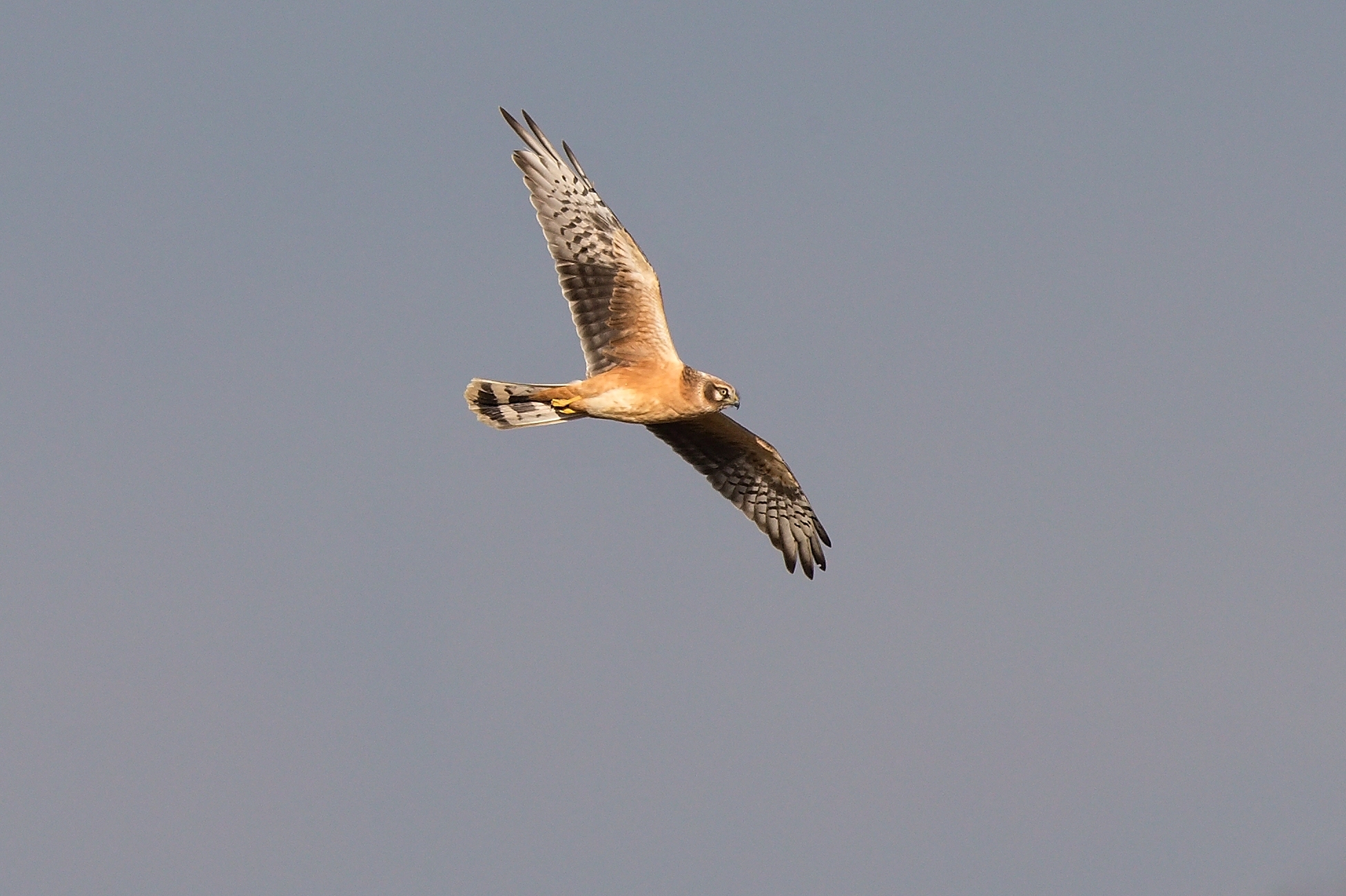
Very pale adult males have narrow dark wingtips. Rusty-brown juveniles require a combination of head, wing and structural features for separation from similar harriers.
Sources: Slovak Wikipedia · English Wikipedia · Nature Conservation Agency of Czechia: species profile · Records Committee: 2023 report
Sign in to send private feedback on the text to our editors.
Explore further
Overview and identification
Descriptions, identification and names.
- Slovak Wikipedia ↗
Taxon account in Slovak: distribution, biology and references for further reading.
https://sk.wikipedia.org/wiki/Ka%C5%88a_stepn%C3%A1 - English Wikipedia ↗
Taxon account in English: distribution, biology and taxonomic context.
https://en.wikipedia.org/wiki/Pallid_harrier - Nature Conservation Agency of Czechia: species profile ↗
Official information on species biology and conservation; Czech context.
https://portal.nature.cz/w/druh-1091 - BTO: Identifying grey harriers - Hen Harrier, Montagu's Harrier and Pallid Harrier ↗
English identification video comparing this taxon with similar species and explaining distinguishing features.
https://www.bto.org/learn/skills/bird-identification/videos/harriers
Data and research
Occurrences, distribution and research.
- Records Committee: 2023 report ↗
Assessed Slovak records and new breeding evidence for 2023 (PDF).
https://www.tichodroma.sk/pdfs/36/Tichodroma_36_6_Mojzis.pdf