


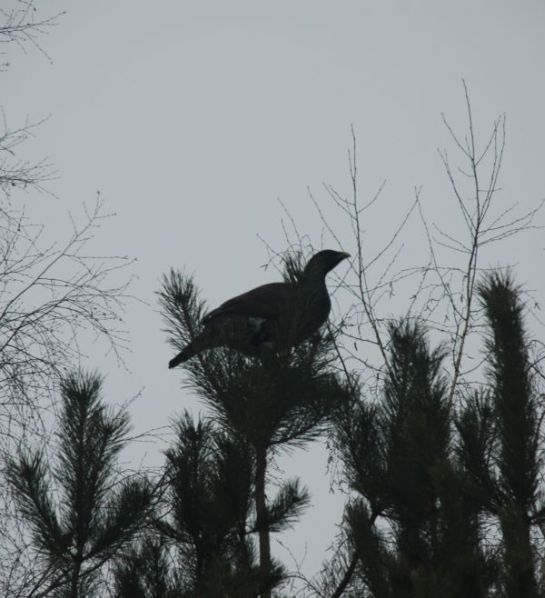
Tetrao urogallus · hlucháň hôrny · Western Capercaillie
Alternative and historical names
Slovak names
- hlucháň hôrny (Kovalik 2010)
- hlucháň lesný (Kovalik 2010)
- hlucháň obyčajný (Kovalik 2010)
- tetrov hlucháň (Kovalik 2010)
- tetrov hlucháň (Matoušek 1990)
- hlucháň (Matoušek 1990)
English names
- Western Capercaillie (IOC 2.5 2010)
- Capercaillie (BOU 1923)
Scientific names
- Tetrao urogallus (AviList 2026)
- Tetrao urogallus (IOC 15.2 2026)
- Tetrao urogallus (IOC 2.5 2010)
- Tetrao urogallus (BOU 1923)
Taxonomic synonyms
- Tetrao urogallus Linnaeus, 1758
Birding Slovakia database
This species through our community’s eyes
Species characteristics in Slovakia
- General occurrence
- resident / R
- Breeding
- uncommon nidificant / Nu
- Wintering
- uncommon wintering / Wu
- Rarities committee:
- Does not require any reporting or registration by Raritties commitee
Conservation — Red Lists
- Slovakia 2023breeding population
- Breeding population Period: 2013–2023 Source: Demko M. a kol. 2025: Červený zoznam vtákov Slovenska: aktualizácia 2013 – 2023. Tichodroma 37: 107–117. Online 18. 1. 2026. DOI: 10.31577/tichodroma.2025.37.18. Príloha 1, s. 116, riadok 10, stĺpec 6 Criteria: A2ac; C2a(i)
- Europe 2021
- Population scope unspecified Source: BirdLife International 2021: European Red List of Birds. Publications Office of the European Union, Luxembourg. Reported in: Demko M. a kol. 2025: Červený zoznam vtákov Slovenska: aktualizácia 2013 – 2023. Tichodroma 37: 107–117. Online 18. 1. 2026. DOI: 10.31577/tichodroma.2025.37.18. Príloha 1, s. 116, riadok 10, stĺpec 4
- World 2025
- Species Source: BirdLife International 2025: Species factsheets. Citované v Demko a kol. 2025, prístup 16. 4. 2025. Reported in: Demko M. a kol. 2025: Červený zoznam vtákov Slovenska: aktualizácia 2013 – 2023. Tichodroma 37: 107–117. Online 18. 1. 2026. DOI: 10.31577/tichodroma.2025.37.18. Príloha 1, s. 116, riadok 10, stĺpec 3
Previous assessments
- Slovakia 2013
- Breeding population Period: 2002–2012 Source: Demko M., Krištín A. & Pačenovský S. 2014: Červený zoznam vtákov Slovenska. SOS/BirdLife Slovensko, Bratislava. Zdroj stĺpca SK 2013 podľa poznámky 5 prílohy Demko a kol. 2025. Reported in: Demko M. a kol. 2025: Červený zoznam vtákov Slovenska: aktualizácia 2013 – 2023. Tichodroma 37: 107–117. Online 18. 1. 2026. DOI: 10.31577/tichodroma.2025.37.18. Príloha 1, s. 116, riadok 10, stĺpec 5
Observation map

Detailed species observation statistics

Source: the Birding.sk database. Counts reflect observer contributions, not population size.
About this species
Distribution
Capercaillie inhabits northern Eurasian forests and isolated mountain forests in central and southern Europe. In Slovakia it is resident in suitable Carpathian ranges, but occurrence is fragmented and conservation-sensitive. It does not leave for distant winter quarters, so its forest must support survival year-round. Historical range maps do not guarantee current occupation.
Habitat
It needs structurally varied older forest with bilberry undergrowth, clearings, shelter and conifers. Extensive clearcuts or dense even-aged young stands do not replace this mosaic. Quiet is particularly important during display and chick rearing.
Breeding
Males display at traditional spring grounds. The female then conceals a ground nest, incubates alone and leads chicks. These feed themselves but need protection and brooding.
Food
Adults eat leaves, shoots and berries, chiefly conifer needles in winter. Young chicks need many insects, making weather and undergrowth quality important.
Interesting fact
The large dark male with a fan-shaped tail differs greatly from the smaller mottled-brown female. Display combines complex sounds and postures; watching should never displace birds from the display ground.
Sources: Slovak Wikipedia · English Wikipedia · Red List of the birds of Slovakia
Sign in to send private feedback on the text to our editors.
Explore further
Overview and identification
Descriptions, identification and names.
- Slovak Wikipedia ↗
Taxon account in Slovak: distribution, biology and references for further reading.
https://sk.wikipedia.org/wiki/Hluch%C3%A1%C5%88_h%C3%B4rny - English Wikipedia ↗
Taxon account in English: distribution, biology and taxonomic context.
https://en.wikipedia.org/wiki/Western_capercaillie - BTO: Identifying Grouse - Red Grouse, Ptarmigan, Black Grouse and Capercaillie ↗
English identification video comparing this taxon with similar species and explaining distinguishing features.
https://www.bto.org/learn/skills/bird-identification/videos/grouse
Data and research
Occurrences, distribution and research.
- Red List of the birds of Slovakia ↗
Assessment of breeding populations based on knowledge available in 2023; Tichodroma 37 (PDF).
https://www.tichodroma.sk/pdfs/37/Tichodroma_37_18_Demko.pdf - Slovak recovery programme: Western Capercaillie 2025–2029 ↗
Slovak expert recovery programme for Western Capercaillie for 2025–2029, covering habitats, threats and conservation measures.
https://www.minzp.sk/files/program-zachrany-hluchana-horneho-24-1-2025.pdf - RSPB: Capercaillie Emergency Plan ↗
English 2024 article explaining Capercaillie measures in Scotland: habitat management, disturbance, predation and research.
https://www.rspb.org.uk/scotland/news/capercaillie-emergency-plan


