


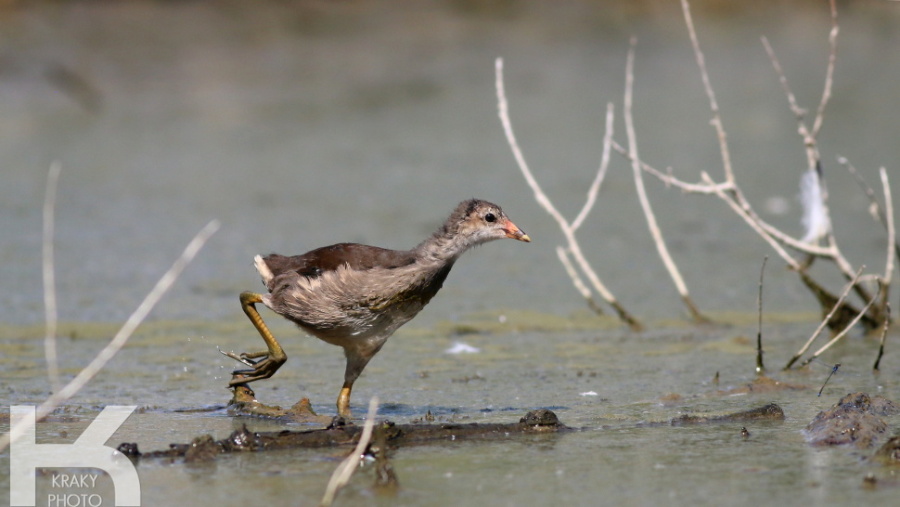
Gallinula chloropus · sliepočka vodná · Common Moorhen
Alternative and historical names
Slovak names
- sliepočka vodná (Kovalik 2010)
- sliepka vodná (Kovalik 2010)
- sliepočka zelenonohá (Kovalik 2010)
- sliepočka zelenonohá (Matoušek 1990)
- sliepočka vodná (Ferianc 1958)
English names
- Common Moorhen (IOC 2.5 2010)
- Moor-Hen (BOU 1923)
Scientific names
- Gallinula chloropus (AviList 2026)
- Gallinula chloropus (IOC 15.2 2026)
- Gallinula chloropus (IOC 2.5 2010)
- Gallinula chloropus (BOU 1923)
Taxonomic synonyms
- Gallinula brodkorbi (McCoy, 1963)
- Gallinula chloropus brodkorbi (McCoy, 1963)
- Fulica chloropus (Linnaeus, 1758)
- Fulica spec (Linnaeus, 1758)
- Gallinula ochropus (Linnaeus, 1758)
- Gallinula chloropus (Linnaeus, 1758)
Birding Slovakia database
This species through our community’s eyes
Species characteristics in Slovakia
- General occurrence
- migrant / M
- Breeding
- common nidificant / Nc
- Migration
- common transmigrant / Tc
- Wintering
- uncommon wintering / Wu
- Rarities committee:
- Does not require any reporting or registration by Raritties commitee
Observation map

Detailed species observation statistics

Source: the Birding.sk database. Counts reflect observer contributions, not population size.
About this species
Distribution
Common Moorhen is widespread in Europe, Asia and Africa. In Slovakia it breeds regularly, especially in lowlands and basins, and may be common in suitable habitat despite often escaping notice. Some birds migrate, with additional individuals appearing on passage. Smaller numbers winter beside unfrozen water, sometimes in urban settings.
Habitat
It favours smaller ponds, river backwaters, canals and slow streams with rich waterside vegetation. Park ponds are also used if cover is available. Birds often move along the water’s edge or across floating plants.
Breeding
The bulky plant-material nest is concealed beside or above water. Both parents incubate and feed the chicks; more than one brood may be raised in a season.
Food
It is omnivorous, collecting leaves, seeds and other plant material, aquatic insects, molluscs and small animals. Food is taken from the surface, vegetation and shore.
Interesting fact
It frequently flicks its tail while walking or swimming, revealing white undertail edges. This conspicuous movement can help identify a bird when only its rear is visible among plants.
Sources: Slovak Wikipedia · English Wikipedia
Sign in to send private feedback on the text to our editors.
Explore further
Overview and identification
Descriptions, identification and names.
- Slovak Wikipedia ↗
Taxon account in Slovak: distribution, biology and references for further reading.
https://sk.wikipedia.org/wiki/Sliepo%C4%8Dka_vodn%C3%A1 - English Wikipedia ↗
Taxon account in English: distribution, biology and taxonomic context.
https://en.wikipedia.org/wiki/Common_moorhen - BTO: Identifying Coot and Moorhen ↗
English identification video comparing this taxon with similar species and explaining distinguishing features.
https://www.bto.org/learn/skills/bird-identification/videos/coot-and-moorhen


