


Thinornis dubius · kulík riečny · Little Ringed Plover
Alternative and historical names
Slovak names
- kulík riečny (Kovalik 2010)
- kulík riečny (Matoušek 1990)
English names
- Little Ringed Plover (IOC 2.5 2010)
Scientific names
- Thinornis dubius (AviList 2026)
- Thinornis dubius (IOC 15.2 2026)
- Charadrius dubius (IOC 2.5 2010)
- Charadrius dubius (BOU 1923)
Taxonomic synonyms
- Thinornis dubius (Scopoli, 1786)
Birding Slovakia database
This species through our community’s eyes
Species characteristics in Slovakia
- General occurrence
- migrant / M
- Breeding
- common nidificant / Nc
- Migration
- common transmigrant / Tc
- Rarities committee:
- Does not require any reporting or registration by Raritties commitee
Observation map

Detailed species observation statistics

Source: the Birding.sk database. Counts reflect observer contributions, not population size.
About this species
Distribution
Little Ringed Plover has a broad distribution in Europe and Asia extending into other parts of the Old World. In Slovakia it is a regular breeder and locally common in suitable habitat. It arrives in spring, breeds in summer and departs for warmer regions on autumn passage. It is normally absent from Slovak riverbanks in winter.
Habitat
It seeks gravel riverbanks, islands, gravel-pit shores and other open ground with sparse vegetation. Temporary habitats in quarries and construction sites may also be occupied. Bare substrate combined with nearby waterside feeding opportunities is crucial.
Breeding
Usually four eggs are laid in a shallow scrape among small stones. Their mottling matches the ground so well that the nest is easily overlooked. Both parents tend the clutch and mobile chicks.
Food
It catches mainly insects, larvae and small worms on gravel, mud and shallow water. Birds run, pause and pick prey from the surface without needing a long probing bill.
Interesting fact
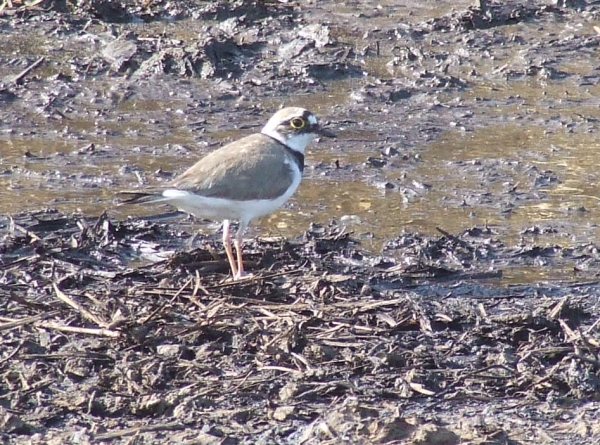
The striking yellow eye-ring is a useful adult identification feature. It may be invisible at distance, however, so several features should be combined rather than relying simply on an apparent absence of yellow.
Sources: Slovak Wikipedia · English Wikipedia
Sign in to send private feedback on the text to our editors.
Explore further
Overview and identification
Descriptions, identification and names.
- Slovak Wikipedia ↗
Taxon account in Slovak: distribution, biology and references for further reading.
https://sk.wikipedia.org/wiki/Kul%C3%ADk_rie%C4%8Dny - English Wikipedia ↗
Taxon account in English: distribution, biology and taxonomic context.
https://en.wikipedia.org/wiki/Little_ringed_plover - BTO: Identifying Ringed Plovers ↗
English identification video comparing this taxon with similar species and explaining distinguishing features.
https://www.bto.org/learn/skills/bird-identification/videos/ringed-plovers


