


Calidris alpina · pobrežník čiernozobý · Dunlin
Alternative and historical names
Slovak names
- pobrežník čiernozobý (Kovalik 2010)
- pobrežník obyčajný (Kovalik 2010)
- pobrežník čiernozobý (Matoušek 1990)
- pobrežník obyčajný (Ferianc 1958)
English names
- Dunlin (IOC 2.5 2010)
- Dunlin (BOU 1923)
Scientific names
- Calidris alpina (AviList 2026)
- Calidris alpina (IOC 15.2 2026)
- Calidris alpina (IOC 2.5 2010)
- Erolia alpina (BOU 1923)
Taxonomic synonyms
- Erolia alpina (Linnaeus, 1758)
- Pelidna alpina (Linnaeus, 1758)
- Tringa alpina (Linnaeus, 1758)
- Calidris alpina (Linnaeus, 1758)
Birding Slovakia database
This species through our community’s eyes
Photographs by category
Species characteristics in Slovakia
- Migration
- common transmigrant / Tc
- Wintering
- rare wintering / Wr
- Rarities committee:
- Does not require any reporting or registration by Raritties commitee
Observation map

Detailed species observation statistics

Source: the Birding.sk database. Counts reflect observer contributions, not population size.
About this species
Distribution
The Dunlin breeds in Arctic and northern parts of Europe, Asia and North America, with some populations farther south. It winters mainly on temperate and warm coasts. In Slovakia it is a regular migrant and relatively common among the small sandpipers, but does not breed here. It is easiest to see on autumn passage, particularly in September and October; spring records are mainly in April and May. Winter occurrences are scarce.
Habitat
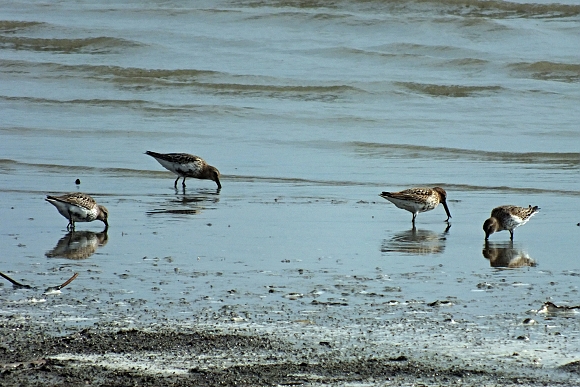
It breeds in wet tundra, peatlands and damp grassland; winter flocks mainly use coastal mudflats. In Slovakia it seeks exposed muddy banks, drained fishponds, reservoir shallows and river deposits. Open sites with low water levels and little tall vegetation are most suitable.
Breeding
It does not breed in Slovakia. On its breeding grounds it usually lays four eggs in a scrape concealed in low vegetation. After hatching, the chicks move away from the nest and collect small food items.
Food
It extracts small invertebrates from mud and shallow water. Worms and molluscs are important on marine coasts, while insects and their larvae also feature at inland sites.
Interesting fact
The conspicuous black belly patch belongs to its breeding plumage. A much plainer appearance replaces it in autumn, so the same species can look very different in photographs from different seasons. Its slightly downcurved bill also helps with identification.
Sources: Slovak Wikipedia · BTO BirdFacts · English Wikipedia
Sign in to send private feedback on the text to our editors.
Explore further
Overview and identification
Descriptions, identification and names.
- Slovak Wikipedia ↗
Taxon account in Slovak: distribution, biology and references for further reading.
https://sk.wikipedia.org/wiki/Pobre%C5%BEn%C3%ADk_oby%C4%8Dajn%C3%BD - BTO BirdFacts ↗
Biology and identification in English; population figures and trends refer to Britain.
https://www.bto.org/learn/about-birds/birdfacts/dunlin - English Wikipedia ↗
Taxon account in English: distribution, biology and taxonomic context.
https://en.wikipedia.org/wiki/Dunlin - BTO: Identifying Sanderlings, Curlew Sandpipers and Dunlin ↗
English identification video comparing this taxon with similar species and explaining distinguishing features.
https://www.bto.org/learn/skills/bird-identification/videos/sanderling-curlew-sandpiper - BTO: Identifying Knot and Dunlin ↗
English identification video comparing this taxon with similar species and explaining distinguishing features.
https://www.bto.org/learn/skills/bird-identification/videos/knot-and-dunlin
























