


Calidris pugnax · bojovník bahenný · Ruff
Alternative and historical names
Slovak names
- bojovník bahenný (Kovalik 2010)
- pobrežník bojovný (Kovalik 2010)
- pobrežník bojovný (Matoušek 1990)
English names
- Ruff (IOC 2.5 2010)
- Ruff (BOU 1923)
Scientific names
- Calidris pugnax (AviList 2026)
- Calidris pugnax (IOC 15.2 2026)
- Philomachus pugnax (IOC 2.5 2010)
- Philomachus pugnax (BOU 1923)
Taxonomic synonyms
- Machetes pugnax (Linnaeus, 1758)
- Philomachus pugnax (Linnaeus, 1758)
- Tringa pugnax (Linnaeus, 1758)
- Calidris pugnax (Linnaeus, 1758)
Birding Slovakia database
This species through our community’s eyes
Species characteristics in Slovakia
- Migration
- common transmigrant / Tc
- Rarities committee:
- Does not require any reporting or registration by Raritties commitee
Observation map

Detailed species observation statistics

Source: the Birding.sk database. Counts reflect observer contributions, not population size.
About this species
Distribution
The Ruff breeds mainly in northern Europe and Asia. It winters from western and southern Europe through Africa to southern Asia. In Slovakia it is a regular migrant, locally numerous at suitable wetlands, but not a regular breeder. Spring passage is particularly noticeable from March to May, and return passage runs from summer into autumn. Winter sightings are much rarer than records during migration.
Habitat
On its breeding grounds it uses wet meadows and tundra; wintering habitats also include extensive floodplains. In Slovakia, search flooded meadows, temporary pools in fields, muddy margins and drained fishponds. It may also feed in a wet field or closely grazed vegetation away from open water.
Breeding
It does not breed regularly in Slovakia. In its breeding range, males display at communal arenas. The female then builds a ground nest, incubates the usual four eggs and tends the young alone. The male takes no part in rearing them.
Food
It collects insects, larvae and other small invertebrates, taking seeds as well outside the breeding season. It feeds on the soil surface, in low vegetation and in shallow water.
Interesting fact
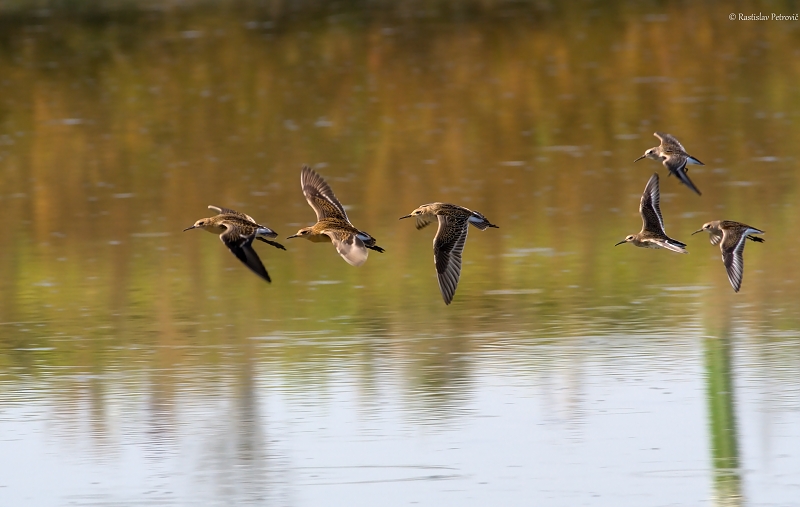
Displaying males wear conspicuous feather ruffs whose colours and patterns vary greatly between individuals. These ornaments are absent on autumn passage. The substantial size difference between males and females can also give the impression that a flock contains two different species.
Sources: Slovak Wikipedia · BTO BirdFacts · English Wikipedia
Sign in to send private feedback on the text to our editors.
Explore further
Overview and identification
Descriptions, identification and names.
- Slovak Wikipedia ↗
Taxon account in Slovak: distribution, biology and references for further reading.
https://sk.wikipedia.org/wiki/Bojovn%C3%ADk_bahenn%C3%BD - BTO BirdFacts ↗
Biology and identification in English; population figures and trends refer to Britain.
https://www.bto.org/learn/about-birds/birdfacts/ruff - English Wikipedia ↗
Taxon account in English: distribution, biology and taxonomic context.
https://en.wikipedia.org/wiki/Ruff_(bird) - BTO: Identifying Ruff ↗
English identification video comparing this taxon with similar species and explaining distinguishing features.
https://www.bto.org/learn/skills/bird-identification/videos/ruff


