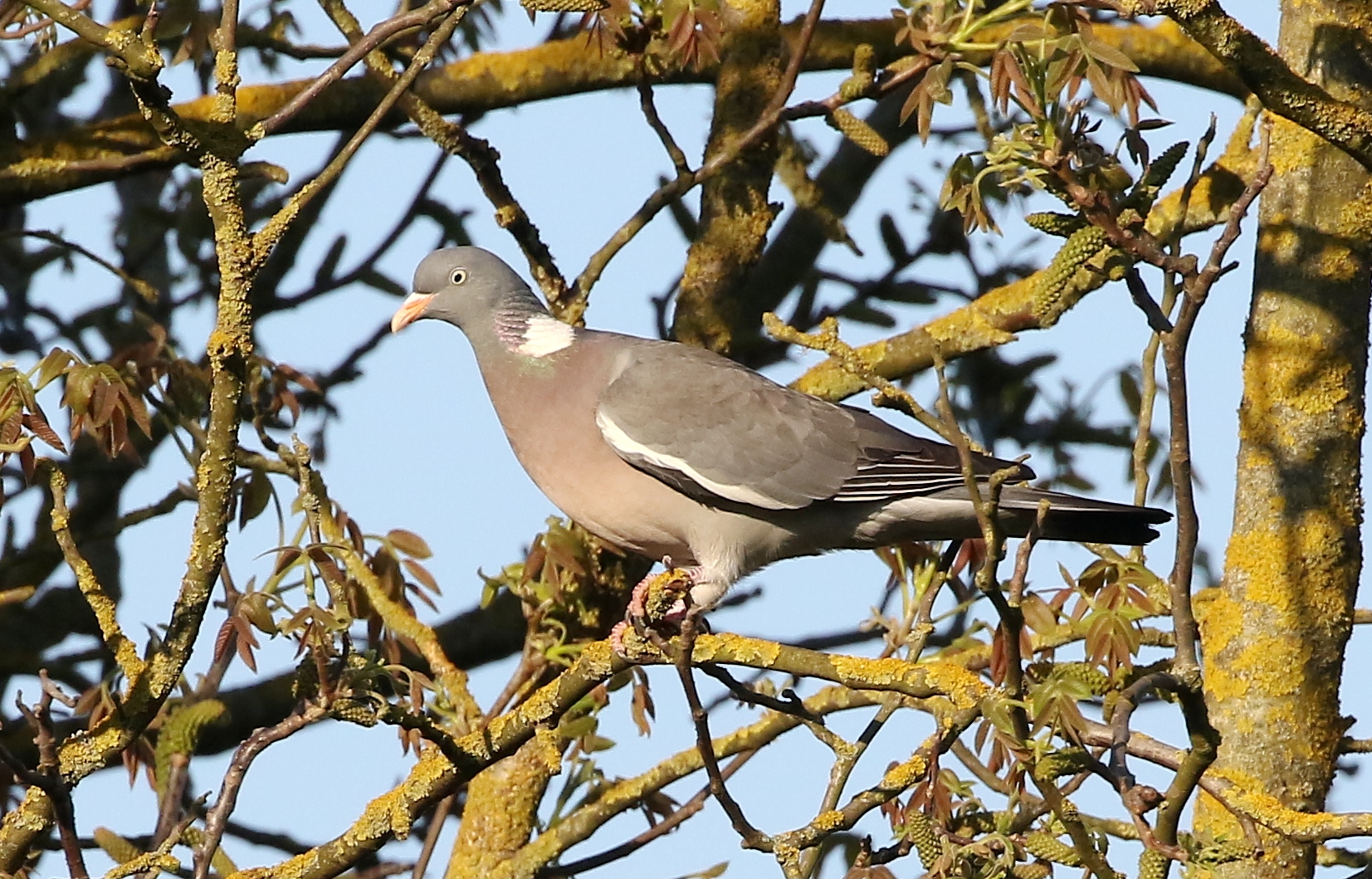
Columba palumbus · holub hrivnák · Common Wood Pigeon
Alternative and historical names
Slovak names
- holub hrivnák (Kovalik 2010)
- hrivnák obyčajný (Kovalik 2010)
- holub hrivnák (Matoušek 1990)
English names
- Common Wood Pigeon (IOC 2.5 2010)
- Ring-Dove or Wood-Pigeon (BOU 1923)
Scientific names
- Columba palumbus (AviList 2026)
- Columba palumbus (IOC 15.2 2026)
- Columba palumbus (IOC 2.5 2010)
- Columba palumbus (BOU 1923)
Taxonomic synonyms
- Columba palumbus Linnaeus, 1758
Birding Slovakia database
This species through our community’s eyes
Species characteristics in Slovakia
- General occurrence
- migrant / M
- Breeding
- common nidificant / Nc
- Migration
- common transmigrant / Tc
- Wintering
- uncommon wintering / Wu
- Rarities committee:
- Does not require any reporting or registration by Raritties commitee
Observation map
Detailed species observation statistics

Source: the Birding.sk database. Counts reflect observer contributions, not population size.
About this species
Distribution
Wood Pigeon breeds across much of Europe and adjoining western Asia and North Africa. In Slovakia it is widespread from lowlands to mountain areas. Most local birds leave for milder Europe in autumn, while some remain in winter. Large passage flocks can be more conspicuous than scattered summer pairs.
Habitat
It uses forests, copses, tree rows, parks and urban greenery. Birds feed in fields and meadows, while nesting pairs need a tree or similar cover. Urban occurrence is now familiar despite its woodland associations.
Breeding
A fairly sparse platform of twigs is built on branches. Both partners incubate the usually two white eggs and feed chicks. Several nesting attempts may occur within one favourable season.
Food
It takes seeds, grain, green plant material, fruit and acorns, feeding both on the ground and in trees. Diet changes markedly with the season.
Interesting fact
During display it climbs steeply, claps its wings and descends in a gliding arc. The white wingbar is visible even in juveniles, which still lack white neck patches.
Sources: Slovak Wikipedia · English Wikipedia
Sign in to send private feedback on the text to our editors.
Explore further
Overview and identification
Descriptions, identification and names.
- Slovak Wikipedia ↗
Taxon account in Slovak: distribution, biology and references for further reading.
https://sk.wikipedia.org/wiki/Holub_hrivn%C3%A1k - English Wikipedia ↗
Taxon account in English: distribution, biology and taxonomic context.
https://en.wikipedia.org/wiki/Common_wood_pigeon - BTO: Bird Song Basics - Collared Dove and Woodpigeon ↗
English identification video comparing this taxon with similar species and explaining distinguishing features.
https://www.bto.org/learn/skills/bird-identification/videos/bird-song-basics-collared-dove-and-woodpigeon - BTO: Identifying pigeons - Woodpigeons, Stock Doves, Rock Doves and Feral Pigeons ↗
English identification video comparing this taxon with similar species and explaining distinguishing features.
https://www.bto.org/learn/skills/bird-identification/videos/pigeons