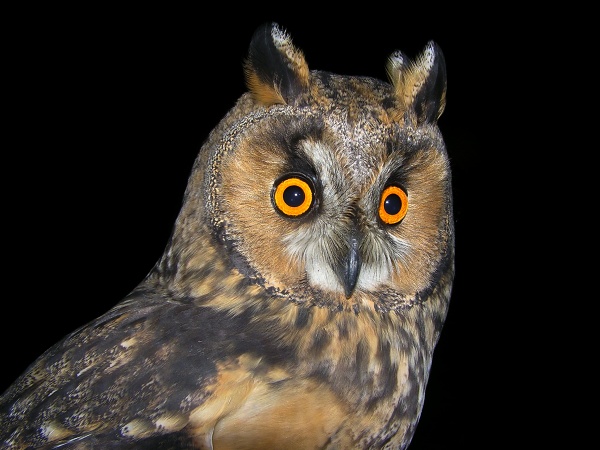
Asio otus · myšiarka ušatá · Long-eared Owl
Alternative and historical names
Slovak names
- myšiarka ušatá (Kovalik 2010)
- sova ušatá (Kovalik 2010)
- myšiarka ušatá (Matoušek 1990)
English names
- Long-eared Owl (IOC 2.5 2010)
- Long-eared Owl (BOU 1923)
Scientific names
- Asio otus (AviList 2026)
- Asio otus (IOC 15.2 2026)
- Asio otus (IOC 2.5 2010)
- Asio otus (BOU 1923)
Taxonomic synonyms
- Strix otus (Linnaeus, 1758)
- Asio otus (Linnaeus, 1758)
Birding Slovakia database
This species through our community’s eyes
Species characteristics in Slovakia
- General occurrence
- mainly resident, minority is migratory / R(M)
- Breeding
- common nidificant / Nc
- Migration
- common transmigrant / Tc
- Wintering
- common wintering / Wc
- Rarities committee:
- Does not require any reporting or registration by Raritties commitee
Observation map

Detailed species observation statistics

Source: the Birding.sk database. Counts reflect observer contributions, not population size.
About this species
Distribution
Long-eared Owl inhabits much of Eurasia and North America and locally North Africa. In Slovakia it is a widespread breeder of open country with trees. Some remain year-round while others arrive or pass through on migration. Winter gatherings therefore need not consist solely of local families, and size varies with food and weather.
Habitat
It hunts fields, meadows and grassy margins, resting by day in dense trees. Winter roosts also occur in park conifers and near settlements. Nesting needs a tree substrate close to open hunting areas.
Breeding
It normally builds no nest, occupying old crow and magpie nests. The female incubates usually three to seven eggs while the male brings prey. Young later leave the nest and beg loudly from nearby branches.
Food
Small mammals, especially voles, dominate. It flies low above open vegetation, using excellent hearing to locate prey.
Interesting fact
Several birds may winter together in one tree. An elongated posture and tightened plumage resemble a branch; repeated flushing wastes energy needed for night hunting.
Sources: Slovak Wikipedia · English Wikipedia
Sign in to send private feedback on the text to our editors.
Explore further
Overview and identification
Descriptions, identification and names.
- Slovak Wikipedia ↗
Taxon account in Slovak: distribution, biology and references for further reading.
https://sk.wikipedia.org/wiki/My%C5%A1iarka_u%C5%A1at%C3%A1 - English Wikipedia ↗
Taxon account in English: distribution, biology and taxonomic context.
https://en.wikipedia.org/wiki/Long-eared_owl - BTO: Identifying Short-eared Owls and Long-eared Owls ↗
English identification video comparing this taxon with similar species and explaining distinguishing features.
https://www.bto.org/learn/skills/bird-identification/videos/short-eared-and-long-eared-owls - Bird.watching.sk: identification and voice – Asio otus ↗
Slovak species lesson describing appearance, voice and habitat, supporting field identification.
https://bird.watching.sk/sk/mysiarka-usata-asio-otus/