Dryocopus martius · tesár čierny · Black Woodpecker
Alternative and historical names
Slovak names
- tesár čierny (Kovalik 2010)
- ďateľ čierny (Kovalik 2010)
- ďateľ čierny (Matoušek 1990)
English names
- Black Woodpecker (IOC 2.5 2010)
Scientific names
- Dryocopus martius (AviList 2026)
- Dryocopus martius (IOC 15.2 2026)
- Dryocopus martius (IOC 2.5 2010)
Taxonomic synonyms
- Picus martius (Linnaeus, 1758)
- Dryocopus martius (Linnaeus, 1758)
Birding Slovakia database
This species through our community’s eyes
Species characteristics in Slovakia
- General occurrence
- resident / R
- Breeding
- common nidificant / Nc
- Wintering
- common wintering / Wc
- Rarities committee:
- Does not require any reporting or registration by Raritties commitee
Observation map

Detailed species observation statistics

Source: the Birding.sk database. Counts reflect observer contributions, not population size.
About this species
Distribution
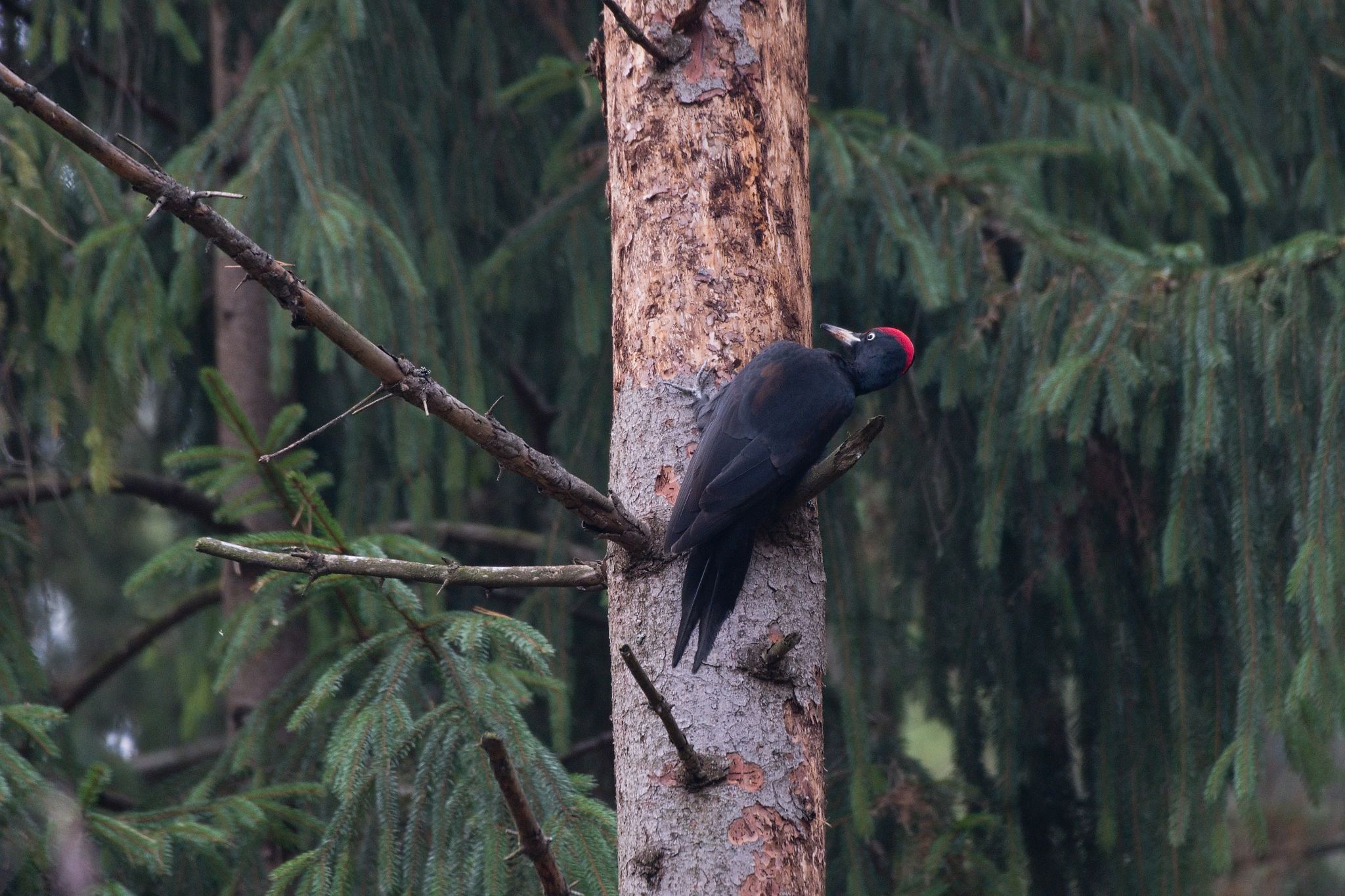
It inhabits Eurasian forests from western Europe to the Far East. In Slovakia it is a widespread breeding woodpecker from lowlands to mountain forests, although individual areas support relatively few pairs. It is resident and can be seen year-round; young birds disperse to find territories of their own.
Habitat
Suitable woodland combines tall, substantial trees for nest cavities with stumps or dead wood for feeding. It uses beech, mixed and coniferous forests. Its far-carrying calls are especially useful when searching for it.
Breeding
It excavates a large cavity in a substantial tall-trunked tree and may reuse it. A typical clutch contains 4–5 white eggs. Both parents incubate and feed the young, with the male taking the night shift. Normally one brood is raised annually.
Food
Its powerful bill exposes ants and wood-boring beetle larvae. It can reach prey deep in decaying timber, leaving large holes and conspicuous wood chips behind.
Interesting fact
Its large abandoned cavities provide homes for other forest inhabitants, including Stock Doves and owls. It therefore creates nesting space for species unable to excavate a comparable cavity themselves.
Sources: Slovak Wikipedia · English Wikipedia
Sign in to send private feedback on the text to our editors.
Explore further
Overview and identification
Descriptions, identification and names.
- Slovak Wikipedia ↗
Taxon account in Slovak: distribution, biology and references for further reading.
https://sk.wikipedia.org/wiki/Tes%C3%A1r_%C4%8Dierny - English Wikipedia ↗
Taxon account in English: distribution, biology and taxonomic context.
https://en.wikipedia.org/wiki/Black_woodpecker - Bird.watching.sk: identification and voice – Dryocopus martius ↗
Slovak species lesson describing appearance, voice and habitat, supporting field identification.
https://bird.watching.sk/sk/tesar-cierny-dryocopus-martius/