


Dendrocoptes medius · ďateľ prostredný · Middle Spotted Woodpecker
Alternative and historical names
Slovak names
- ďateľ prostredný (Kovalik 2010)
- ďatel (strakatý) prostredný (Kovalik 2010)
- ďateľ prostredný (Matoušek 1990)
English names
- Middle Spotted Woodpecker (IOC 2.5 2010)
Scientific names
- Dendrocoptes medius (AviList 2026)
- Dendrocoptes medius (IOC 15.2 2026)
- Dendrocopos medius (IOC 2.5 2010)
Taxonomic synonyms
- Dendrocopos medius (Linnaeus, 1758)
- Dendropicos medius (Linnaeus, 1758)
- Leiopicus medius (Linnaeus, 1758)
- Picoides medius (Linnaeus, 1758)
- Picus medius (Linnaeus, 1758)
- Dendrocoptes medius (Linnaeus, 1758)
Birding Slovakia database
This species through our community’s eyes
Species characteristics in Slovakia
- General occurrence
- resident / R
- Breeding
- common nidificant / Nc
- Wintering
- common wintering / Wc
- Rarities committee:
- Does not require any reporting or registration by Raritties commitee
Observation map

Detailed species observation statistics

Source: the Birding.sk database. Counts reflect observer contributions, not population size.
About this species
Distribution
Its range is centred on continental Europe and extends into southwestern Asia. In Slovakia it is a resident breeder mainly in warmer lowlands and hills in the southern half of the country. It occurs regularly in suitable oak and floodplain woodland but is much scarcer in the north and at high elevations.
Habitat
Look in mature oak woods, oak-rich floodplain forests and woodland with large, rough-barked trees. The structure of the trees matters, not simply the presence of woodland. It often stays high in the canopy, making sustained views difficult.
Breeding
The cavity is excavated in a decaying trunk or substantial branch. Both partners work on it, with the male more active. A typical clutch contains 5–6 white eggs. Parents share incubation and feed the young together, continuing after they leave the hole.
Food
It gathers insects and their immature stages from bark, branches and twigs. Compared with more powerful woodpeckers, it more often searches surfaces and crevices instead of excavating deeply for prey.
Interesting fact
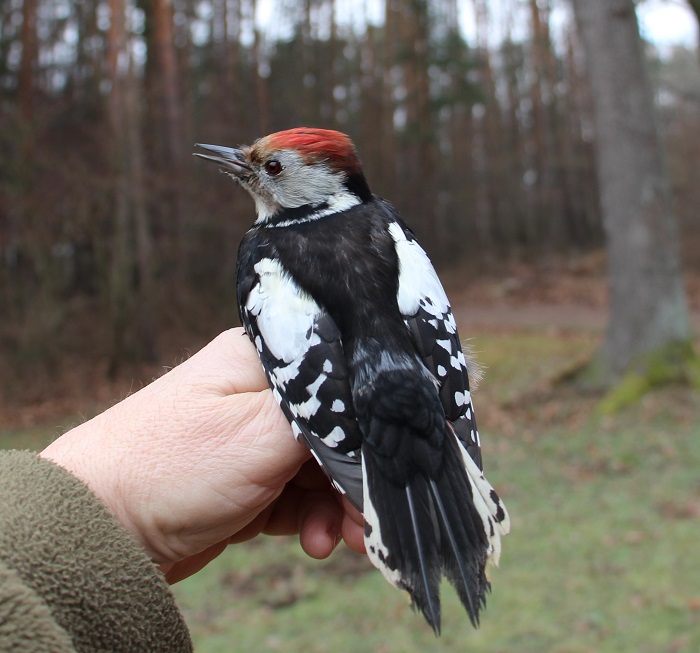
Instead of frequent drumming, spring brings its unusual nasal, almost quacking calls. Both sexes have a red crown, so the simple rule that a red head indicates a male does not work for this woodpecker.
Sources: Slovak Wikipedia · English Wikipedia
Sign in to send private feedback on the text to our editors.
Explore further
Overview and identification
Descriptions, identification and names.
- Slovak Wikipedia ↗
Taxon account in Slovak: distribution, biology and references for further reading.
https://sk.wikipedia.org/wiki/%C4%8Eate%C4%BE_prostredn%C3%BD - English Wikipedia ↗
Taxon account in English: distribution, biology and taxonomic context.
https://en.wikipedia.org/wiki/Middle_spotted_woodpecker - Bird.watching.sk: identification and voice – Dendrocoptes medius ↗
Slovak species lesson describing appearance, voice and habitat, supporting field identification.
https://bird.watching.sk/sk/datel-prostredny-dendrocopos-medius/


