


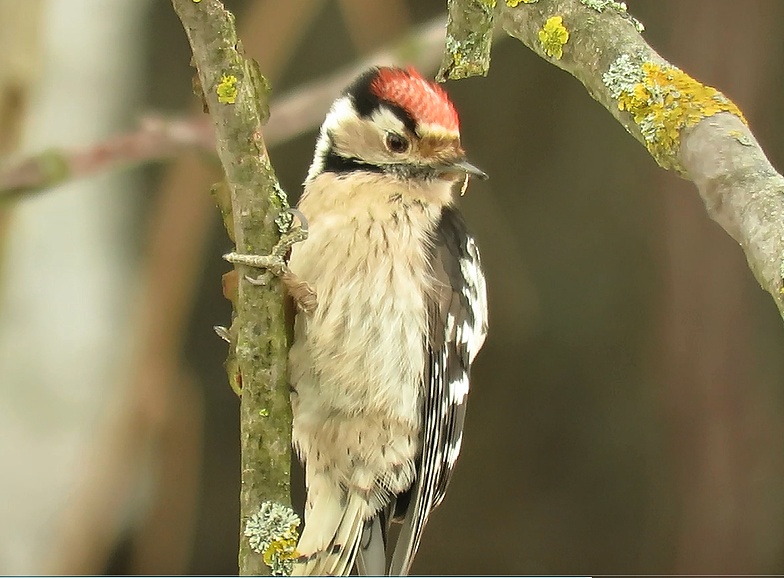
Dryobates minor · ďateľ malý · Lesser Spotted Woodpecker
Alternative and historical names
Slovak names
- ďateľ malý (Kovalik 2010)
- ďatel (strakatý) malý (Kovalik 2010)
- ďateľ malý (Matoušek 1990)
English names
- Lesser Spotted Woodpecker (IOC 2.5 2010)
- Lesser Spotted Woodpecker (BOU 1923)
Scientific names
- Dryobates minor (AviList 2026)
- Dryobates minor (IOC 15.2 2026)
- Dendrocopos minor (IOC 2.5 2010)
- Dryobates minor (BOU 1923)
Taxonomic synonyms
- Dendrocopos minor (Linnaeus, 1758)
- Picoides minor (Linnaeus, 1758)
- Picus minor (Linnaeus, 1758)
- Dryobates minor (Linnaeus, 1758)
Birding Slovakia database
This species through our community’s eyes
Species characteristics in Slovakia
- General occurrence
- resident / R
- Breeding
- common nidificant / Nc
- Wintering
- common wintering / Wc
- Rarities committee:
- Does not require any reporting or registration by Raritties commitee
Observation map

Detailed species observation statistics

Source: the Birding.sk database. Counts reflect observer contributions, not population size.
About this species
Distribution
It occupies extensive parts of Eurasia. In Slovakia it is a widespread but inconspicuous and generally uncommon breeder, mainly in lowlands and foothills. It is resident. Outside the breeding season it may join mixed flocks of tits, treecreepers and nuthatches, making winter woodland flocks worth checking.
Habitat
It favours mature deciduous and floodplain woodland, riverside trees, orchards and parks with dead branches. It often works along slender branches high in the canopy. Its small size and unobtrusive movements can make it easy to overlook even at regularly visited sites.
Breeding
It excavates a small cavity, including in dead parts high in trees. Both partners work on it for around two weeks. A typical clutch contains 5–6 white eggs. Both parents incubate and feed the chicks, continuing briefly after fledging.
Food
It takes small insects and larvae from bark, foliage and thin dead branches. During chick-rearing, prey living on plant surfaces, including aphids, is also important.
Interesting fact
This woodpecker is only about sparrow-sized. Nevertheless, it gives conspicuous series of calls and delicate, prolonged drumming; in late-winter woodland, hearing often reveals it before binoculars do.
Sources: Slovak Wikipedia · English Wikipedia
Sign in to send private feedback on the text to our editors.
Explore further
Overview and identification
Descriptions, identification and names.
- Slovak Wikipedia ↗
Taxon account in Slovak: distribution, biology and references for further reading.
https://sk.wikipedia.org/wiki/%C4%8Eate%C4%BE_mal%C3%BD - English Wikipedia ↗
Taxon account in English: distribution, biology and taxonomic context.
https://en.wikipedia.org/wiki/Lesser_spotted_woodpecker - BTO: Identifying Great Spotted Woodpeckers and Lesser Spotted Woodpeckers ↗
English identification video comparing this taxon with similar species and explaining distinguishing features.
https://www.bto.org/learn/skills/bird-identification/videos/great-lesser-spotted-woodpeckers - Bird.watching.sk: identification and voice – Dryobates minor ↗
Slovak species lesson describing appearance, voice and habitat, supporting field identification.
https://bird.watching.sk/sk/datel-maly-dendrocopos-minor/


