


Delichon urbicum · belorítka obyčajná · Western House Martin
Alternative and historical names
Slovak names
- belorítka obyčajná (Kovalik 2010)
- belorítka domová (Kovalik 2010)
- belorítka domová (Matoušek 1990)
English names
- Common House Martin (IOC 2.5 2010)
- Martin (BOU 1923)
Scientific names
- Delichon urbicum (AviList 2026)
- Delichon urbicum (IOC 15.2 2026)
- Delichon urbicum (IOC 2.5 2010)
- Delichon urbica (BOU 1923)
Taxonomic synonyms
- Delichon urbica urbica (Linnaeus, 1758)
- Hirundo urbica (Linnaeus, 1758)
- Delichon urbicum (Linnaeus, 1758)

Birding Slovakia database
This species through our community’s eyes
Species characteristics in Slovakia
- General occurrence
- migrant / M
- Breeding
- common nidificant / Nc
- Migration
- common transmigrant / Tc
- Rarities committee:
- Does not require any reporting or registration by Raritties commitee
Observation map
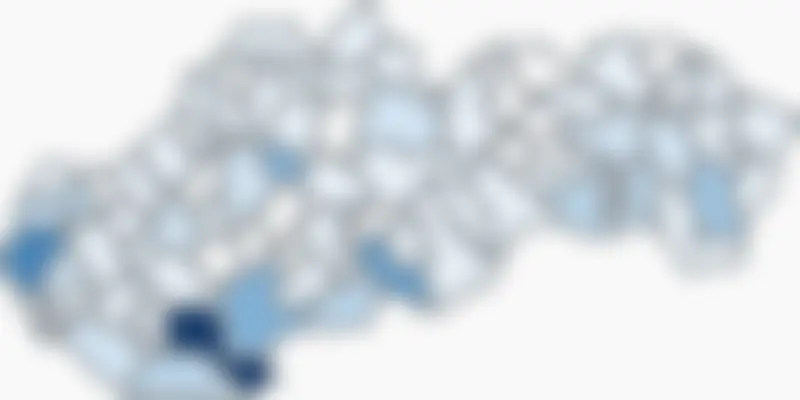
Detailed species observation statistics

Source: the Birding.sk database. Counts reflect observer contributions, not population size.
About this species
Distribution
It breeds in Europe, North Africa and western to central Asia, wintering mainly in sub-Saharan Africa. In Slovakia it is a widespread summer breeder in towns and villages. Arrival is around April, with most departures in late summer and autumn. Wintering in Slovakia is not a normal part of its annual cycle.
Habitat
It is easiest to find around houses, housing estates and bridges, especially where suitable ledges and wet mud are available. It feeds over built-up and open country. Originally a cliff-nester, it still uses natural rocky sites locally.
Breeding
Both partners build an enclosed nest with a small entrance beneath an overhang. The usual clutch is 4–5 eggs, and nesting is often colonial. Both parents feed the young and may raise two broods in a favourable season.
Food
It eats flying insects and adjusts its feeding height to conditions: in poor weather it may hunt just above water, at other times high over roofs or slopes.
Interesting fact
Nest construction requires many small loads of wet mud. Even an ordinary puddle can therefore become an important building-material source for a nearby colony during a dry spring.
Sources: Slovak Wikipedia · English Wikipedia
Sign in to send private feedback on the text to our editors.
Explore further
Overview and identification
Descriptions, identification and names.
- Slovak Wikipedia ↗
Taxon account in Slovak: distribution, biology and references for further reading.
https://sk.wikipedia.org/wiki/Belor%C3%ADtka_oby%C4%8Dajn%C3%A1 - English Wikipedia ↗
Taxon account in English: distribution, biology and taxonomic context.
https://en.wikipedia.org/wiki/Western_house_martin
Sounds, photographs and video
Recordings and visual comparisons.
- BTO: identifying Swallow, Sand Martin and House Martin ↗
English comparative identification video covering appearance and vocalisations.
https://www.bto.org/learn/skills/bird-identification/videos/hirundines-and-swift


