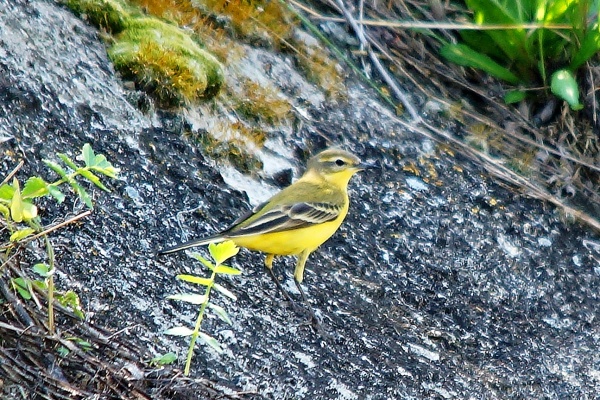
Motacilla flava · trasochvost žltý · Western Yellow Wagtail
Alternative and historical names
Slovak names
- trasochvost žltý (Kovalik 2010)
- trasochvost žltý (Matoušek 1990)
English names
- Western Yellow Wagtail (IOC 2.5 2010)
- Yellow Wagtail (BOU 1923)
Scientific names
- Motacilla flava (AviList 2026)
- Motacilla flava (IOC 15.2 2026)
- Motacilla flava (IOC 2.5 2010)
- Motacilla flava (BOU 1923)
Taxonomic synonyms
- Budytes rayi (Bonaparte, 1858)
- Motacilla flava rayi (Bonaparte, 1858)
- Budytes flavus (Linnaeus, 1758)
- Motacilla flava Linnaeus, 1758
Birding Slovakia database
This species through our community’s eyes
Species characteristics in Slovakia
- General occurrence
- migrant / M
- Breeding
- common nidificant / Nc
- Migration
- common transmigrant / Tc
- Rarities committee:
- Does not require any reporting or registration by Raritties commitee
Observation map
Detailed species observation statistics

Source: the Birding.sk database. Counts reflect observer contributions, not population size.
About this species
Distribution
In its current narrower treatment it breeds across much of Europe and western to central Asia, wintering mainly in Africa and southern Asia. In Slovakia it breeds regularly, chiefly in lowlands. Numbers increase during spring and autumn passage, when other subspecies may also appear. Wintering here is not usual.
Habitat
It breeds in wet meadows, pastures and farmland with suitable vegetation. Passage birds stop at temporary pools, fields and around grazing animals. They feed on open ground and rest on stems, fences or low shrubs.
Breeding
In open grassland or farmland the nest is hidden at the base of a tussock, rather than in the bushes used as perches. The female usually lays 5–6 spotted eggs and incubates alone. Both parents feed the chicks, and pairs may breed again during the season.
Food
It collects small insects and larvae from soil and low vegetation. Grazing animals may flush prey, but their presence is not essential for feeding. Parents supply their chicks chiefly with small invertebrates.
Interesting fact
Male head colour varies markedly among subspecies, from blue-grey to yellowish or almost black. An unusually coloured passage male need not be a different species, and intermediate or hybrid forms also occur.
Sources: Slovak Wikipedia · English Wikipedia
Sign in to send private feedback on the text to our editors.
Explore further
Overview and identification
Descriptions, identification and names.
- Slovak Wikipedia ↗
Taxon account in Slovak: distribution, biology and references for further reading.
https://sk.wikipedia.org/wiki/Trasochvost_%C5%BElt%C3%BD - English Wikipedia ↗
Taxon account in English: distribution, biology and taxonomic context.
https://en.wikipedia.org/wiki/Western_yellow_wagtail
Sounds, photographs and video
Recordings and visual comparisons.
- BTO: identifying yellow-coloured wagtails ↗
English comparative identification video covering appearance and vocalisations.
https://www.bto.org/learn/skills/bird-identification/videos/yellow-coloured-wagtails