


Luscinia svecica · slávik modrák · Bluethroat
Alternative and historical names
Slovak names
- slávik modrák (Kovalik 2010)
- modrák obyčajný (Kovalik 2010)
- slávik modrák (Matoušek 1990)
English names
- Bluethroat (IOC 2.5 2010)
- Bluethroat (BOU 1923)
Scientific names
- Luscinia svecica (AviList 2026)
- Luscinia svecica (IOC 15.2 2026)
- Luscinia svecica (IOC 2.5 2010)
- Cyanosylvia svecica (BOU 1923)
Taxonomic synonyms
- Cyanecula svecica (Linnaeus, 1758)
- Erithacus svecicus (Linnaeus, 1758)
- Motacilla svecica (Linnaeus, 1758)
- Luscinia svecica (Linnaeus, 1758)
Birding Slovakia database
This species through our community’s eyes
Species characteristics in Slovakia
- General occurrence
- migrant / M
- Breeding
- rare nidificant / Nr
- Migration
- uncommon transmigrant / Tu
- Rarities committee:
- Does not require any reporting or registration by Raritties commitee
Conservation — Red Lists
- Slovakia 2023breeding population
- Breeding population Period: 2013–2023 Source: Demko M. a kol. 2025: Červený zoznam vtákov Slovenska: aktualizácia 2013 – 2023. Tichodroma 37: 107–117. Online 18. 1. 2026. DOI: 10.31577/tichodroma.2025.37.18. Príloha 1, s. 117, riadok 73, stĺpec 6 Criteria: D Category downgraded by 1 level due to surrounding populations.
- Europe 2021
- Population scope unspecified Source: BirdLife International 2021: European Red List of Birds. Publications Office of the European Union, Luxembourg. Reported in: Demko M. a kol. 2025: Červený zoznam vtákov Slovenska: aktualizácia 2013 – 2023. Tichodroma 37: 107–117. Online 18. 1. 2026. DOI: 10.31577/tichodroma.2025.37.18. Príloha 1, s. 117, riadok 73, stĺpec 4
- World 2025
- Species Source: BirdLife International 2025: Species factsheets. Citované v Demko a kol. 2025, prístup 16. 4. 2025. Reported in: Demko M. a kol. 2025: Červený zoznam vtákov Slovenska: aktualizácia 2013 – 2023. Tichodroma 37: 107–117. Online 18. 1. 2026. DOI: 10.31577/tichodroma.2025.37.18. Príloha 1, s. 117, riadok 73, stĺpec 3
Previous assessments
- Slovakia 2013
- Breeding population Period: 2002–2012 Source: Demko M., Krištín A. & Pačenovský S. 2014: Červený zoznam vtákov Slovenska. SOS/BirdLife Slovensko, Bratislava. Zdroj stĺpca SK 2013 podľa poznámky 5 prílohy Demko a kol. 2025. Reported in: Demko M. a kol. 2025: Červený zoznam vtákov Slovenska: aktualizácia 2013 – 2023. Tichodroma 37: 107–117. Online 18. 1. 2026. DOI: 10.31577/tichodroma.2025.37.18. Príloha 1, s. 117, riadok 73, stĺpec 5 Category downgraded by 1 level due to surrounding populations.
Observation map

Detailed species observation statistics

Source: the Birding.sk database. Counts reflect observer contributions, not population size.
About this species
Distribution
It breeds across Eurasia and reaches Alaska, wintering in warmer parts of Europe, Africa and Asia. In Slovakia it is a local, scarce breeder and more frequently encountered on passage. Central European white-spotted birds use lowland wetlands, while the red-spotted northern form has a different mountain and northern distribution. Regular wintering here is not typical.
Habitat
In lowlands, look along reed margins, willow scrub and wet ground with exposed soil. It needs dense shelter as well as open feeding patches. Passage birds may also stop at small temporary pools and overgrown shores.
Breeding
The nest is placed near the ground among vegetation tussocks or low in dense scrub. In wetland breeding habitat it remains concealed in the lower growth while the male sings above. The female usually lays 5–7 eggs and incubates them; parents bring invertebrates to the chicks.
Food
It catches small insects and other invertebrates mainly on the ground close to cover. Berries are also eaten later in the season. It often runs out of vegetation after prey and then retreats again.
Interesting fact
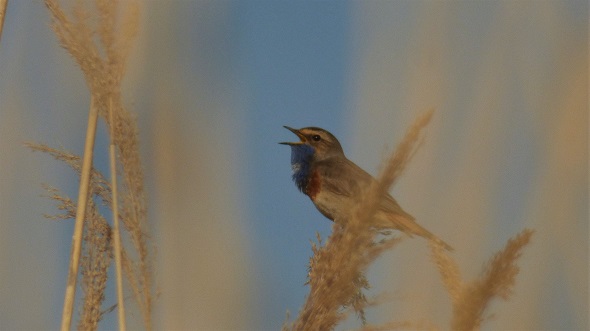
The male incorporates imitations of other birds into its varied song. The brilliant blue bib is not equally developed in every individual: females and young birds may look much plainer.
Sources: Slovak Wikipedia · English Wikipedia
Sign in to send private feedback on the text to our editors.
Explore further
Overview and identification
Descriptions, identification and names.
- Slovak Wikipedia ↗
Taxon account in Slovak: distribution, biology and references for further reading.
https://sk.wikipedia.org/wiki/Sl%C3%A1vik_modr%C3%A1k - English Wikipedia ↗
Taxon account in English: distribution, biology and taxonomic context.
https://en.wikipedia.org/wiki/Bluethroat
Data and research
Occurrences, distribution and research.
- Naturalis: identifying Bluethroat and subspecies ↗
English identification account explicitly comparing svecica and cyanecula.
https://birds-europe.linnaeus.naturalis.nl/linnaeus_ng/app/views/species/taxon.php?id=130851 - Slovak Red List: Bluethroat ↗
Species entry in Appendix1,p.59 (2023 assessment).
https://www.tichodroma.sk/pdfs/37/Tichodroma_37_18_Demko.pdf#page=11 - ŠOP SR: Bluethroat – morphology and ecology ↗
Slovak state nature-conservation atlas with species morphology and ecology.
https://www.biomonitoring.sk/Registration/AtlasAnimal/Detail/48775
























