


Ciconia ciconia · bocian biely · White Stork
Alternative and historical names
Slovak names
- bocian biely (Kovalik 2010)
- bocian biely (Matoušek 1990)
English names
- White Stork (IOC 2.5 2010)
- White Stork (BOU 1923)
Scientific names
- Ciconia ciconia (AviList 2026)
- Ciconia ciconia (IOC 15.2 2026)
- Ciconia ciconia (IOC 2.5 2010)
- Ciconia ciconia (BOU 1923)
Taxonomic synonyms
- Ardea ciconia (Linnaeus, 1758)
- Ciconia ciconia (Linnaeus, 1758)
Birding Slovakia database
This species through our community’s eyes
Species characteristics in Slovakia
- General occurrence
- migrant / M
- Breeding
- common nidificant / Nc
- Migration
- common transmigrant / Tc
- Wintering
- rare wintering / Wr
- Rarities committee:
- Does not require any reporting or registration by Raritties commitee
Observation map

Detailed species observation statistics

Source: the Birding.sk database. Counts reflect observer contributions, not population size.
About this species
Distribution
The White Stork breeds mainly in Europe and adjoining parts of North Africa and western Asia. Most of our birds winter in Africa. In Slovakia it is a regular, familiar breeder in the lowlands and several basins. It arrives mainly in March and April, and flocks depart in late summer. Individual storks may stay through the winter, but year-round residence is not typical of most of the population.
Habitat
It searches for food in meadows, pastures, fields and shallow wetlands. It often follows mowing or other farm work. Nests on poles, chimneys and roofs are commonly in villages, while productive feeding areas lie in the surrounding open countryside.
Breeding
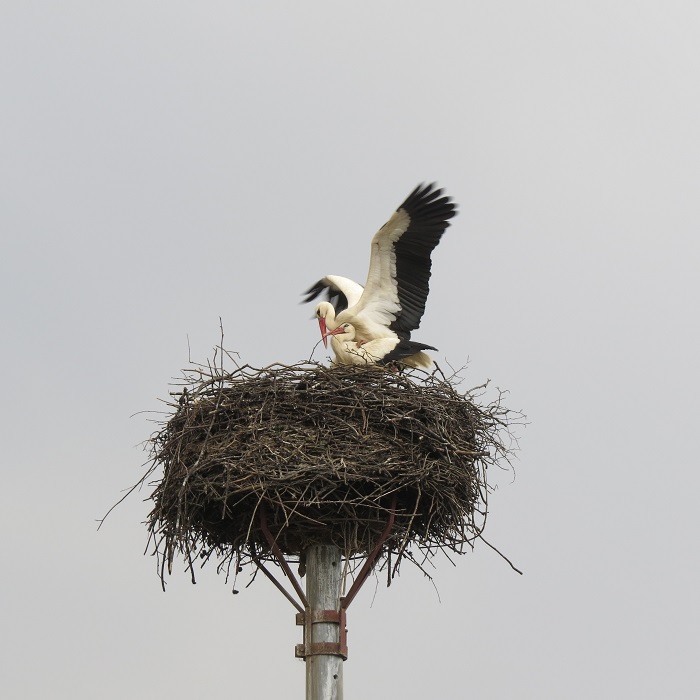
It repeatedly uses and repairs its large stick nest. The breeding season begins in spring, and a typical clutch contains two to five eggs. Both parents incubate and bring food to the young. Repeated additions can make an old nest remarkably large and heavy.
Food
It catches insects, earthworms, small rodents, amphibians and other small animals according to availability. The balance of prey varies between sites and seasons; the idea of a stork feeding only on frogs is far too narrow.
Interesting fact
The familiar clattering sound is made with its bill. When partners meet on the nest, it accompanies this sound by throwing its head far back. This is an important part of communication and greeting between the pair.
Sources: Slovak Wikipedia · BTO BirdFacts · English Wikipedia
Sign in to send private feedback on the text to our editors.
Explore further
Overview and identification
Descriptions, identification and names.
- Slovak Wikipedia ↗
Taxon account in Slovak: distribution, biology and references for further reading.
https://sk.wikipedia.org/wiki/Bocian_biely - BTO BirdFacts ↗
Biology and identification in English; population figures and trends refer to Britain.
https://www.bto.org/learn/about-birds/birdfacts/white-stork - English Wikipedia ↗
Taxon account in English: distribution, biology and taxonomic context.
https://en.wikipedia.org/wiki/White_stork
Data and research
Occurrences, distribution and research.
- State Nature Conservancy: identification, ecology and conservation – Ciconia ciconia ↗
Slovak expert profile with morphology, ecology and species conservation information.
https://www.biomonitoring.sk/Registration/AtlasAnimal/Detail/48658


