


Phylloscopus sibilatrix · kolibiarik sykavý · Wood Warbler
Alternative and historical names
Slovak names
- kolibiarik sykavý (Kovalik 2010)
- kolibiarik hôrny (Kovalik 2010)
- kolibkárik sykavý (Kovalik 2010)
- kolibkárik sykavý (Matoušek 1990)
English names
- Wood Warbler (IOC 2.5 2010)
- Wood-Warbler (BOU 1923)
Scientific names
- Phylloscopus sibilatrix (AviList 2026)
- Phylloscopus sibilatrix (IOC 15.2 2026)
- Phylloscopus sibilatrix (IOC 2.5 2010)
- Phylloscopus sibilatrix (BOU 1923)
Taxonomic synonyms
- Phylloscopus sibilatrix (Bechstein, 1793)
Birding Slovakia database
This species through our community’s eyes
Species characteristics in Slovakia
- General occurrence
- migrant / M
- Breeding
- common nidificant / Nc
- Migration
- common transmigrant / Tc
- Rarities committee:
- Does not require any reporting or registration by Raritties commitee
Observation map

Detailed species observation statistics

Source: the Birding.sk database. Counts reflect observer contributions, not population size.
About this species
Distribution
It breeds across much of Europe as far as the Urals and winters in tropical Africa. In Slovakia it is a regular woodland breeder from lower elevations into mountain forests. It arrives in April and May and departs in late summer and autumn. Outside the singing period it is inconspicuous, so failure to detect it during a brief visit does not prove local absence.
Habitat
It favours deciduous and mixed forests, especially beech and oak woodland with a canopy above relatively open undergrowth. Listen for the ringing song and watch lower branches as well as crowns. The nest itself remains on the forest floor.
Breeding
The female builds a domed nest with a side entrance in ground-level leaf litter, often beside a shrub or fallen wood. A typical clutch contains 5–7 eggs. She incubates, parents feed the chicks and usually one brood is raised.
Food
It hunts small insects and spiders on vegetation, catching some prey in flight and moving continually among leaves and twigs.
Interesting fact
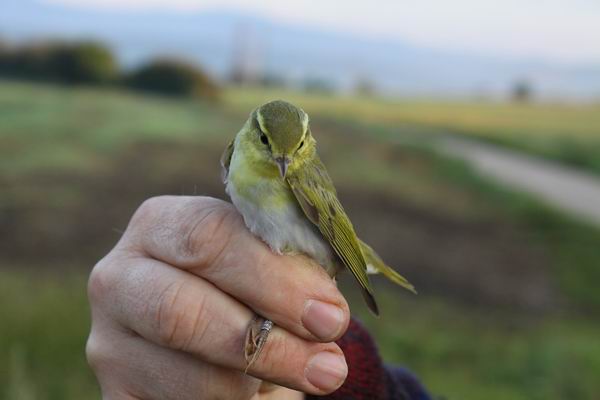
The accelerating trill ends in a metallic buzz, an excellent identification clue. Bright yellow throat and white belly create a sharper contrast than in most other local leaf warblers.
Sources: Slovak Wikipedia · English Wikipedia · BTO BirdFacts
Sign in to send private feedback on the text to our editors.
Explore further
Overview and identification
Descriptions, identification and names.
- Slovak Wikipedia ↗
Taxon account in Slovak: distribution, biology and references for further reading.
https://sk.wikipedia.org/wiki/Kolibiarik_sykav%C3%BD - English Wikipedia ↗
Taxon account in English: distribution, biology and taxonomic context.
https://en.wikipedia.org/wiki/Wood_warbler - BTO BirdFacts ↗
Biology and identification in English; population figures and trends refer to Britain.
https://www.bto.org/learn/about-birds/birdfacts/wood-warbler - Bird.watching: Wood Warbler – identification and voice ↗
Slovak species lesson with identification features and an example vocalisation.
https://bird.watching.sk/sk/kolibkarik-sykavy-phylloscopus-sibilatrix/


