


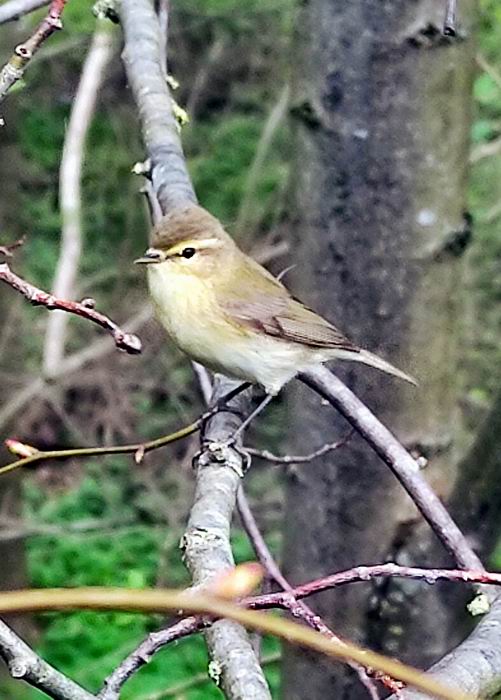
Phylloscopus collybita · kolibiarik čipčavý · Common Chiffchaff
Alternative and historical names
Slovak names
- kolibiarik čipčavý (Kovalik 2010)
- kolibiarik malý (Kovalik 2010)
- kolibkárik čipčavý (Kovalik 2010)
- kolibkárik čipčavý (Matoušek 1990)
English names
- Common Chiffchaff (IOC 2.5 2010)
- Chiffchaff (BOU 1923)
Scientific names
- Phylloscopus collybita (AviList 2026)
- Phylloscopus collybita (IOC 15.2 2026)
- Phylloscopus collybita (IOC 2.5 2010)
- Phylloscopus collybita (BOU 1923)
Taxonomic synonyms
- Sylvia collybita (Vieillot, 1817)
- Phylloscopus collybita (Vieillot, 1817)
Birding Slovakia database
This species through our community’s eyes
Species characteristics in Slovakia
- General occurrence
- migrant / M
- Breeding
- common nidificant / Nc
- Migration
- common transmigrant / Tc
- Wintering
- rare wintering / Wr
- Rarities committee:
- Does not require any reporting or registration by Raritties commitee
Observation map

Detailed species observation statistics

Source: the Birding.sk database. Counts reflect observer contributions, not population size.
About this species
Distribution
It occurs in Europe and large parts of temperate Asia, wintering chiefly in milder Europe, northern Africa and southern Asia. In Slovakia it is a common widespread breeder and regular migrant. The first males sing early in spring, with main departure in autumn. Some birds remain in winter, but wintering is much less routine than summer occurrence.
Habitat
Search open woodland with undergrowth, edges, streamsides, parks and wooded gardens. Winter birds may exploit warmer waterside places where insects remain accessible. Feeding involves inspecting leaves, fine twigs and lower vegetation.
Breeding
The female builds a domed nest with a side entrance on or just above the ground. She usually lays 5–6 eggs, incubates and supplies most chick feeding. The male chiefly defends the territory and does not invariably help with feeding.
Food
Its food consists of small insects, larvae, spiders and other invertebrates gleaned from vegetation, sometimes caught in brief flights or while hovering.
Interesting fact
The simple alternating song gave the species its Slovak and several other names. Song is the most reliable distinction from Willow Warbler; leg colour alone can be misleading in poor light.
Sources: Slovak Wikipedia · English Wikipedia · BTO BirdFacts
Sign in to send private feedback on the text to our editors.
Explore further
Overview and identification
Descriptions, identification and names.
- Slovak Wikipedia ↗
Taxon account in Slovak: distribution, biology and references for further reading.
https://sk.wikipedia.org/wiki/Kolibiarik_%C4%8Dip%C4%8Dav%C3%BD - English Wikipedia ↗
Taxon account in English: distribution, biology and taxonomic context.
https://en.wikipedia.org/wiki/Common_chiffchaff - BTO BirdFacts ↗
Biology and identification in English; population figures and trends refer to Britain.
https://www.bto.org/learn/about-birds/birdfacts/chiffchaff - Bird.watching: Common Chiffchaff – identification and voice ↗
Slovak species lesson with identification features and an example vocalisation.
https://bird.watching.sk/sk/kolibkarik-cipcavy-phylloscopus-collybita/
Sounds, photographs and video
Recordings and visual comparisons.
- BTO: identifying Chiffchaff and Willow Warbler ↗
English comparative identification video covering appearance and vocalisations.
https://www.bto.org/learn/skills/bird-identification/videos/willow-warbler-chiffchaff
Data and research
Occurrences, distribution and research.
- British Birds: identifying Siberian Chiffchaff ↗
English specialist identification paper on the Common Chiffchaff complex (2005).
https://britishbirds.co.uk/sites/default/files/pdf-store/V98_N08_P396_410_A001.pdf
























