


Aegithalos caudatus · mlynárka dlhochvostá · Long-tailed Tit
Alternative and historical names
Slovak names
- mlynárka dlhochvostá (Kovalik 2010)
- mlynárik chvostnatý (Kovalik 2010)
- mlynárka dlhochvostá (Matoušek 1990)
English names
- Long-tailed Tit (IOC 2.5 2010)
- Long-tailed Titmouse (BOU 1923)
Scientific names
- Aegithalos caudatus (AviList 2026)
- Aegithalos caudatus (IOC 15.2 2026)
- Aegithalos caudatus (IOC 2.5 2010)
- Aegithalos caudatus (BOU 1923)
Taxonomic synonyms
- Aegithalos caudatus tyrrhenius (Parrot, 1910)
- Parus caudatus (Linnaeus, 1758)
- Aegithalos caudatus (Linnaeus, 1758)
Birding Slovakia database
This species through our community’s eyes
Species characteristics in Slovakia
- General occurrence
- resident / R
- Breeding
- common nidificant / Nc
- Wintering
- common wintering / Wc
- Rarities committee:
- Does not require any reporting or registration by Raritties commitee
Observation map

Detailed species observation statistics

Source: the Birding.sk database. Counts reflect observer contributions, not population size.
About this species
Distribution
It occurs across Europe and Asia. In Slovakia it breeds regularly and remains throughout the year, making mainly local movements outside nesting. Northern populations can travel farther. Winter flocks visit suitable vegetation from lowlands to mountain valleys, often crossing a garden in only a few minutes.
Habitat
Search deciduous and mixed woodland edges, riverside willows, orchards, parks and gardens with denser undergrowth. It feeds on fine twigs, often hanging upside down. Following the whole flock and listening for both thin and harsher contact calls is helpful.
Breeding
Both partners build an elastic egg-shaped nest of moss and cobwebs, camouflaged with lichens and lined with feathers. The entrance is high on the side. The female usually lays 6–10 eggs and incubates them; both parents feed the chicks.
Food
Throughout the year it seeks tiny insects, their eggs and larvae, and spiders. The small bill extracts food from the finest branches, less accessible to larger birds.
Interesting fact
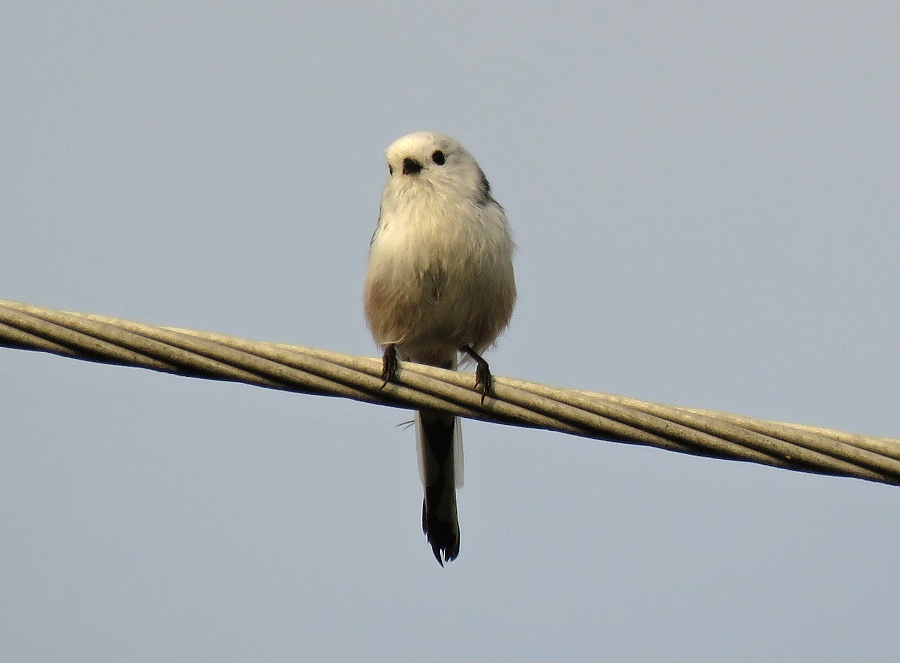
Outside breeding it forms cohesive family groups. The long tail accounts for much of its total length and, with the tiny rounded head, creates a silhouette recognisable even against the light.
Sources: Slovak Wikipedia · English Wikipedia · BTO BirdFacts
Sign in to send private feedback on the text to our editors.
Explore further
Overview and identification
Descriptions, identification and names.
- Slovak Wikipedia ↗
Taxon account in Slovak: distribution, biology and references for further reading.
https://sk.wikipedia.org/wiki/Mlyn%C3%A1rka_dlhochvost%C3%A1 - English Wikipedia ↗
Taxon account in English: distribution, biology and taxonomic context.
https://en.wikipedia.org/wiki/Long-tailed_tit - BTO BirdFacts ↗
Biology and identification in English; population figures and trends refer to Britain.
https://www.bto.org/learn/about-birds/birdfacts/long-tailed-tit - Bird.watching: Long-tailed Tit – identification and voice ↗
Slovak species lesson with identification features and an example vocalisation.
https://bird.watching.sk/sk/mlynarka-dlhochvosta-aegithalos-caudatus/


