


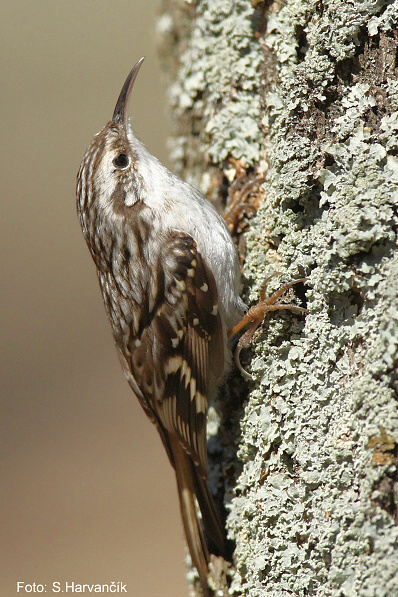
Certhia brachydactyla · kôrovník krátkoprstý · Short-toed Treecreeper
Alternative and historical names
Slovak names
- kôrovník krátkoprstý (Kovalik 2010)
- kôrovník krátkoprstý (Matoušek 1990)
English names
- Short-toed Treecreeper (IOC 2.5 2010)
Scientific names
- Certhia brachydactyla (AviList 2026)
- Certhia brachydactyla (IOC 15.2 2026)
- Certhia brachydactyla (IOC 2.5 2010)
Taxonomic synonyms
- Certhia brachydactyla bureaui (Jouard, 1929)
- Certhia brachydactyla parisi (Jouard, 1929)
- Certhia brachydactyla Brehm, CL, 1820
Birding Slovakia database
This species through our community’s eyes
Species characteristics in Slovakia
- General occurrence
- resident / R
- Breeding
- common nidificant / Nc
- Wintering
- common wintering / Wc
- Rarities committee:
- Does not require any reporting or registration by Raritties commitee
Observation map

Detailed species observation statistics

Source: the Birding.sk database. Counts reflect observer contributions, not population size.
About this species
Distribution
It occupies warmer parts of Europe and northern Africa. In Slovakia it is a regular resident breeder, chiefly in lowlands and hills, locally higher in suitable habitat. Eurasian Treecreeper is more typical of mountain conifer forests, although both can occur together. Winter sightings usually involve local birds or short movements rather than long-distance migration.
Habitat
It favours old deciduous and floodplain woods, parks, orchards and large gardens with rough-barked trees. Extensive trunk and branch surfaces provide feeding opportunities. Calls or movement around the visible side of a trunk often reveal it.
Breeding
It nests in tree cracks, behind loose bark, sometimes in buildings or suitable boxes. A typical clutch contains 5–7 eggs. The female incubates and both parents feed the young, often raising a second brood.
Food
The slender curved bill extracts insects and spiders from bark. Stiff tail feathers support it as it climbs in short hops.
Interesting fact
Unlike a nuthatch it does not normally descend headfirst, instead flying to the base of another tree. The most practical distinction from Eurasian Treecreeper is its characteristic song and calls.
Sources: Slovak Wikipedia · English Wikipedia · BTO BirdFacts
Sign in to send private feedback on the text to our editors.
Explore further
Overview and identification
Descriptions, identification and names.
- Slovak Wikipedia ↗
Taxon account in Slovak: distribution, biology and references for further reading.
https://sk.wikipedia.org/wiki/K%C3%B4rovn%C3%ADk_kr%C3%A1tkoprst%C3%BD - English Wikipedia ↗
Taxon account in English: distribution, biology and taxonomic context.
https://en.wikipedia.org/wiki/Short-toed_treecreeper - BTO BirdFacts ↗
Biology and identification in English; population figures and trends refer to Britain.
https://www.bto.org/learn/about-birds/birdfacts/short-toed-treecreeper - Bird.watching: Short-toed Treecreeper – identification and voice ↗
Slovak species lesson with identification features and an example vocalisation.
https://bird.watching.sk/sk/korovnik-kratkoprsty-certhia-brachydactyla/


